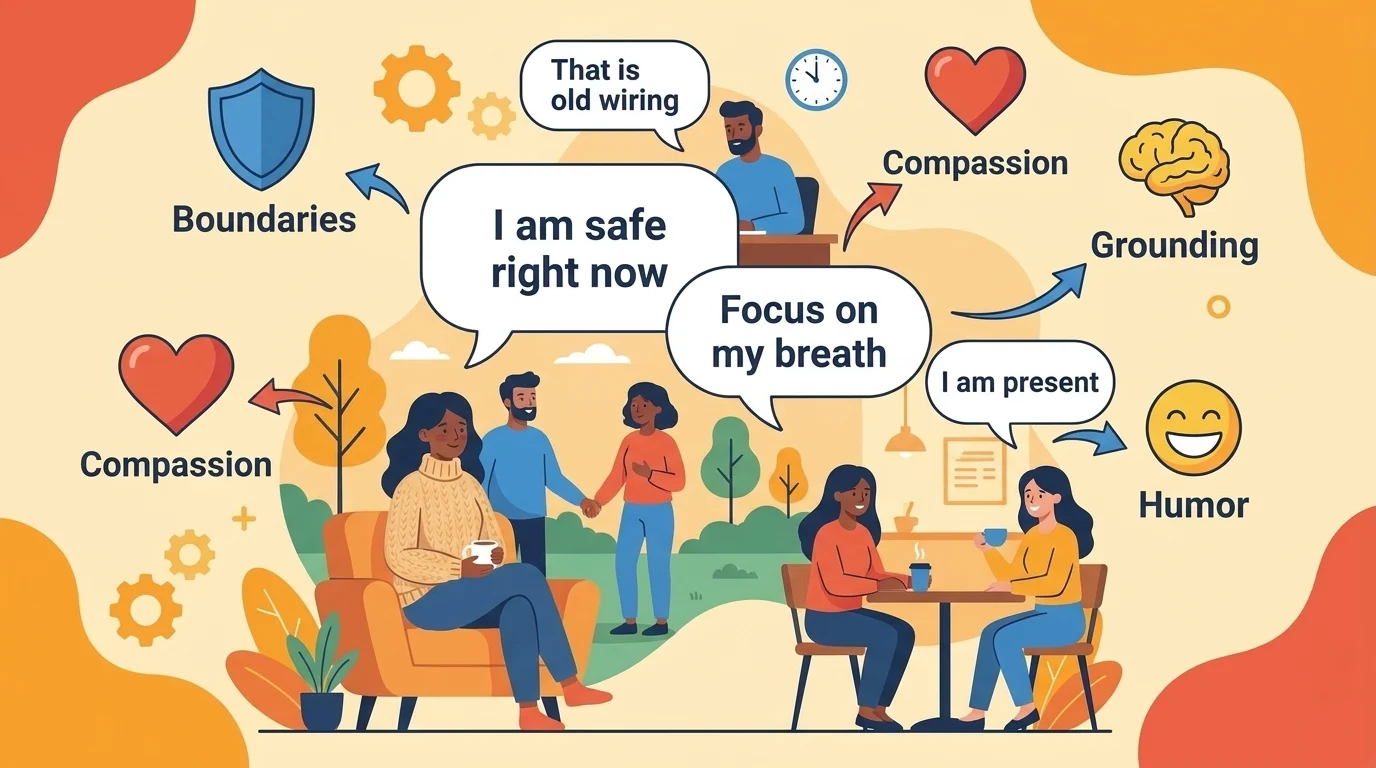
The best response is to name the trauma response without shame and ground yourself in the present. Try saying: “This is my nervous system protecting me,” “I am safe right now,” “I need a minute to regulate,” “That reaction is old wiring,” or “I can choose a new response.”
You are texting someone and suddenly your brain says they hate you. You get a work email and your chest tightens like you are back in that childhood kitchen. Childhood trauma responses in adults are real, sneaky, and often show up in the most random moments. They are not character flaws. They are your brain trying to keep you safe using old maps.
The way you respond to these moments changes everything. Shame keeps you stuck. Curiosity and self-compassion help you rewire. Whether you are in a relationship, at work, or just trying to get through a Tuesday, having ready-to-use phrases helps you pause, breathe, and choose something different. This guide gives you 150+ responses for every mood and situation.
Funny Responses
- “My trauma response just ordered an espresso and a side of overthinking.”
Example: You catch yourself spiraling after a simple text and use this to break the tension.
Meaning: Uses light humor to name the spiral without shame. - “That is not anxiety. That is my inner child trying to run the group project.”
Example: You notice people-pleasing at work and say this to a trusted friend.
Meaning: Playfully separates your adult self from the old pattern. - “I am not dramatic. My nervous system is just doing a fire drill.”
Example: You feel a sudden panic before a meeting and say this to yourself.
Meaning: Reframes a trauma response as an overactive safety system. - “My brain said ‘danger’ and I said ‘sir, this is a Wendy’s.'”
Example: You feel triggered in a safe space and use this to reset.
Meaning: Uses meme energy to bring yourself back to reality. - “I just dissociated into the snack aisle. Anyway.”
Example: You lose focus during a hard conversation and gently name it after.
Meaning: Keeps the moment honest without making it heavy. - “That reaction was brought to you by 2009. We are not doing reruns.”
Example: You snap at your partner and quickly own the old pattern.
Meaning: Labels the response as outdated without blaming yourself. - “My hypervigilance just did a full security sweep of the group chat.”
Example: You overanalyze a message and use this to laugh at yourself.
Meaning: Names the overchecking with playful honesty. - “I am not ignoring you. I am just buffering in trauma mode.”
Example: You go quiet during conflict and explain it later.
Meaning: Communicates your freeze response in a relatable way. - “My inner critic just tried to give a TED Talk. I declined.”
Example: You catch harsh self-talk and gently shut it down.
Meaning: Shows you can notice the voice without obeying it. - “I am one deep breath away from becoming a functional adult again.”
Example: You feel overwhelmed in public and say this to a friend.
Meaning: Adds humor while signaling you need a moment. - “That was not a meltdown. That was an emotional software update.”
Example: You cry unexpectedly and reframe it afterward.
Meaning: Normalizes emotional release as part of healing. - “My fight or flight just chose ‘freeze and overthink.’ Classic.”
Example: You shut down in a conflict and name it later.
Meaning: Uses self-aware humor to reduce shame.
Brutal Responses
- “That is an old fear, not a current fact.”
Example: You assume someone is mad at you and say this to yourself.
Meaning: Separates past danger from present reality. - “I am not being rejected. I am being triggered.”
Example: You feel abandoned after a delayed reply and name it.
Meaning: Clearly labels the trauma response without drama. - “This reaction belongs to my past, not my partner.”
Example: You catch yourself picking a fight and pause.
Meaning: Takes ownership without blaming the other person. - “I am not obsessed. I am having a trauma response.”
Example: You feel intense fear in a safe situation and say this.
Meaning: Replaces self-judgment with accurate language. - “My nervous system is lying to me right now.”
Example: You feel unsafe in a calm room and name the distortion.
Meaning: Reminds you that feelings are not facts. - “I do not need to earn love by shrinking.”
Example: You catch people-pleasing and say this out loud.
Meaning: Confronts the old survival strategy directly. - “That is not intuition. That is hypervigilance.”
Example: You sense danger that is not there and check yourself.
Meaning: Distinguishes trauma alert from real intuition. - “I am allowed to take up space without apologizing.”
Example: You start over-explaining and stop mid-sentence.
Meaning: Challenges the fawn response in real time. - “This shame is not mine to carry anymore.”
Example: You feel guilty for setting a boundary and say this.
Meaning: Releases inherited guilt from childhood. - “I can be scared and still do the thing.”
Example: You feel fear before a social event and go anyway.
Meaning: Refuses to let fear make all the decisions. - “My brain is trying to protect me. I can thank it and move on.”
Example: You notice avoidance and acknowledge it without obeying.
Meaning: Honors the protective intent while choosing differently. - “I am not responsible for managing everyone’s emotions.”
Example: You feel responsible for a friend’s mood and step back.
Meaning: Sets a hard line against over-functioning.
Compassionate Responses
- “Thank you for trying to keep me safe. I am okay now.”
Example: You feel a surge of anxiety and speak gently to yourself.
Meaning: Honors the protective part of your trauma response. - “That makes sense. You learned this for a reason.”
Example: You catch yourself people-pleasing and offer kindness.
Meaning: Validates the old strategy without judgment. - “You are not too much. You are healing.”
Example: You feel ashamed after an emotional reaction and say this.
Meaning: Reassures yourself that healing is messy. - “It is okay to need a minute. Take your time.”
Example: You feel overwhelmed and give yourself permission to pause.
Meaning: Offers patience instead of pressure. - “You survived then. You can handle now.”
Example: You face a hard conversation and remind yourself of strength.
Meaning: Connects past resilience to present ability. - “That reaction was a younger version of you asking for help.”
Example: You feel a childlike fear and respond with care.
Meaning: Reframes the response as an unmet need, not a flaw. - “You do not have to explain yourself to feel worthy.”
Example: You catch over-explaining and stop with kindness.
Meaning: Releases the need to justify your existence. - “It is safe to rest now. You are not in trouble.”
Example: You feel guilty for relaxing and say this softly.
Meaning: Calms the hypervigilant part of your brain. - “Your feelings are valid even if they are old.”
Example: You cry about something small and honor the emotion.
Meaning: Respects the feeling without making it the boss. - “You are allowed to outgrow old survival skills.”
Example: You notice a pattern that no longer serves you.
Meaning: Gives permission to change without guilt. - “I see you. I hear you. I am here.”
Example: You feel alone in a flashback and say this to yourself.
Meaning: Provides internal comfort and presence. - “This is hard, and you are doing it anyway.”
Example: You push through a triggering task and acknowledge effort.
Meaning: Celebrates courage in small everyday moments.
Professional Responses
- “I need a brief moment to collect my thoughts.”
Example: You feel triggered in a meeting and ask for a pause.
Meaning: Buys time without oversharing at work. - “Let me circle back on this after I review it.”
Example: You feel reactive to feedback and delay your response.
Meaning: Creates space to regulate before replying. - “I want to give this the attention it deserves. Can we revisit tomorrow?”
Example: You feel overwhelmed by a request and set a boundary.
Meaning: Protects your capacity while staying professional. - “I am taking a short break and will return shortly.”
Example: You feel a freeze response coming and step away.
Meaning: Normalizes regulation breaks in the workplace. - “That is a fair point. Let me think on it.”
Example: You feel defensive and choose curiosity instead.
Meaning: Prevents trauma-driven conflict in professional settings. - “I prefer to communicate this in writing.”
Example: You feel unsafe in a confrontational meeting and request email.
Meaning: Uses boundaries to reduce nervous system load. - “I am not available for that conversation right now.”
Example: A colleague pushes your buttons and you decline.
Meaning: Asserts a boundary without explaining your trauma. - “I need clarity on expectations before I commit.”
Example: You feel anxious about vague tasks and ask for specifics.
Meaning: Reduces ambiguity that triggers hypervigilance. - “I am stepping out for some air. Back in ten.”
Example: You feel panic rising at your desk and take a walk.
Meaning: Prioritizes regulation without oversharing. - “I appreciate the feedback. I will sit with it.”
Example: You feel shame after criticism and respond calmly.
Meaning: Allows time to process without reacting from trauma. - “I am not able to take on more right now.”
Example: You feel pressured to overcommit and say no.
Meaning: Protects against fawn-driven burnout. - “Let us keep this conversation respectful and focused.”
Example: A discussion gets heated and you reset the tone.
Meaning: Sets a boundary while staying professional.
Creative Responses
- “My inner child just asked for a snack and a nap. I am listening.”
Example: You feel small and scared and honor the need.
Meaning: Uses creative language to meet an emotional need. - “That fear is a smoke alarm, not a house fire.”
Example: You feel panic and remind yourself of the difference.
Meaning: Paints a clear picture to calm your nervous system. - “I am the adult now. I get to choose the next scene.”
Example: You feel stuck in an old story and rewrite it.
Meaning: Reclaims agency through narrative reframing. - “My nervous system is a loyal dog barking at shadows.”
Example: You feel irrational fear and offer yourself compassion.
Meaning: Uses imagery to reduce shame about the response. - “I am not a project to fix. I am a person to know.”
Example: You feel pressure to heal faster and slow down.
Meaning: Reframes healing as relationship, not performance. - “That trigger is a breadcrumb back to a need.”
Example: You feel upset and ask what you actually need.
Meaning: Turns the response into useful information. - “I am rewriting the ending of a story I did not choose.”
Example: You notice a pattern and consciously choose a new path.
Meaning: Empowers you as the author of your life. - “My brain built walls to keep me safe. I am learning to add doors.”
Example: You struggle with vulnerability and name the process.
Meaning: Uses metaphor to normalize gradual change. - “The past is a teacher, not a landlord.”
Example: You feel ruled by old memories and reframe them.
Meaning: Reminds you that history does not own your present. - “I am not broken. I am a work in progress with excellent notes.”
Example: You make a mistake and speak kindly to yourself.
Meaning: Uses humor and creativity to reduce shame. - “That reaction was a rerun. I am ready for new episodes.”
Example: You catch the same old pattern and choose differently.
Meaning: Playfully labels the pattern as changeable. - “My healing is a garden, not a race.”
Example: You feel behind in progress and slow down.
Meaning: Uses nature imagery to encourage patience.
Sarcastic Responses
- “My trauma response just RSVP’d to a conversation I did not invite it to.”
Example: You feel triggered at a party and name it with dry humor.
Meaning: Uses irony to distance yourself from the reaction. - “Oh good, the overthinking committee is meeting again.”
Example: You catch yourself spiraling and narrate it sarcastically.
Meaning: Lightens the internal experience without dismissing it. - “My nervous system did not get the memo that we are safe now.”
Example: You feel irrational fear and say this to a friend.
Meaning: Uses sarcasm to acknowledge the lag in healing. - “That was my inner child. She does not do well in group settings.”
Example: You feel small in a meeting and joke about it later.
Meaning: Names the regression with self-aware humor. - “I am not avoiding conflict. I am giving it a long, thoughtful vacation.”
Example: You catch yourself people-pleasing and call it out.
Meaning: Uses sarcasm to expose the avoidance pattern. - “My brain loves a good sequel. Especially the trauma ones.”
Example: You experience the same old fear and name it dryly.
Meaning: Highlights the repetitive nature of trauma responses. - “Apparently my fight or flight missed the ‘we are adults now’ update.”
Example: You react strongly to a small issue and check yourself.
Meaning: Uses sarcasm to highlight the mismatch. - “I am not being dramatic. My nervous system is just theatrical.”
Example: You feel overwhelmed and describe it with humor.
Meaning: Playfully reframes the intensity of your response. - “My inner critic has excellent job security. Unfortunately.”
Example: You notice harsh self-talk and call it out sarcastically.
Meaning: Uses dry humor to create distance from the critic. - “I am fine. My trauma response is just doing its morning yoga.”
Example: You feel anxious in the morning and name it lightly.
Meaning: Normalizes the daily presence of trauma responses. - “That boundary felt illegal. I am doing it anyway.”
Example: You set a limit and feel guilty but proud.
Meaning: Uses sarcasm to acknowledge the discomfort of growth. - “My brain is a drama queen. I still love her.”
Example: You experience intense emotion and speak kindly after.
Meaning: Balances sarcasm with self-compassion.
Cute Responses
- “My inner child just needs a hug and a gold star.”
Example: You feel small and scared and offer yourself kindness.
Meaning: Meets the vulnerable part of you with sweetness. - “It is okay, little one. I have got you now.”
Example: You feel a childlike fear and speak gently to yourself.
Meaning: Provides internal nurturing and protection. - “You are safe. You are loved. You are allowed to rest.”
Example: You feel anxious before bed and repeat this softly.
Meaning: Offers comfort to your nervous system. - “That was a big feeling. You handled it well.”
Example: You get through a triggering moment and praise yourself.
Meaning: Celebrates small wins with warmth. - “I am proud of you for trying something different.”
Example: You choose a new response instead of an old pattern.
Meaning: Encourages yourself like a supportive friend. - “Your feelings make sense. You make sense.”
Example: You feel confused by your reaction and reassure yourself.
Meaning: Validates your experience with tenderness. - “It is okay to need extra care today.”
Example: You feel fragile and give yourself permission to slow down.
Meaning: Normalizes self-care as a trauma-informed need. - “You are not a burden. You are a person with a story.”
Example: You feel guilty for needing support and say this.
Meaning: Reminds you of your inherent worth. - “Let us take this one small step at a time.”
Example: You feel overwhelmed by healing and simplify the plan.
Meaning: Offers gentle pacing instead of pressure. - “You did not choose this. You are choosing healing.”
Example: You feel ashamed of your past and reframe it.
Meaning: Honors your agency in the present. - “Your inner child is lucky to have you as a parent now.”
Example: You feel alone in your healing and say this to yourself.
Meaning: Acknowledges the reparenting work you are doing. - “I love you even on the days you feel broken.”
Example: You struggle with self-worth and offer unconditional care.
Meaning: Practices deep self-acceptance.
Dramatic Responses
- “My trauma response just entered the chat like it owns the place.”
Example: You feel triggered in a calm moment and name it loudly.
Meaning: Uses drama to externalize the reaction. - “I am not having a moment. I am having a whole cinematic universe.”
Example: You feel overwhelmed and describe it with flair.
Meaning: Playfully exaggerates the experience to reduce shame. - “My nervous system just called an emergency meeting.”
Example: You feel sudden anxiety and narrate it dramatically.
Meaning: Names the response with expressive humor. - “That was not a flashback. That was a full 4D experience.”
Example: You feel transported to the past and say this after.
Meaning: Uses dramatic language to describe dissociation. - “I am fine. My inner child is just throwing a tantrum in the background.”
Example: You feel emotional and explain it to a friend.
Meaning: Uses drama to separate adult self from child part. - “My brain just played the worst highlight reel from 2008.”
Example: You feel flooded with old memories and name it.
Meaning: Dramatizes the intrusive nature of trauma memories. - “I need a standing ovation for not spiraling today.”
Example: You get through a hard day and celebrate dramatically.
Meaning: Rewards yourself for small acts of regulation. - “The drama is not me. The drama is my nervous system.”
Example: You feel intense emotion and externalize it.
Meaning: Creates distance between you and the response. - “My trauma response deserves its own Netflix special.”
Example: You notice a pattern and joke about its complexity.
Meaning: Uses humor to cope with the intensity. - “I am not crying. I am releasing a dramatic documentary.”
Example: You cry and reframe it with flair.
Meaning: Normalizes tears as emotional expression. - “My inner critic just gave a five star performance. I left the theater.”
Example: You catch harsh self-talk and choose to disengage.
Meaning: Shows you can walk away from the critic. - “That trigger was so last season. I am not wearing it anymore.”
Example: You notice an old pattern and choose a new response.
Meaning: Uses fashion language to claim change.
Chill And Casual Responses
- “That is just my brain being extra. I am good.”
Example: You feel a small trigger and explain it casually.
Meaning: Normalizes the response without making it a big deal. - “Old wiring. Working on it.”
Example: You react strongly to something and name it simply.
Meaning: Acknowledges the pattern without drama. - “I need a minute. Be right back.”
Example: You feel overwhelmed and step away briefly.
Meaning: Communicates a need without oversharing. - “That is my trauma talking. I am listening to my adult self now.”
Example: You catch a fear-based thought and reframe it.
Meaning: Shows you can choose which voice to follow. - “No big deal. Just my nervous system doing its thing.”
Example: You feel anxious and downplay it gently.
Meaning: Reduces shame by normalizing the experience. - “I am good. Just needed to breathe for a sec.”
Example: You pause during a conversation and return calmly.
Meaning: Shows regulation is a normal part of your day. - “That was an old reaction. I am choosing a new one.”
Example: You snap at someone and quickly correct course.
Meaning: Demonstrates awareness and accountability. - “I am not upset with you. I am just triggered.”
Example: You feel hurt by a comment and clarify the source.
Meaning: Separates the person from the trauma response. - “Let me just ground myself for a second.”
Example: You feel dissociative and take a moment to reset.
Meaning: Names a coping skill casually. - “That is not me. That is my survival brain.”
Example: You feel an intense reaction and externalize it.
Meaning: Creates distance without drama. - “I am fine. Just need a snack and some quiet.”
Example: You feel overwhelmed and name simple needs.
Meaning: Communicates self-care without explanation. - “We are good. My brain just took a detour.”
Example: You get distracted by a trigger and reassure a friend.
Meaning: Keeps things light while staying honest.
Confident Responses
- “I know that reaction. I am choosing a different one.”
Example: You catch an old pattern and consciously shift.
Meaning: Shows self-awareness and agency. - “That is my past talking. I am the one in charge now.”
Example: You feel small and remind yourself of your power.
Meaning: Reclaims authority over your life. - “I can feel scared and still set this boundary.”
Example: You feel fear before saying no and do it anyway.
Meaning: Demonstrates courage alongside vulnerability. - “My trauma does not get to make my decisions anymore.”
Example: You feel avoidance and choose to move forward.
Meaning: Asserts control over your choices. - “I am not broken. I am healing with intention.”
Example: You make a mistake and reframe it confidently.
Meaning: Owns your progress without shame. - “That trigger is information, not identity.”
Example: You feel activated and use it to understand yourself.
Meaning: Separates the response from who you are. - “I know my patterns. I am rewriting them.”
Example: You notice a familiar reaction and choose differently.
Meaning: Shows confidence in your ability to change. - “I do not need to prove my worth to anyone.”
Example: You feel people-pleasing urges and let them go.
Meaning: Asserts inherent value without external validation. - “My healing is my responsibility, and I am showing up.”
Example: You face a hard truth and take action.
Meaning: Owns your journey with confidence. - “I can handle this. I have handled harder.”
Example: You face a triggering situation and remind yourself.
Meaning: Draws on past resilience for present strength. - “I am allowed to take up space and set limits.”
Example: You feel guilty for boundary-setting and stand firm.
Meaning: Confidently claims your right to boundaries. - “That was a trauma response. This is my adult choice.”
Example: You react strongly and then consciously choose again.
Meaning: Shows you can pivot from reaction to intention.
Emotional Responses
- “I feel like I am back there. But I know I am here.”
Example: You experience a flashback and ground yourself.
Meaning: Acknowledges the emotional truth while anchoring in reality. - “This is heavy. I need to sit with it for a bit.”
Example: You feel overwhelmed by a memory and give yourself time.
Meaning: Honors the weight of the emotion without rushing. - “I did not expect that to hit me so hard.”
Example: You cry at a small trigger and name your surprise.
Meaning: Shares your emotional experience honestly. - “My heart is racing and my brain is loud. I need a minute.”
Example: You feel panic rising and communicate your state.
Meaning: Describes the physical and emotional experience. - “That touched something old in me.”
Example: You feel a deep sadness after a comment and name it.
Meaning: Connects the present emotion to past wounds. - “I am feeling small right now. Please be gentle with me.”
Example: You feel vulnerable in a relationship and ask for care.
Meaning: Advocates for your emotional needs. - “I am not okay, but I will be.”
Example: You feel overwhelmed and reassure yourself.
Meaning: Holds hope alongside current pain. - “That scared me. I need to talk about it.”
Example: You feel frightened by a reaction and seek support.
Meaning: Communicates fear and opens a conversation. - “I am carrying a lot today. I am trying to be kind to myself.”
Example: You feel emotionally heavy and share it with a friend.
Meaning: Names your burden without shame. - “That memory came out of nowhere. I am still processing.”
Example: You feel flooded by the past and explain your state.
Meaning: Shows self-awareness about the healing process. - “I feel raw and open. I need safety right now.”
Example: You feel exposed after a trigger and ask for comfort.
Meaning: Communicates your vulnerability clearly. - “This is hard to say, but I am struggling.”
Example: You feel overwhelmed and reach out for help.
Meaning: Shows courage in sharing your emotional truth.
Sweet Responses
- “You are doing better than you think.”
Example: You feel discouraged by a trauma response and say this.
Meaning: Offers gentle encouragement to yourself. - “I am proud of you for noticing the pattern.”
Example: You catch an old reaction and praise yourself.
Meaning: Celebrates self-awareness as progress. - “It is okay to be a work in progress. You are still worthy.”
Example: You feel frustrated with healing and offer kindness.
Meaning: Reminds you that worth is not earned. - “You are not too much. You are just right.”
Example: You feel ashamed of your emotions and reassure yourself.
Meaning: Validates your full emotional experience. - “Your trauma does not make you unlovable.”
Example: You feel unworthy in a relationship and say this.
Meaning: Counters the shame that often comes with trauma. - “You are allowed to heal at your own pace.”
Example: You feel behind in progress and give yourself grace.
Meaning: Removes pressure from the healing timeline. - “I see how hard you are trying. That matters.”
Example: You struggle with a pattern and acknowledge effort.
Meaning: Honors the work you are doing. - “You are safe to feel whatever comes up.”
Example: You feel a wave of emotion and give yourself permission.
Meaning: Creates internal safety for emotional expression. - “Your past does not define your future.”
Example: You feel stuck in old patterns and remind yourself.
Meaning: Offers hope and perspective. - “You are worthy of love exactly as you are.”
Example: You feel broken and offer yourself unconditional care.
Meaning: Reinforces inherent worth. - “It is okay to ask for what you need.”
Example: You feel guilty for needing support and say this.
Meaning: Normalizes healthy dependence. - “You are enough. Right now. Today.”
Example: You feel like you are failing and say this softly.
Meaning: Affirms your inherent sufficiency.
Clever Responses
- “That is not intuition. That is my nervous system doing detective work without a license.”
Example: You overanalyze a situation and name the pattern.
Meaning: Uses clever language to distinguish trauma from reality. - “My brain is a time traveler. I am learning to stay in the present.”
Example: You feel transported to the past and ground yourself.
Meaning: Describes dissociation with clever imagery. - “That trigger is a clue, not a verdict.”
Example: You feel a strong reaction and use it as information.
Meaning: Reframes triggers as useful data. - “I am not overreacting. I am under-supported.”
Example: You feel dismissed for your emotions and reframe it.
Meaning: Shifts blame from your response to your environment. - “My survival brain is excellent at its job. I am giving it a new assignment.”
Example: You notice hypervigilance and redirect your energy.
Meaning: Honors the protective part while choosing new focus. - “That old story just played on repeat. I am changing the playlist.”
Example: You catch a negative thought loop and shift it.
Meaning: Uses music imagery to show agency. - “I am not a problem to solve. I am a person to understand.”
Example: You feel pathologized and reframe your experience.
Meaning: Rejects the idea that you need fixing. - “My inner child is not running the show anymore. I am.”
Example: You feel small and remind yourself of your adult power.
Meaning: Reclaims authority over your inner world. - “That reaction was a protection spell. I am learning new magic.”
Example: You feel defensive and name the pattern creatively.
Meaning: Uses fantasy language to normalize change. - “The past is a reference point, not a residence.”
Example: You feel stuck in old memories and reframe them.
Meaning: Reminds you that you do not have to live there. - “I am not broken. I am a limited edition with a complex backstory.”
Example: You feel ashamed of your trauma and reclaim it.
Meaning: Uses clever language to build self-acceptance. - “My nervous system is a loyal guard dog. I am teaching it to relax.”
Example: You feel hypervigilant and speak to yourself kindly.
Meaning: Uses clever imagery to honor and retrain the response.
Boundary-Setting Responses
- “I am not available for that conversation right now.”
Example: Someone pushes your buttons and you decline to engage.
Meaning: Protects your peace without explaining your trauma. - “I need space to process this before we continue.”
Example: You feel overwhelmed in a conflict and ask for time.
Meaning: Sets a clear boundary around your emotional capacity. - “That topic is off limits for me. Please respect that.”
Example: Someone brings up a triggering subject and you shut it down.
Meaning: Asserts a firm boundary without apology. - “I can talk about this when I am calm. Not right now.”
Example: You feel reactive and delay the conversation.
Meaning: Prevents trauma-driven conflict. - “I am not responsible for managing your emotions.”
Example: Someone expects you to fix their mood and you decline.
Meaning: Releases over-functioning and fawn responses. - “I need you to ask before giving advice.”
Example: You feel dismissed by unsolicited suggestions and set a limit.
Meaning: Protects your autonomy in conversations. - “I am not comfortable with that. I am saying no.”
Example: Someone crosses a line and you stand firm.
Meaning: Demonstrates clear, direct boundary-setting. - “I need a break from this conversation. I will return when I can.”
Example: You feel flooded and step away temporarily.
Meaning: Communicates your need for regulation. - “Please do not raise your voice at me.”
Example: A conflict escalates and you set a firm limit.
Meaning: Protects your nervous system from additional stress. - “I am not going to explain myself again.”
Example: Someone repeatedly questions your boundaries and you stop.
Meaning: Refuses to justify your needs. - “I love you, and I need this boundary.”
Example: You set a limit with a loved one and reaffirm care.
Meaning: Shows boundaries and love can coexist. - “That is not okay with me. I am removing myself.”
Example: A situation becomes toxic and you leave.
Meaning: Prioritizes safety over politeness.
Grounding Responses
- “I am here. I am safe. I am breathing.”
Example: You feel a flashback coming and repeat this slowly.
Meaning: Anchors you in the present moment. - “Five things I can see. Four I can touch. Three I can hear.”
Example: You feel dissociative and use your senses to ground.
Meaning: Uses a classic grounding technique to return to reality. - “My feet are on the floor. The chair is holding me.”
Example: You feel untethered and notice physical support.
Meaning: Reconnects you to your body and environment. - “That was then. This is now. I am an adult.”
Example: You feel small and remind yourself of your age.
Meaning: Distinguishes past from present clearly. - “I can feel my breath moving in and out.”
Example: You feel panic rising and focus on breathing.
Meaning: Uses breath as an anchor to calm your nervous system. - “The color of the wall is blue. The light is warm.”
Example: You feel overwhelmed and describe your surroundings.
Meaning: Engages your senses to reduce dissociation. - “I am not in danger. My body is just confused.”
Example: You feel a threat response and name the reality.
Meaning: Reassures your nervous system of safety. - “I can touch something cold. I can taste something sour.”
Example: You feel numb and use strong sensations to ground.
Meaning: Activates your senses to bring you back. - “My name is ___. I am __ years old. I am here.”
Example: You feel disoriented and state basic facts.
Meaning: Reinforces your identity and present reality. - “I am allowed to take up space in this moment.”
Example: You feel small and remind yourself of your presence.
Meaning: Grounds you in your right to exist. - “The past is a memory. I am the one remembering.”
Example: You feel pulled into a flashback and reframe it.
Meaning: Reclaims your position as the observer. - “I choose to be here now. I choose safety.”
Example: You feel pulled into old patterns and ground yourself.
Meaning: Uses intentional choice to anchor in the present.
FAQs
What does “childhood trauma responses in adults” mean?
It refers to the ways adults react to present situations based on unresolved childhood trauma. These responses include fight, flight, freeze, fawn, and other protective patterns.
Is it flirty if someone recognizes my trauma response?
Not inherently. Recognizing a trauma response is usually a sign of emotional intelligence, not flirtation. But if someone uses that awareness to be caring and attentive, it can feel intimate.
Can I use these phrases in professional settings?
Yes, many of them are work-appropriate. Use the professional responses when you need to set boundaries or buy time without oversharing.
What if I do not actually mean it when I respond?
Honesty matters. If you are not ready to name the trauma response, use a neutral phrase like “I need a minute” and process later with a trusted person.
Is humor appropriate when talking about trauma responses?
Yes, with the right people and at the right time. Humor can reduce shame and create connection, but it should never minimize your experience or someone else’s.
Conclusion
Healing from childhood trauma is not about never having a trauma response again. It is about recognizing the response, offering yourself compassion, and choosing something different. The 150+ phrases in this guide are here for every mood, every moment, and every level of healing. You do not have to use them perfectly.
You just have to use them. Save this list, share it with someone who needs it, and come back whenever your nervous system needs a reminder that you are safe, you are capable, and you are allowed to take up space. You have got this.
