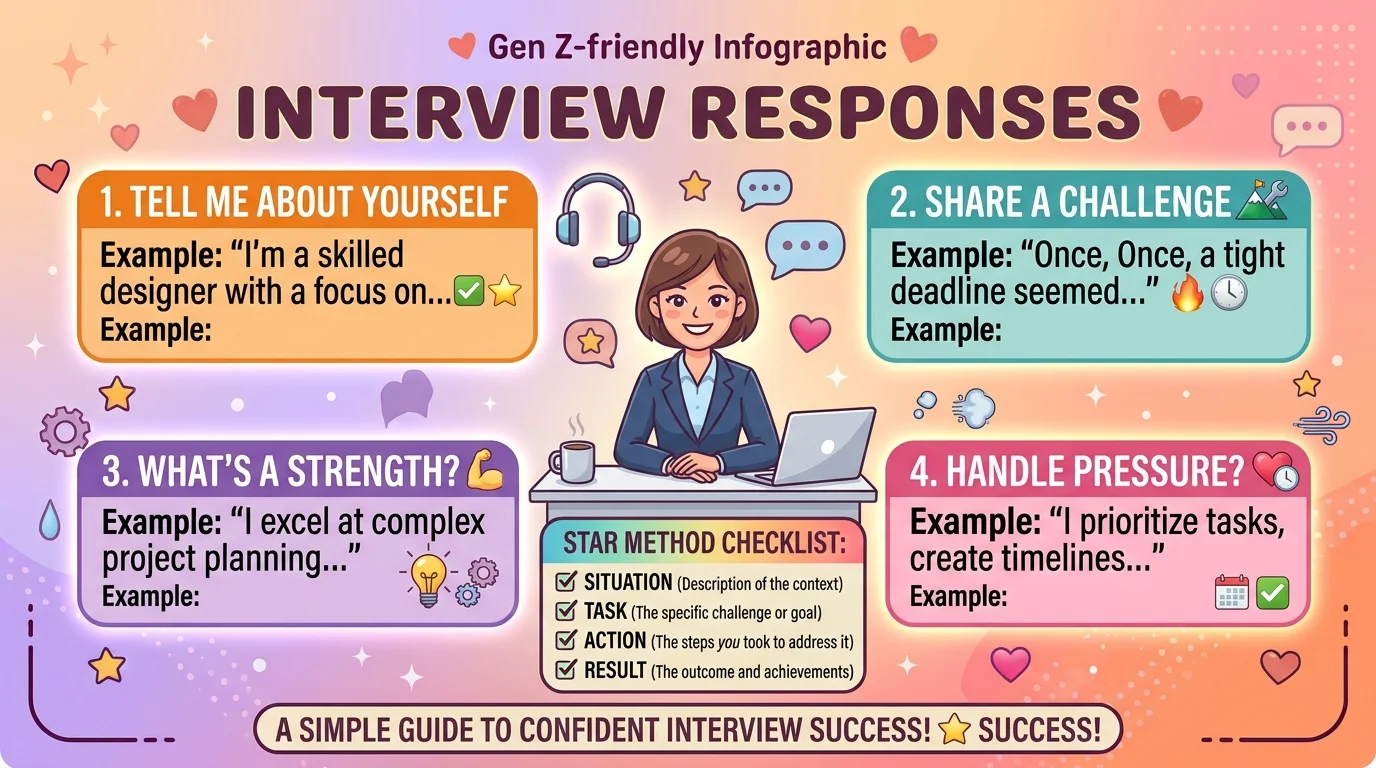
The best interview responses are short, specific, and backed by a real example, like “In my last role I solved that by,” “Let me walk you through how I handled it,” “I would approach it in three steps,” “That is a fair question, here is my honest take,” and “I am still learning that, and here is how.”
Your interview is in two hours, you have rehearsed your resume in the mirror, and then someone asks “tell me about a time you failed” and your mind goes completely blank. Interview responses are the whole game, because how you answer matters more than what your CV says. A confident answer lands different from a rambling one, even when the facts are the same.
The trick is preparation without sounding rehearsed. Hiring managers can spot a memorized script in seconds, but they respond well to clear structure and honest examples. This guide gives you 180+ ready to use phrases sorted by tone and question type, from salary talks to weakness questions. Pick the ones that sound like you and walk in prepared.
Professional Responses
- “In my last role, I owned that process end to end and improved turnaround by 20 percent.”
Example: When asked about a responsibility listed on your resume.
Meaning: It shows ownership with a measurable result attached. - “I would approach that in three steps: assess, prioritize, and follow up.”
Example: When asked how you would handle a new project.
Meaning: It proves you think in structure, not chaos. - “My experience there was focused on client retention and account growth.”
Example: When asked to walk through a previous position.
Meaning: It gives a clean summary instead of a long resume read. - “I collaborated with the finance and operations teams to close that gap.”
Example: When asked about cross functional work.
Meaning: It shows you can work beyond your own lane. - “I documented the process so the team could repeat it without me.”
Example: When asked about a contribution you are proud of.
Meaning: It signals maturity and long term thinking. - “That project required balancing speed with accuracy, and I managed both.”
Example: When asked about a challenging deliverable.
Meaning: It demonstrates judgment under competing priorities. - “I would first confirm the requirements, then set a clear timeline.”
Example: When given a hypothetical task.
Meaning: It shows you plan before you act. - “I escalated early rather than letting a small issue grow.”
Example: When asked about handling risk.
Meaning: It shows good instincts and communication. - “I have experience in both independent and team based settings.”
Example: When asked how you prefer to work.
Meaning: It keeps options open without sounding vague. - “My approach was to align expectations in writing before we started.”
Example: When asked how you avoid misunderstandings.
Meaning: It shows professionalism and clarity. - “I reviewed the data weekly and adjusted based on what it showed.”
Example: When asked how you measure success.
Meaning: It proves you are results driven. - “I take responsibility for the outcome, including the parts that went wrong.”
Example: When asked about accountability.
Meaning: It signals honesty and ownership.
Confident Responses
- “Yes, I have done that, and I can walk you through exactly how.”
Example: When asked if you have relevant experience.
Meaning: It answers directly and invites the story. - “That is a strength of mine, and here is a quick example.”
Example: When asked about a skill you genuinely have.
Meaning: It backs the claim with proof instead of modesty. - “I am confident I could take that on from day one.”
Example: When asked about a core job responsibility.
Meaning: It signals readiness without arrogance. - “I have solved a version of that before, so I know where the traps are.”
Example: When given a tricky scenario question.
Meaning: It shows experience applied to a new problem. - “Let me give you the short version, then we can go deeper.”
Example: When answering a broad opening question.
Meaning: It shows control over the conversation. - “That is exactly the kind of problem I enjoy solving.”
Example: When asked about a difficult part of the role.
Meaning: It shows genuine motivation, not just capability. - “I would take ownership and drive it to completion.”
Example: When asked how you handle unassigned work.
Meaning: It demonstrates initiative. - “I can share a specific number for that if it helps.”
Example: When discussing impact.
Meaning: It adds credibility through specifics. - “I am comfortable presenting to senior stakeholders.”
Example: When asked about communication skills.
Meaning: It removes doubt about a common concern. - “I do my best work when expectations are clear, so I ask early.”
Example: When asked about your working style.
Meaning: It frames a habit as a professional strength. - “I would rather over communicate than surprise anyone later.”
Example: When asked about teamwork.
Meaning: It signals reliability. - “I know what I bring, and I am happy to be tested on it.”
Example: When asked why they should hire you.
Meaning: It closes with quiet self assurance.
Polite and Respectful Responses
- “That is a great question, let me think for a second.”
Example: When you need a moment before answering.
Meaning: It buys time without looking unprepared. - “Thank you for explaining the role so clearly.”
Example: When the interviewer gives context about the position.
Meaning: It builds rapport and shows attentiveness. - “I appreciate you asking that, it is important.”
Example: When asked about a sensitive topic.
Meaning: It acknowledges the weight of the question. - “May I ask a quick clarifying question before I answer?”
Example: When the question could mean two things.
Meaning: It shows care and avoids a wrong answer. - “I would be glad to walk you through that in more detail.”
Example: When asked about a complex project.
Meaning: It offers depth without forcing it. - “I do not have direct experience there, but I have adjacent experience.”
Example: When you lack a specific requirement.
Meaning: It is honest and still positive. - “That is a fair point, and I would approach it differently now.”
Example: When asked about a past mistake.
Meaning: It shows humility and growth. - “I understand why that matters for this role.”
Example: When the interviewer explains a requirement.
Meaning: It shows you are listening, not just waiting to talk. - “I would want to learn how your team already handles it first.”
Example: When asked how you would change a process.
Meaning: It shows respect for existing systems. - “Thank you for the feedback, that is helpful to know.”
Example: When an interviewer challenges your answer.
Meaning: It keeps the tone calm and open. - “I would be happy to follow up with an example by email.”
Example: When you cannot recall a detail on the spot.
Meaning: It offers a graceful way to complete the answer. - “I really enjoyed learning about how your team works.”
Example: When closing the interview.
Meaning: It ends on a warm, sincere note.
Honest Responses
- “I do not know the answer to that, but here is how I would find it.”
Example: When asked something outside your knowledge.
Meaning: It shows honesty plus problem solving. - “That is a genuine weakness of mine, and here is what I am doing about it.”
Example: When asked about your biggest weakness.
Meaning: It answers with self awareness instead of a humble brag. - “I left that role because the growth I wanted was not available.”
Example: When asked why you left a previous job.
Meaning: It is truthful without criticizing anyone. - “I handled that badly at the time and I learned from it.”
Example: When asked about a failure.
Meaning: It shows maturity and reflection. - “I would need to check that before giving you a number.”
Example: When asked about salary expectations too early.
Meaning: It avoids committing to a figure blindly. - “I am still building that skill, and I have a plan for it.”
Example: When asked about a gap in your experience.
Meaning: It frames growth honestly. - “My last team was great, but the pace was slower than I wanted.”
Example: When asked why you are looking to move.
Meaning: It explains motivation without blame. - “I prefer clear feedback, even when it is uncomfortable.”
Example: When asked about your work preferences.
Meaning: It signals self awareness and coachability. - “That was a team effort, but my specific part was the analysis.”
Example: When discussing a shared success.
Meaning: It gives credit and clarifies your contribution. - “I do not want to overstate my role in that project.”
Example: When asked about an impressive outcome.
Meaning: It builds credibility through honesty. - “I have not managed a team directly, but I have led projects.”
Example: When asked about leadership experience.
Meaning: It offers the closest true equivalent. - “If I am being fully honest, that is the part I am least sure about.”
Example: When discussing a new responsibility.
Meaning: It shows candor without undermining confidence.
Clever Responses
- “The short answer is yes. The longer answer is how I got there.”
Example: When asked a yes or no question with depth behind it.
Meaning: It answers first and then explains. - “I would start by asking why it is done that way now.”
Example: When asked how you would improve a process.
Meaning: It shows thoughtful curiosity before action. - “There are two ways to solve that, and I would pick based on timeline.”
Example: When given an open ended problem.
Meaning: It demonstrates flexible thinking. - “I measure success by the outcome, not the effort.”
Example: When asked how you define good work.
Meaning: It reframes the answer around results. - “I would rather solve the root cause than the symptom.”
Example: When asked about handling recurring issues.
Meaning: It shows depth of thinking. - “My first move would be to understand what has already been tried.”
Example: When asked about a new challenge.
Meaning: It avoids repeating past mistakes. - “I treat feedback as data, not as a verdict.”
Example: When asked how you handle criticism.
Meaning: It shows emotional intelligence. - “The best idea wins, regardless of who said it.”
Example: When asked about collaboration.
Meaning: It signals a healthy, ego free mindset. - “I would map the stakeholders before mapping the plan.”
Example: When asked about managing a complex project.
Meaning: It shows strategic awareness. - “I like problems where the answer is not obvious yet.”
Example: When asked what kind of work energizes you.
Meaning: It communicates intellectual curiosity. - “If it is not written down, it did not happen.”
Example: When asked about documentation habits.
Meaning: It shows process discipline with a memorable line.
Thoughtful Responses
- “I want to make sure I answer the question you are actually asking.”
Example: When the question feels broad or layered.
Meaning: It shows care and precision. - “There is a trade off there, and I would weigh both sides.”
Example: When asked about a difficult decision.
Meaning: It shows balanced judgment. - “I would want to know how this decision affects the team first.”
Example: When asked how you handle priorities.
Meaning: It shows consideration beyond yourself. - “That question has a short answer and a longer one, which helps you more?”
Example: When given a broad behavioral prompt.
Meaning: It lets the interviewer guide the depth. - “My instinct is X, but I would test that assumption.”
Example: When asked for your initial take on a problem.
Meaning: It shows confidence balanced with rigor. - “I would rather flag a risk early than defend a surprise later.”
Example: When asked about project management.
Meaning: It communicates proactive thinking. - “What matters most to me is doing the work properly.”
Example: When asked what motivates you.
Meaning: It is grounded and sincere. - “I would want to see the data before changing the process.”
Example: When asked how you would improve something.
Meaning: It shows evidence based thinking. - “I have thought about that question a lot, actually.”
Example: When asked about your long term goals.
Meaning: It signals genuine self reflection. - “I would consider how this looks to the customer, not just the team.”
Example: When asked about decision making.
Meaning: It shows customer awareness. - “Sometimes the right answer is to wait a week.”
Example: When asked about urgency.
Meaning: It shows patience and judgment. - “I care more about being right than being first.”
Example: When asked about pace and accuracy.
Meaning: It communicates thoughtful standards.
Emotional and Self Aware Responses
- “I felt out of my depth at first, and I asked for help early.”
Example: When asked about a hard moment in your career.
Meaning: It shows vulnerability paired with action. - “That feedback stung at the time, and it made me better.”
Example: When asked about criticism you received.
Meaning: It shows growth from discomfort. - “I was genuinely nervous about that presentation, so I over prepared.”
Example: When asked about overcoming nerves.
Meaning: It is relatable and shows coping strategy. - “I care a lot about doing right by the people I work with.”
Example: When asked what matters to you at work.
Meaning: It reveals a genuine value. - “I took that personally at first, and then I separated the feedback from my identity.”
Example: When asked how you handle critique.
Meaning: It shows emotional maturity. - “That was a difficult period for the team, and I tried to stay steady.”
Example: When asked about a stressful time.
Meaning: It shows composure under pressure. - “I was proud of that, honestly, because it took a lot out of me.”
Example: When asked about an achievement.
Meaning: It adds authentic feeling to the answer. - “I have learned to say no earlier than I used to.”
Example: When asked about burnout or workload.
Meaning: It shows boundary awareness. - “I wanted to prove I could do it, and I pushed too hard at first.”
Example: When asked about a lesson learned.
Meaning: It is honest about ambition and its cost. - “I try to leave people better than I found them.”
Example: When asked about your values.
Meaning: It reveals character in one line. - “That situation taught me to ask for clarity sooner.”
Example: When asked about a past conflict.
Meaning: It turns a tough moment into a lesson. - “I am still working on not overcommitting.”
Example: When asked about areas for growth.
Meaning: It shows self awareness without self sabotage.
Funny and Lighthearted Responses
- “I have definitely broken a spreadsheet or two in my time.”
Example: When asked about a mistake.
Meaning: It is honest and disarming without being flippant. - “My biggest weakness is probably assuming everyone loves a detailed update.”
Example: When asked the weakness question.
Meaning: It adds personality while still being true. - “I am the person who reads the instructions. All of them.”
Example: When asked about your working style.
Meaning: It is a self aware joke that signals diligence. - “I have been told I ask too many questions. I am not sorry.”
Example: When asked about a habit others notice.
Meaning: It is playful while showing curiosity. - “My coffee order is more complicated than my career plan.”
Example: When asked about long term goals.
Meaning: It keeps the mood light without dodging entirely. - “I genuinely enjoy spreadsheets, which I am told is unusual.”
Example: When asked what you enjoy doing.
Meaning: It is charming and reveals a real preference. - “I once sent the wrong file to a client, and I have never trusted autocomplete since.”
Example: When asked about a lesson learned.
Meaning: It is honest and memorable. - “I would describe my patience as a work in progress.”
Example: When asked about a weakness.
Meaning: It is honest with a smile. - “I am competitive, but mostly with my own to do list.”
Example: When asked about teamwork.
Meaning: It shows drive without threatening anyone. - “I like to think I am the calm one in the meeting. Results vary.”
Example: When asked about stress management.
Meaning: It is relatable and disarming. - “I have a strong opinion about meeting agendas, and I will keep it brief.”
Example: When asked about work habits.
Meaning: It signals structure with humor. - “I promise I am more impressive than my typing speed suggests.”
Example: When recovering from a small awkward moment.
Meaning: It resets the tone with charm.
Chill and Casual Responses
- “Honestly, I just like getting things done.”
Example: When asked what motivates you.
Meaning: It is simple, sincere, and easy to trust. - “I am pretty low drama, and I like it that way.”
Example: When asked about team fit.
Meaning: It signals a calm, steady presence. - “I do not need a lot of hand holding, but I do ask when I need it.”
Example: When asked about supervision preferences.
Meaning: It shows independence with realism. - “I am happy to get stuck in and figure it out.”
Example: When asked about an unfamiliar task.
Meaning: It signals adaptability. - “That sounds like a good fit for how I like to work.”
Example: When the role is described in detail.
Meaning: It shows genuine alignment. - “I am not precious about how things get done.”
Example: When asked about process preferences.
Meaning: It shows flexibility. - “I prefer a quick chat over a long email chain, personally.”
Example: When asked about communication style.
Meaning: It is honest and practical. - “I have no problem rolling up my sleeves.”
Example: When asked about willingness to do hands on work.
Meaning: It signals a lack of ego. - “I would rather be useful than impressive.”
Example: When asked about your approach to work.
Meaning: It shows grounded priorities. - “I like to know what good looks like, then get on with it.”
Example: When asked how you start a project.
Meaning: It shows clarity and independence. - “I am easy to work with, as long as people tell me the truth.”
Example: When asked about team preferences.
Meaning: It sets a clear, reasonable expectation. - “I am excited to just get started, honestly.”
Example: When closing the interview.
Meaning: It ends on genuine, simple energy.
Creative and Storytelling Responses
- “Let me paint the picture of how that actually happened.”
Example: When asked about a complex achievement.
Meaning: It turns a bullet point into a story. - “It started with a problem nobody wanted to own.”
Example: When asked about a challenge you solved.
Meaning: It hooks the interviewer immediately. - “The turning point was a conversation I almost did not have.”
Example: When asked about a lesson learned.
Meaning: It builds narrative interest. - “There were three moving parts, and only one of them was mine.”
Example: When asked about a team project.
Meaning: It shows perspective and context. - “The result was good, but the process is what taught me the most.”
Example: When asked about an outcome.
Meaning: It shifts focus to insight, not just a number. - “I would handle it differently now, and here is exactly how.”
Example: When asked about a past decision.
Meaning: It shows reflective storytelling. - “That project changed how I think about deadlines.”
Example: When asked about something that shaped you.
Meaning: It connects a specific story to a broader lesson. - “The first version failed, which was the best thing that happened.”
Example: When asked about iteration.
Meaning: It frames failure as progress. - “I had to choose between being fast and being right.”
Example: When asked about a hard call.
Meaning: It sets up real tension. - “The best part was what happened after we shipped it.”
Example: When asked about impact.
Meaning: It highlights results beyond delivery. - “That is a story I tell in interviews, so I will keep it short.”
Example: When an anecdote is long.
Meaning: It keeps the interview moving with charm. - “Spoiler alert, it worked out.”
Example: When telling a long story.
Meaning: It adds light suspense and warmth.
Salary and Negotiation Responses
- “I would like to understand the range budgeted for the role before I answer.”
Example: When asked for your salary expectations early.
Meaning: It turns the question around professionally. - “Based on my research, I am targeting the mid to upper range for this role.”
Example: When you have done your homework.
Meaning: It gives a figure without underselling. - “My current package is competitive, and I am looking for a meaningful step forward.”
Example: When asked about current compensation.
Meaning: It is honest and sets a trajectory. - “Is the total package negotiable as a whole?”
Example: When the offer feels tight.
Meaning: It opens discussion without demanding. - “I am flexible on structure if the base is aligned.”
Example: When discussing salary composition.
Meaning: It shows willingness to work toward a deal. - “Could you share what the top performers typically earn?”
Example: When you want context on growth.
Meaning: It surfaces upside without confrontation. - “I would want to see the full breakdown before deciding.”
Example: When offered a verbal number.
Meaning: It keeps the discussion grounded. - “I am comfortable with that number if the start date is flexible.”
Example: When settling final details.
Meaning: It shows flexible negotiation. - “That works for me, thank you for being clear.”
Example: When the offer meets your expectation.
Meaning: It closes confidently and warmly. - “I would need to be closer to X to make the move work.”
Example: When the offer is below your minimum.
Meaning: It states a clear boundary politely. - “Can we revisit this after the probation period?”
Example: When immediate flexibility is limited.
Meaning: It offers a practical middle ground. - “I appreciate the offer and I am excited about the role.”
Example: When opening a negotiation.
Meaning: It frames the conversation positively.
Behavioral and STAR Responses
- “In my last role, the situation was X, so I did Y, and the result was Z.”
Example: When asked a behavioral question.
Meaning: It gives a complete, structured answer. - “My task was specific: get the project back on track in six weeks.”
Example: When asked about your responsibilities.
Meaning: It shows clarity on your exact role. - “The action I took was to rebuild the timeline with the team.”
Example: When asked what you did.
Meaning: It keeps the focus on your behavior. - “The outcome was a 15 percent improvement in delivery time.”
Example: When asked about results.
Meaning: It closes the story with a measurable win. - “What I would do differently is involve the client earlier.”
Example: When asked for reflection.
Meaning: It adds maturity to a success story. - “There was tension in the team, so I set up a weekly check in.”
Example: When asked about conflict.
Meaning: It shows a practical intervention. - “I noticed the pattern and raised it before it became a problem.”
Example: When asked about initiative.
Meaning: It shows proactive behavior. - “I asked for feedback halfway through rather than waiting for the end.”
Example: When asked about learning.
Meaning: It shows a deliberate feedback loop. - “The decision was mine, and I stood behind it.”
Example: When asked about tough calls.
Meaning: It shows accountability. - “I made sure the quieter people in the room were heard.”
Example: When asked about leadership.
Meaning: It shows inclusive leadership. - “I wrote down what went well and what I would repeat.”
Example: When asked about improvement habits.
Meaning: It shows reflective practice. - “That is the example I usually use for this question.”
Example: When you have a strong story ready.
Meaning: It signals preparedness and focus.
Closing and Follow Up Responses
- “Thank you for your time today, this was a great conversation.”
Example: When the interview is ending.
Meaning: It closes warmly and professionally. - “Is there anything about my background you would like me to clarify?”
Example: When you want to address concerns directly.
Meaning: It invites honest feedback and shows confidence. - “What would success look like in the first 90 days?”
Example: When you want to signal ambition.
Meaning: It shows forward thinking. - “Is there anything I have not covered that would help your decision?”
Example: When wrapping up.
Meaning: It offers a final chance to strengthen your case. - “What are the next steps from here?”
Example: When ending the conversation.
Meaning: It shows clear, practical interest. - “I really enjoyed hearing about the team’s work.”
Example: When you genuinely liked the conversation.
Meaning: It ends on a sincere note. - “I will follow up with that example by email today.”
Example: When you could not answer something fully.
Meaning: It shows follow through. - “I would be excited to join and contribute from week one.”
Example: When expressing interest.
Meaning: It states enthusiasm clearly. - “Is there anything I should prepare for the next stage?”
Example: When moving to the next round.
Meaning: It shows initiative and preparation. - “Thank you for the thoughtful questions.”
Example: When the interview was challenging.
Meaning: It acknowledges their effort warmly. - “I will send a quick note recapping our conversation.”
Example: When you want to stand out.
Meaning: It reinforces your interest professionally. - “Either way, I really appreciated the conversation.”
Example: When you want to stay gracious regardless of outcome.
Meaning: It ends with grace and professionalism.
Entry Level and Fresher Responses
- “I have not done this professionally, but I have done it in a project setting.”
Example: When you lack formal experience.
Meaning: It offers the closest true equivalent. - “I am new to the industry, and I have been learning quickly.”
Example: When asked about your experience level.
Meaning: It is honest and shows momentum. - “I built a version of that myself to understand how it works.”
Example: When asked about self learning.
Meaning: It shows initiative beyond coursework. - “My coursework covered that, and I applied it in a group project.”
Example: When asked about academic background.
Meaning: It connects theory to practice. - “I do not have the experience yet, but I know how I would start.”
Example: When asked about a complex task.
Meaning: It shows practical thinking anyway. - “I am looking for a place where I can learn from strong people.”
Example: When asked why you applied.
Meaning: It shows humility and ambition. - “I am comfortable being new, as long as I can ask questions.”
Example: When asked about onboarding.
Meaning: It sets a realistic, positive tone. - “I would spend the first month listening and learning.”
Example: When asked what you would do first.
Meaning: It shows patience and good instincts. - “I have done internships, side projects, and a lot of reading.”
Example: When asked how you prepared.
Meaning: It signals genuine interest. - “I know I have a lot to prove, and I am ready to work for it.”
Example: When addressing a gap.
Meaning: It shows drive without excuses. - “I am a quick learner, and I have examples to back that up.”
Example: When asked about adaptability.
Meaning: It turns a claim into a promise. - “I would rather start somewhere I can grow than somewhere easy.”
Example: When asked about your priorities.
Meaning: It shows long term thinking.
Tricky and Curveball Responses
- “That is a question I have not been asked before, let me think.”
Example: When a curveball lands.
Meaning: It buys time honestly. - “I do not think I would take that approach, and here is why.”
Example: When asked to do something you disagree with.
Meaning: It shows independent judgment. - “If I had to choose, I would pick the option with the longer term payoff.”
Example: When forced to choose between two options.
Meaning: It shows clear decision criteria. - “That depends on what the team needs most right now.”
Example: When the question has no single right answer.
Meaning: It shows contextual thinking. - “I would want to ask a few questions before committing to that.”
Example: When given an unclear hypothetical.
Meaning: It shows caution and good instincts. - “I am not sure that is the real problem, honestly.”
Example: When a case question has a hidden issue.
Meaning: It shows deeper analysis. - “If I am wrong, I would want to know quickly.”
Example: When asked how you handle uncertainty.
Meaning: It shows a healthy relationship with feedback. - “I would rather say I do not know than guess.”
Example: When asked a factual question you cannot answer.
Meaning: It builds credibility. - “That is a hard one, and I think there are two valid answers.”
Example: When asked a value based question.
Meaning: It shows nuance. - “I would need to know the constraints before answering fully.”
Example: When given an open ended scenario.
Meaning: It shows discipline in problem framing. - “I think the honest answer is that I would find it difficult.”
Example: When asked about a tough part of the role.
Meaning: It shows realism without weakness. - “Can I ask what prompted that question?”
Example: When a question feels unusual.
Meaning: It shows curiosity and confidence.
FAQs
What are interview responses?
They are the answers you give to interview questions, and the best ones are structured, specific, and backed by real examples.
Can interview responses be flirty or personal?
No, keep them professional. Warmth and personality are fine, but romantic or overly personal answers will hurt your chances.
What if I do not actually have the experience they ask about?
Be honest and offer the closest equivalent. Then show how you would approach the task or learn it quickly.
Is humor appropriate in an interview?
Yes, in small doses and when it fits the room. A light, self aware joke can build rapport, but keep the substance of your answer strong.
How long should each answer be?
Roughly 60 to 90 seconds. Long enough to show depth, short enough to leave room for follow up questions.
What should I say at the end of the interview?
Thank them, ask one thoughtful question, and confirm the next steps. A short follow up email the same day helps too.
Conclusion
Interview responses are less about having perfect answers and more about sounding clear, honest, and prepared. A structured answer with a real example beats a polished script every time, and the small phrases you use to open and close carry more weight than most people realize. Practice the ones that fit your voice, and the room will feel a lot less intimidating.
Save this list, review it the night before, and pick three responses to rehearse out loud. Share it with a friend who has an interview coming up. Walk in calm, answer with structure, and let your experience do the talking.
