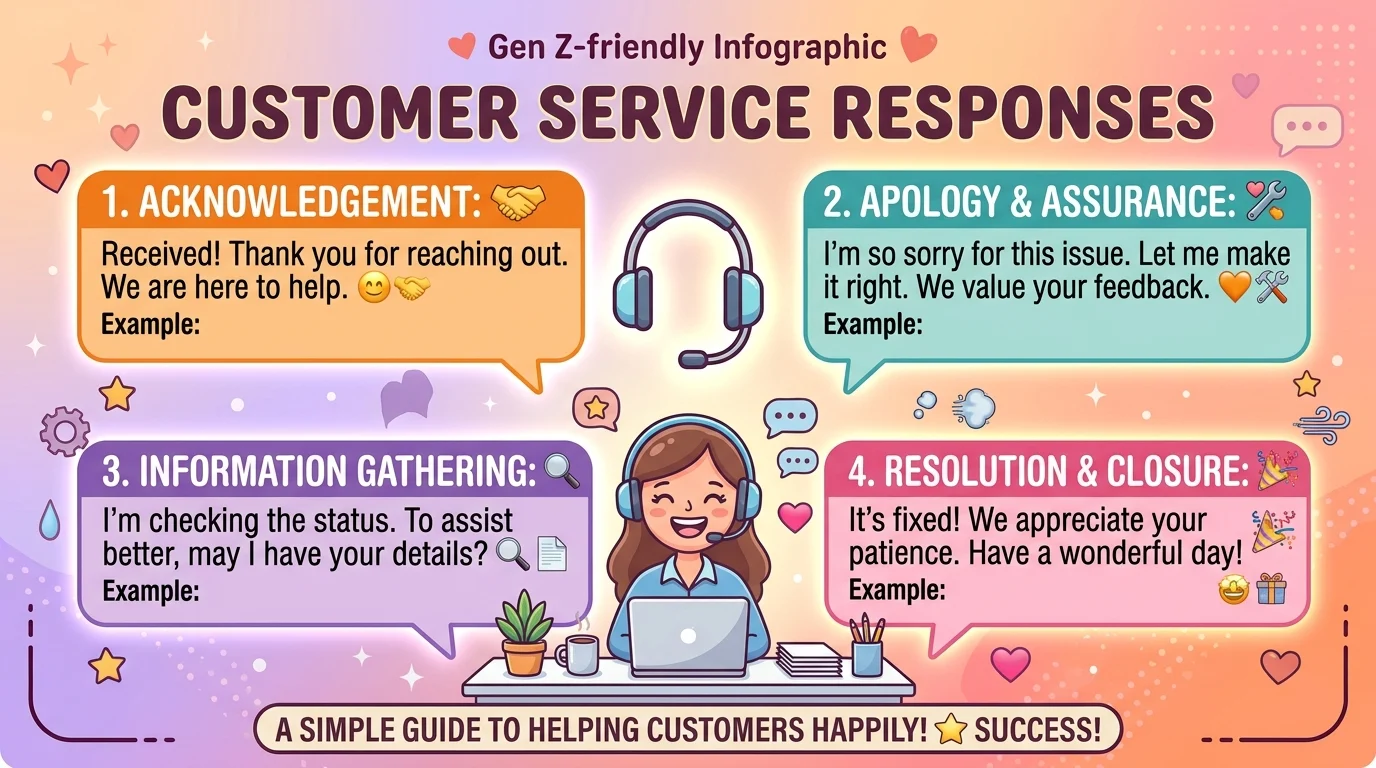
The best customer service responses are calm, clear, and solution focused, like “I understand, let me fix this for you,” “Thank you for your patience, here’s what happens next,” “I’d feel the same way in your position,” “Let me escalate this right away,” and “You’re all set, is there anything else I can help with?”
Your chat window dings and the message is in all caps. Or a customer walks up already mid rant. That is the moment good customer service responses either save the day or make everything worse. Whether you work retail, run a support desk, or answer DMs for a small brand, the words you choose in the first ten seconds decide how the rest of the conversation goes.
The tricky part is that every situation needs a different tone. An angry refund request is not the same as a confused first time buyer or a loyal customer who just had a bad day. This guide gives you 180+ ready to use replies sorted by mood and moment, so you are never caught scrambling for the right thing to say. Save it, screenshot it, keep it open on shift.
Calm De-Escalation Responses
- “I understand you’re frustrated, and I want to help. Let’s start with what happened.”
Example: When a customer opens a chat already upset.
Meaning: It validates their emotion while steering toward a solution. - “I hear you. Let me take a look and see what I can do.”
Example: When someone is venting before explaining the issue.
Meaning: It shows you are listening instead of defending. - “That sounds really frustrating. I would be upset too.”
Example: When a customer describes a genuine inconvenience.
Meaning: It builds empathy before you ask for details. - “I’m sorry this happened. Let’s get it sorted out together.”
Example: When a customer reports a problem you can fix.
Meaning: It reframes the interaction as teamwork. - “I can see why this upset you. Give me a moment to check.”
Example: When the complaint is valid and needs investigation.
Meaning: It acknowledges fault without overpromising. - “You have every right to be annoyed. Here is what I can do right now.”
Example: When a mistake clearly caused trouble.
Meaning: It validates the reaction and moves to action. - “Let’s take this one step at a time. I’m not going anywhere.”
Example: When a customer feels overwhelmed by a complicated issue.
Meaning: It reassures them they have your full attention. - “I want to make this right for you. Can you tell me exactly what went wrong?”
Example: When the complaint is vague.
Meaning: It invites clarity without sounding dismissive. - “I’m going to stay on this until it’s resolved. You have my word.”
Example: When a customer worries about being passed around.
Meaning: It builds trust through commitment. - “I completely understand. Let me check what options we have for you.”
Example: When a customer is upset and unsure what they want.
Meaning: It stays collaborative instead of defensive. - “That’s not the experience we want you to have. I’m sorry.”
Example: When the service genuinely fell short.
Meaning: It owns the gap between promise and reality. - “Thank you for telling me. I know it’s not easy to complain.”
Example: When a customer is hesitant about raising an issue.
Meaning: It makes them feel heard and respected.
Empathetic and Understanding Responses
- “I’m really sorry you’re dealing with this. Let me help however I can.”
Example: When a customer describes a stressful situation.
Meaning: It leads with care instead of process. - “I can hear how much this matters to you. I’ll treat it that way.”
Example: When a complaint involves something personal.
Meaning: It signals you are taking it seriously. - “That sounds like a lot to deal with. Let’s lighten it for you.”
Example: When a customer is overwhelmed.
Meaning: It offers relief rather than instructions. - “I’ve been in a similar spot, so I get it. Let me see what I can do.”
Example: When the situation is relatable.
Meaning: It builds connection through shared experience. - “Thank you for being patient with us. I know this has taken longer than it should.”
Example: When a customer waited too long.
Meaning: It honors their grace and acknowledges the delay. - “I’m sorry this affected your day. Let’s see if we can turn it around.”
Example: When the issue spilled into their personal time.
Meaning: It recognizes the human impact. - “You deserve better than this. Let me look into it properly.”
Example: When the service clearly missed the mark.
Meaning: It validates their standard without excuses. - “I can tell you’ve been trying to get this fixed for a while. I’m on it now.”
Example: When a customer returns after failed attempts.
Meaning: It acknowledges their persistence and frustration. - “That’s a fair point, and I appreciate you explaining it so clearly.”
Example: When a customer gives thoughtful criticism.
Meaning: It rewards honesty and opens a better conversation. - “Take your time explaining. I’m listening properly.”
Example: When a customer is flustered or rushing.
Meaning: It slows the pace and builds trust. - “I understand this is important to you, so I’ll be straight with you.”
Example: When you need to deliver an honest answer.
Meaning: It signals transparency before the hard news. - “Thank you for giving us a chance to fix it.”
Example: When a customer stays after a mistake.
Meaning: It appreciates their patience sincerely.
Solution Focused Responses
- “Here’s what I can do for you right now. Does that work?”
Example: When a customer needs an immediate option.
Meaning: It offers action instead of an apology loop. - “I’ve found the issue. Here’s the fix and how long it will take.”
Example: When the problem is identified.
Meaning: It delivers clarity and a timeline. - “I can offer you two options. Which one works better for you?”
Example: When you have flexibility to resolve things.
Meaning: It gives the customer control over the outcome. - “Let me walk you through the steps to get this sorted.”
Example: When a customer needs guidance.
Meaning: It makes the process feel manageable. - “I’ve processed that for you now. You should see it within 24 hours.”
Example: When an action is complete.
Meaning: It confirms the fix with realistic timing. - “Good news, I can resolve this today.”
Example: When a fix is straightforward.
Meaning: It delivers relief and confidence quickly. - “I’ve escalated this to a specialist who can fix it properly.”
Example: When the issue is beyond your scope.
Meaning: It shows you are routing it correctly. - “Here’s the honest answer, and here’s what we can do about it.”
Example: When the news is not ideal.
Meaning: It builds trust by pairing truth with action. - “Let me check that for you and come back with a proper answer.”
Example: When you need time to verify details.
Meaning: It avoids guessing and promises follow up. - “I’ve applied a credit to your account to make up for the trouble.”
Example: When the inconvenience warrants compensation.
Meaning: It backs the apology with something real. - “That’s fully sorted on our end. You don’t need to do anything else.”
Example: When the customer has done their part.
Meaning: It removes any lingering worry. - “I’ll follow up personally once it’s done so you’re not left guessing.”
Example: When the resolution takes time.
Meaning: It promises communication, not silence.
Professional and Formal Responses
- “Thank you for contacting us. I would be glad to assist with this matter.”
Example: When a formal inquiry arrives by email.
Meaning: It sets a polished, courteous tone. - “I can confirm that your request has been received and logged.”
Example: When a customer needs proof of contact.
Meaning: It gives them a concrete record. - “We kindly ask for up to two business days to complete the review.”
Example: When the process has a defined timeline.
Meaning: It sets clear expectations politely. - “I have forwarded your case to the relevant department for review.”
Example: When the issue needs specialist handling.
Meaning: It shows proper routing and ownership. - “Please accept our apologies for any inconvenience this has caused.”
Example: When a formal apology is required.
Meaning: It addresses the disruption respectfully. - “Your feedback has been documented and passed to our team.”
Example: When a customer shares a complaint formally.
Meaning: It confirms the message reached the right place. - “I am happy to confirm that the matter has now been resolved.”
Example: When closing out a formal ticket.
Meaning: It provides clean closure. - “Should you require further assistance, please do not hesitate to reach out.”
Example: When wrapping up a professional exchange.
Meaning: It keeps the door open courteously. - “I understand your position and I will do what I can within our policy.”
Example: When a request falls outside what you can approve.
Meaning: It is honest without being dismissive. - “Thank you for your patience while we completed our checks.”
Example: When a verification process took time.
Meaning: It appreciates their cooperation formally. - “I have attached the confirmation for your records.”
Example: When documentation supports the resolution.
Meaning: It gives them something tangible to keep. - “We value your business and appreciate the opportunity to assist.”
Example: When closing a client interaction.
Meaning: It ends on a respectful, relationship focused note.
Friendly and Warm Responses
- “Hi there! Thanks for reaching out. I’d love to help with this.”
Example: When a customer’s first message is cheerful.
Meaning: It matches their energy and feels welcoming. - “Thanks for letting us know. Let’s get this fixed for you.”
Example: When someone reports a small issue.
Meaning: It is friendly and action oriented. - “So glad you got in touch. I’ll take care of it.”
Example: When a customer finally raises a problem.
Meaning: It makes them feel welcomed rather than a burden. - “Happy to help with that. Give me just a moment.”
Example: When the request is easy to handle.
Meaning: It signals willingness and speed. - “You’re welcome, and thanks for being so easy to work with.”
Example: When a customer is cooperative.
Meaning: It returns their good attitude warmly. - “That’s a great question. Let me find you a proper answer.”
Example: When someone asks something thoughtful.
Meaning: It compliments them and commits to accuracy. - “Anytime! That’s exactly what we’re here for.”
Example: When a customer apologizes for asking something.
Meaning: It removes any guilt about needing help. - “Thanks for your patience. You’ve been lovely about this.”
Example: When a customer waited calmly.
Meaning: It acknowledges their grace sincerely. - “We love hearing from you. Keep the questions coming.”
Example: When a regular customer checks in often.
Meaning: It encourages engagement in a relaxed way. - “Hope your day is going well. Here’s the update you asked for.”
Example: When sending a routine status message.
Meaning: It adds a human touch to a standard reply. - “That’s completely sorted. Thanks for being so understanding.”
Example: When a customer stayed calm through a hiccup.
Meaning: It closes warmly and appreciatively. - “You made this easy. Thanks for the clear details.”
Example: When a customer explains their issue well.
Meaning: It compliments them and speeds up the process.
Apology and Recovery Responses
- “I’m sorry for the mix up. We’ve corrected it and here’s what happened.”
Example: When an order or booking went wrong.
Meaning: It owns the error and explains briefly. - “We got this wrong, and I want to make it right.”
Example: When the failure was clearly on your side.
Meaning: It delivers an honest, direct apology. - “I take full responsibility for this. Here’s how we’re fixing it.”
Example: When a high value customer is affected.
Meaning: It builds trust through accountability. - “I’m sorry it took longer than it should have. Your issue is now resolved.”
Example: When a fix finally lands after a delay.
Meaning: It confirms resolution and owns the wait. - “That’s not acceptable, and I understand why you’re upset.”
Example: When the service standard clearly slipped.
Meaning: It validates their reaction without excuses. - “We’ve added a credit to your account as an apology.”
Example: When the inconvenience was significant.
Meaning: It makes the apology tangible. - “I’m sorry for the confusion. Let me clarify exactly what happened.”
Example: When a message or policy was unclear.
Meaning: It clears the misunderstanding calmly. - “Thank you for giving us the chance to put this right.”
Example: When a customer stays after a mistake.
Meaning: It appreciates their patience sincerely. - “We’re reviewing our process so this doesn’t happen again.”
Example: When a systemic issue caused the problem.
Meaning: It signals long term improvement, not just words. - “I know an apology isn’t enough, so here’s what I can actually do.”
Example: When the customer needs more than words.
Meaning: It pairs regret with real action. - “I’m sorry you had to chase us on this. That’s on us.”
Example: When the customer had to follow up repeatedly.
Meaning: It owns the communication failure directly. - “Thanks for sticking with us. We don’t take that lightly.”
Example: When a customer stays after a rough patch.
Meaning: It honors their loyalty with humility.
Angry Customer Responses
- “I can see you’re upset, and I want to fix this. Can I start with your order number?”
Example: When a chat opens with an all caps complaint.
Meaning: It moves from emotion to a concrete starting point. - “I’m not going to argue with you. I’m going to help you.”
Example: When a customer tries to pick a fight.
Meaning: It signals cooperation and drops the defensiveness. - “You’re right to be frustrated. Let me see what went wrong.”
Example: When the complaint is clearly valid.
Meaning: It validates them and shifts to investigation. - “I understand. Give me two minutes to check this properly.”
Example: When you need to pause an escalating conversation.
Meaning: It buys time while keeping them engaged. - “I want to resolve this for you, and I need your help to do it.”
Example: When a customer is too angry to share details.
Meaning: It reframes them as part of the solution. - “I hear you. Let’s not let this get worse. Here’s what I can do.”
Example: When the tone is rising fast.
Meaning: It de-escalates while offering a path forward. - “If I were in your position, I’d be frustrated too.”
Example: When a customer feels dismissed.
Meaning: It builds instant empathy. - “I’m going to be honest with you about what I can and can’t do.”
Example: When the demands exceed policy.
Meaning: It sets expectations without hostility. - “I can’t change what happened, but I can control how we fix it.”
Example: When the customer keeps returning to the past issue.
Meaning: It redirects toward resolution. - “Let me get a manager involved so you get the answer you need.”
Example: When the customer demands escalation.
Meaning: It responds to their request without resistance. - “I’d rather solve this with you than argue about it.”
Example: When the conversation becomes circular.
Meaning: It keeps the focus on outcomes. - “We can keep going until this is sorted. I’m not rushing you.”
Example: When the customer feels brushed off.
Meaning: It reassures them they have your full attention.
Polite Boundary Responses
- “I want to help you, and I need us to keep this conversation respectful.”
Example: When a customer starts insulting you personally.
Meaning: It sets a clear boundary without escalating. - “I’m happy to continue helping once we can speak calmly.”
Example: When someone is shouting in a chat or on a call.
Meaning: It pauses the interaction without walking away permanently. - “I can help with the issue, but I can’t help if I’m being spoken to like that.”
Example: When rudeness crosses a line.
Meaning: It is firm and fair at the same time. - “I’ll do everything I can within our policy. I want to be upfront about that.”
Example: When the request exceeds what is allowed.
Meaning: It sets limits early and honestly. - “I understand you want a different answer, but this is the accurate one.”
Example: When a customer keeps pushing for a yes.
Meaning: It stays steady without being cold. - “That’s outside what I’m able to approve, but here’s who can help.”
Example: When the request needs higher authority.
Meaning: It declines and redirects in one move. - “I’m going to end this call if the shouting continues, and I’ll gladly pick it back up after.”
Example: When a phone conversation becomes abusive.
Meaning: It protects you while keeping the door open. - “I’d rather be honest with you than promise something I can’t deliver.”
Example: When the customer wants a guarantee you cannot give.
Meaning: It earns trust through transparency. - “I can escalate this, but I want to set realistic expectations first.”
Example: When a customer thinks a manager will overturn everything.
Meaning: It prevents disappointment later. - “I’ve explained what I can do. The next step is yours.”
Example: When you have offered everything available.
Meaning: It closes your side of the negotiation politely. - “I want to keep helping, and I need you to stop the personal comments.”
Example: When a customer attacks your character.
Meaning: It draws a clear line while remaining professional. - “Let’s take a short break and come back to this in a few minutes.”
Example: When the tension is too high to continue productively.
Meaning: It resets the conversation without abandoning it.
Upset About Delay Responses
- “I’m sorry this has taken so long. Here’s exactly where things stand.”
Example: When a customer chases an update.
Meaning: It gives them clarity instead of another apology alone. - “You’ve been waiting longer than you should have. I’m checking now.”
Example: When a delivery or response is overdue.
Meaning: It acknowledges the delay directly. - “I don’t have a final answer yet, but I didn’t want to leave you in silence.”
Example: When the resolution is still in progress.
Meaning: It shows proactive communication. - “Here’s the realistic timeline, and I’ll update you if anything changes.”
Example: When you can give an honest estimate.
Meaning: It sets expectations and promises follow through. - “I’ve flagged this as urgent so it moves faster.”
Example: When the delay has caused real problems.
Meaning: It shows you are pushing internally. - “Thank you for not giving up on us. I’m on it now.”
Example: When a customer returns after a long wait.
Meaning: It appreciates their persistence. - “I know waiting is the worst part. Let me get you a real update.”
Example: When a customer is anxious about status.
Meaning: It empathizes while committing to information. - “We dropped the ball on communication here. I’m sorry.”
Example: When the fix was fine but updates were missing.
Meaning: It owns the specific failure accurately. - “Your order is moving again. Here’s the new estimated date.”
Example: When something was stuck and is now resolved.
Meaning: It delivers good news with specifics. - “I’ll stay on this until you have a confirmed answer.”
Example: When the customer needs certainty.
Meaning: It reassures them they are not alone in it. - “That delay wasn’t fair to you. Here’s what we’re doing about it.”
Example: When the wait caused inconvenience.
Meaning: It validates the frustration and offers action. - “Thank you for your patience. I know that’s easy to say and hard to do.”
Example: When a customer has waited calmly.
Meaning: It is honest and human about their effort.
Refund and Billing Responses
- “I’ve processed your refund. It should appear in 3 to 5 business days.”
Example: When a refund is approved.
Meaning: It gives a clear outcome and realistic timing. - “I can see the duplicate charge. Let me get that reversed for you.”
Example: When a customer was billed twice.
Meaning: It confirms the issue before fixing it. - “I understand the charge was unexpected. Let me explain what it was for.”
Example: When a customer questions a fee.
Meaning: It clarifies without being defensive. - “Your refund has been approved in full. I’m sorry for the trouble.”
Example: When a return is accepted.
Meaning: It delivers the outcome with an apology. - “I’ve applied a credit to your next order as a goodwill gesture.”
Example: When a small issue caused inconvenience.
Meaning: It offers compensation without a formal refund. - “That charge shouldn’t have gone through. I’ve corrected it now.”
Example: When an error was on your side.
Meaning: It owns the mistake and confirms the fix. - “Here’s a breakdown of the charges so you can see exactly what happened.”
Example: When a bill looks confusing.
Meaning: It builds trust through transparency. - “I can cancel that subscription for you today. No further charges will apply.”
Example: When a customer wants to stop a service.
Meaning: It gives them control and clarity. - “I know money issues are stressful. Let’s sort this out quickly.”
Example: When a billing error caused worry.
Meaning: It acknowledges the emotional weight. - “I’ve escalated this to billing as a priority. You’ll hear back today.”
Example: When the issue needs specialist handling.
Meaning: It sets a clear follow up promise. - “You’re fully refunded and I’ve added a note to your account.”
Example: When closing a billing complaint.
Meaning: It confirms the fix and creates a record. - “Thank you for flagging this. It helps us catch errors faster.”
Example: When a customer spots a billing mistake.
Meaning: It frames their complaint as valuable.
Technical Support Responses
- “Let’s try a quick fix first. Can you refresh and try again?”
Example: When a user reports a glitch.
Meaning: It starts with the simplest solution. - “I can see the error on our end. Give me a moment to correct it.”
Example: When the problem is confirmed internally.
Meaning: It shows competence and ownership. - “I’ve reset your access. Please log in again and let me know how it goes.”
Example: When someone is locked out.
Meaning: It gives a clear action and invites feedback. - “That sounds like a browser issue. Let’s try a different one together.”
Example: When the problem seems device specific.
Meaning: It guides troubleshooting without blame. - “Here are the three steps to fix that. Let me know if any part is unclear.”
Example: When a known issue has a documented fix.
Meaning: It delivers structured help. - “This is a known issue and our team is working on a fix.”
Example: When multiple users report the same bug.
Meaning: It reduces duplicate reports and builds patience. - “I’ll need a screenshot to see exactly what you’re seeing.”
Example: When the description is unclear.
Meaning: It requests the detail needed to help properly. - “I’ve escalated this to our technical team with full details.”
Example: When the fix requires engineers.
Meaning: It shows the issue is in the right hands. - “Your data is safe. This is a display issue, not a loss.”
Example: When a customer panics about missing files.
Meaning: It calms the biggest fear first. - “That’s working now on our side. Can you confirm on yours?”
Example: When a fix has been applied.
Meaning: It verifies before closing the ticket. - “I’m going to stay with you until this is working properly.”
Example: When a customer has had repeated failures.
Meaning: It reassures them they are not alone. - “Thanks for your patience while we sorted that. Anything else playing up?”
Example: When a technical issue is resolved.
Meaning: It closes warmly and checks for other problems.
Order and Delivery Responses
- “I’ve checked your order and it’s on the way. Here’s the tracking link.”
Example: When a customer asks where their package is.
Meaning: It answers the question with proof. - “That’s arriving later than promised. I’m sorry, and here’s the new date.”
Example: When a delivery is delayed.
Meaning: It owns the gap and gives clarity. - “I can see it’s stuck in transit. Let me chase it for you.”
Example: When tracking has not updated.
Meaning: It takes action instead of offering a platitude. - “I’ve sent a replacement out today. You’ll get tracking shortly.”
Example: When a package arrived damaged.
Meaning: It solves the problem quickly. - “Your order was marked delivered but isn’t there. Let’s investigate.”
Example: When a package shows delivered but is missing.
Meaning: It takes the claim seriously immediately. - “I can update the delivery address if it hasn’t shipped yet.”
Example: When a customer spots a mistake in time.
Meaning: It offers a fast fix. - “Here’s exactly where your order is in the process.”
Example: When a customer wants a status update.
Meaning: It provides transparency at each stage. - “That item is out of stock. Here are two similar options in the same price range.”
Example: When a product is unavailable.
Meaning: It solves the problem instead of just saying no. - “I’ve refunded the shipping cost because of the delay.”
Example: When delivery took too long.
Meaning: It makes the apology concrete. - “I’ve flagged this with the courier as a priority.”
Example: When a delivery has gone wrong.
Meaning: It shows you are escalating externally too. - “Your order is being packed now and ships tomorrow.”
Example: When a customer checks in right after ordering.
Meaning: It reassures them progress is happening. - “Thanks for your patience. Your parcel is back on track.”
Example: When a stuck delivery finally moves.
Meaning: It delivers good news with appreciation.
Retail and In Store Responses
- “I’m sorry about the wait. Let me help you now.”
Example: When a customer reaches the counter frustrated.
Meaning: It acknowledges the delay and shifts attention. - “I can check out back for that size if you have a minute.”
Example: When a customer cannot find their size.
Meaning: It shows effort beyond the shelf. - “That’s not the experience we want in store. Let me fix it.”
Example: When a customer reports poor service from staff.
Meaning: It owns the issue on behalf of the business. - “I completely understand. Let me see what we can do about the price.”
Example: When a customer questions a cost.
Meaning: It stays open instead of defensive. - “I can hold that for you until the end of the day.”
Example: When a customer needs time to decide.
Meaning: It offers flexibility and goodwill. - “I’m sorry, we don’t have that today. I can order it in for you.”
Example: When a product is out of stock.
Meaning: It turns a no into an option. - “Let me grab my manager so you get a proper answer.”
Example: When a request needs approval.
Meaning: It escalates without making the customer repeat themselves. - “I’ve checked the system and the return is eligible. Let’s process it.”
Example: When a customer wants to return an item.
Meaning: It confirms and acts in one step. - “That sounds annoying. Let me see if we can make it easier.”
Example: When a customer describes a frustrating process.
Meaning: It validates the feeling and offers help. - “I’ve let the team know so it doesn’t happen again.”
Example: When a customer reports a store issue.
Meaning: It shows their feedback creates change. - “Thanks for being so patient while I sorted that.”
Example: When a transaction took longer than normal.
Meaning: It appreciates their cooperation. - “You’re all set. Thanks for shopping with us today.”
Example: When closing a positive transaction.
Meaning: It ends the interaction warmly.
Chat and DM Responses
- “Thanks for messaging us. I’m here and ready to help.”
Example: When a customer opens a chat.
Meaning: It sets an attentive tone immediately. - “Got your message. Give me a moment to look into it.”
Example: When you need a second to check details.
Meaning: It confirms receipt without leaving them hanging. - “Could you share your order number so I can pull up the details?”
Example: When a customer describes a problem without context.
Meaning: It gets the information needed to help fast. - “I’m sorry for the slow reply. I’m with you now.”
Example: When the chat queued for a while.
Meaning: It acknowledges the delay honestly. - “That’s a fair question. Here’s the answer.”
Example: When a customer asks about policy.
Meaning: It validates them and delivers clarity. - “I’ve checked and here’s what I can do for you.”
Example: When the investigation is complete.
Meaning: It moves from questions to action. - “Let me transfer you to a colleague who can help better with this.”
Example: When the query needs a specialist.
Meaning: It routes them properly instead of guessing. - “Thanks for the details. That’s everything I need.”
Example: When a customer provides the full picture.
Meaning: It confirms you can move forward. - “I’ll send you a follow up here once it’s resolved.”
Example: When the fix takes time.
Meaning: It promises an update in the same channel. - “You’re all set. Anything else I can help with today?”
Example: When a chat issue is resolved.
Meaning: It closes cleanly while staying available. - “I understand. Let me look at this from a different angle.”
Example: When the first solution did not work.
Meaning: It shows persistence rather than a script. - “Thanks for your patience. That’s now sorted for you.”
Example: When a chat takes several messages to resolve.
Meaning: It closes with appreciation.
Social Media and Public Responses
- “Thanks for reaching out here. Could you send us a DM so we can help properly?”
Example: When a customer complains in a public comment.
Meaning: It moves the conversation to a private, useful channel. - “We’re sorry to see this. Let’s get it sorted for you.”
Example: When a public complaint appears on a post.
Meaning: It responds publicly with care and action. - “Thanks for flagging this. We’ve sent you a message to help.”
Example: When a customer raises an issue in comments.
Meaning: It shows public accountability and private follow up. - “We appreciate the feedback, even when it’s tough to hear.”
Example: When a public review is critical.
Meaning: It signals maturity and openness. - “That’s not what we want to hear, and we’d like to fix it.”
Example: When a customer shares a bad experience publicly.
Meaning: It acknowledges the issue without arguing. - “Thanks for the love. This made our day.”
Example: When someone posts positive feedback.
Meaning: It rewards public praise with warmth. - “We’ve replied to your DM with the details.”
Example: When a public thread needs an update.
Meaning: It closes the loop visibly. - “We hear you. Here’s what we’re doing about it.”
Example: When a public issue affects several customers.
Meaning: It provides transparency at scale. - “Please check your inbox. We’ve sent a solution.”
Example: When a public complaint needs a private fix.
Meaning: It signals action without exposing details. - “Thanks for being patient while we looked into this.”
Example: When a public response took time.
Meaning: It acknowledges the wait openly. - “We’d rather solve this than debate it here. Message us anytime.”
Example: When a comment thread turns argumentative.
Meaning: It keeps things professional and solution oriented. - “Thank you for the honest review. It helps us improve.”
Example: When a customer leaves mixed public feedback.
Meaning: It turns criticism into credibility.
Follow Up and Check In Responses
- “Just checking in to make sure everything is working well.”
Example: When a fix was applied a few days ago.
Meaning: It shows you care beyond the transaction. - “Following up on your request. Is there anything still outstanding?”
Example: When a ticket was closed but may not be finished.
Meaning: It confirms nothing was left behind. - “I wanted to confirm you received the replacement okay.”
Example: When a product was resent.
Meaning: It verifies delivery and satisfaction. - “Here’s a quick update on where things stand.”
Example: When a resolution is in progress.
Meaning: It keeps the customer informed proactively. - “We’d love to hear how your experience was.”
Example: When a service was completed.
Meaning: It invites feedback and shows interest. - “Thanks again for your patience. Everything is now resolved.”
Example: When closing a long running issue.
Meaning: It ends with gratitude and clarity. - “I’ve made a note so this is handled faster next time.”
Example: When a customer had a repeat issue.
Meaning: It reassures them the pattern will change. - “Just a reminder that your appointment is tomorrow.”
Example: When a booking is approaching.
Meaning: It reduces no shows with a friendly nudge. - “Let me know if anything else comes up. I’m happy to help.”
Example: When wrapping up a resolved case.
Meaning: It leaves the door open warmly. - “We’ve flagged your account so future requests are smoother.”
Example: When a customer had repeated friction.
Meaning: It shows long term care. - “Thanks for sticking with us through that. It’s sorted now.”
Example: When a fix took several attempts.
Meaning: It appreciates their loyalty. - “I’ll check back in a week to make sure all is well.”
Example: When a big change was made.
Meaning: It sets a clear follow up promise.
FAQs
What are customer service responses?
They are the replies support teams use to handle questions, complaints, refunds, delays, and follow ups in a way that keeps customers calm and satisfied.
Can these responses be flirty or playful?
Keep them warm and friendly, not romantic. A little personality works for casual brands, but professionalism should always come first.
Are these suitable for formal or corporate settings?
Yes, the professional and formal sections work well for corporate use. Swap casual phrases for more measured wording where needed.
What if I don’t actually mean the apology I sent?
Keep it short and factual instead of overly emotional. A simple “I’m sorry for the inconvenience, here’s the fix” stays honest and safe.
Is humor appropriate in customer service responses?
Only when the customer is calm and your brand voice supports it. Never joke with someone who is genuinely upset.
How do I stop responses from sounding scripted?
Use the customer’s name, reference their exact issue, and vary your opening lines. Small personal details make templates feel human.
Conclusion
Customer service responses are never just about answering a question. They decide whether someone hangs up angrier or leaves feeling looked after. The right words calm a complaint, protect your energy, and turn a bad moment into a reason to come back. You do not need to be perfect, you just need to be clear, calm, and genuinely helpful.
Save this list, keep it open during busy shifts, and tweak the lines until they sound like you. Share it with the teammate who handles the toughest chats. Try one new response this week and notice how differently people react.
