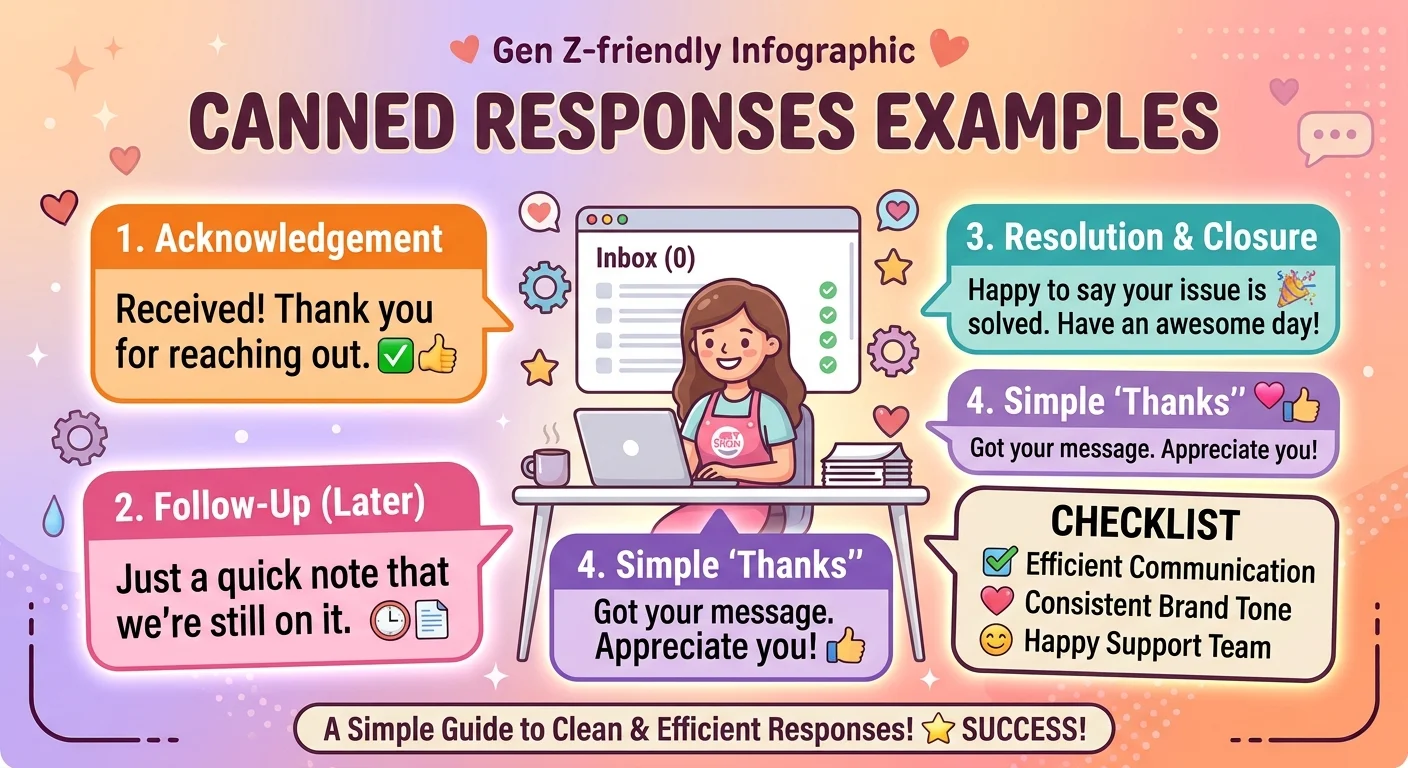
The best canned responses examples are short, warm, and specific, like “Thanks for reaching out, I’m on it,” “Happy to help with that,” “Got your message and will reply by 5,” “Sorry for the delay, here’s an update,” and “Appreciate your patience while I check.”
You’re juggling twelve DMs, three emails, and a support queue that will not quit, and suddenly you type the same sentence for the fifth time. That’s exactly where canned responses examples save your day. They keep your replies fast, consistent, and still sound like a real person instead of a copy paste robot.
The catch is that a lazy template reads cold, and customers notice instantly. A well built one feels personal, solves the problem faster, and protects your energy. This guide gives you 180+ ready to use templates sorted by tone and situation, from friendly support replies to professional follow ups. Steal them, tweak them, and stop retyping the same thing forever.
Professional and Business Responses
- “Thank you for reaching out. I am reviewing your request and will follow up within one business day.”
Example: When a client emails a detailed project question.
Meaning: It confirms receipt and sets a clear expectation. - “Thanks for your message. I have shared this with the relevant team and will update you shortly.”
Example: When a request needs input from another department.
Meaning: It shows action instead of a vague acknowledgment. - “We appreciate your patience while we look into this for you.”
Example: When a customer follows up on an open ticket.
Meaning: It acknowledges the wait and reassures them. - “Thank you for the details. I can confirm we have everything we need to proceed.”
Example: When a client sends documents you requested.
Meaning: It closes the loop and removes uncertainty. - “Your request has been received and logged under reference 4821.”
Example: When a formal complaint needs tracking.
Meaning: It gives them something concrete to reference later. - “I understand your concern and I want to resolve this quickly. Here is what happens next.”
Example: When a customer reports a problem with an order.
Meaning: It moves from acknowledgment into a clear next step. - “Thank you for bringing this to our attention. Our team is on it.”
Example: When a customer flags an error.
Meaning: It shows ownership without overpromising. - “I have escalated this to a senior team member who will contact you today.”
Example: When an issue is above your authority level.
Meaning: It tells them exactly what changed and when to expect contact. - “We have processed your request. Please allow up to 48 hours for confirmation.”
Example: When an action is complete but not yet visible.
Meaning: It prevents unnecessary follow up messages. - “Thank you for your feedback. It has been passed to the product team.”
Example: When a user suggests a new feature.
Meaning: It validates their input and shows the right channel. - “I am sorry for the inconvenience. We have corrected the issue on our end.”
Example: When a mistake was genuinely yours.
Meaning: It owns the error and reports the fix. - “Thank you for choosing us. Please let me know if there is anything else I can help with.”
Example: When closing out a resolved conversation.
Meaning: It ends warmly while keeping the door open.
Customer Support Responses
- “Hi there, thanks for getting in touch. I would be happy to help with this.”
Example: When a support chat opens with a new question.
Meaning: It sets a friendly, helpful tone immediately. - “I can see your order status right here. Let me walk you through it.”
Example: When a customer asks where their package is.
Meaning: It signals competence and reduces frustration. - “Sorry to hear that did not work. Let us try a quick fix together.”
Example: When a customer reports a technical hiccup.
Meaning: It frames troubleshooting as teamwork. - “I have reset your account. Please try logging in again and let me know how it goes.”
Example: When someone is locked out.
Meaning: It gives a clear action and invites a follow up. - “Thanks for confirming. I have updated your details now.”
Example: When a customer corrects their address or email.
Meaning: It confirms the change so they stop worrying. - “That sounds frustrating. I am going to check this with our technical team.”
Example: When the issue is unusual and needs escalation.
Meaning: It validates the emotion before acting. - “Good news, your refund has been approved and should appear in 3 to 5 business days.”
Example: When a refund request is settled.
Meaning: It delivers the outcome with realistic timing. - “I have applied a discount to your next order as an apology for the delay.”
Example: When a delivery ran late.
Meaning: It turns an apology into something tangible. - “You are all set. Is there anything else I can help you with today?”
Example: When a ticket is fully resolved.
Meaning: It closes cleanly without leaving loose ends. - “I have sent the replacement out today. You will get tracking by email shortly.”
Example: When a product arrived damaged.
Meaning: It shows action and manages expectations. - “Thanks for your patience. I have now fixed the billing error on your account.”
Example: When a customer was overcharged.
Meaning: It confirms the fix after a wait. - “I completely understand. Let me check what options we have for you.”
Example: When a customer is upset and unsure what to do.
Meaning: It stays calm and collaborative.
Sales and Lead Follow Up Responses
- “Thanks for your interest. I would love to learn more about what you are looking for.”
Example: When a new lead fills out a contact form.
Meaning: It opens the conversation with genuine curiosity. - “Great to hear from you. Here is a quick overview of how we can help.”
Example: When someone asks about your services.
Meaning: It gives value upfront instead of a sales pitch. - “Just following up on my last message. Happy to answer any questions.”
Example: When a prospect has gone quiet for a few days.
Meaning: It nudges gently without pressure. - “Thanks for the details. I will put together a quote and send it over today.”
Example: When a lead shares their requirements.
Meaning: It commits to a clear deliverable and timeline. - “Would Thursday or Friday work better for a quick call?”
Example: When scheduling an intro conversation.
Meaning: It makes booking easy with a simple choice. - “I have attached the proposal. Let me know what questions come up.”
Example: When sending pricing or scope documents.
Meaning: It invites dialogue instead of a silent yes or no. - “No rush at all. Whenever you are ready, I am here.”
Example: When a lead is still deciding.
Meaning: It removes pressure and builds goodwill. - “Thanks for your time today. Here is a quick recap of what we discussed.”
Example: After a discovery call.
Meaning: It keeps the conversation documented and clear. - “If the timing is not right, I am happy to check back in next quarter.”
Example: When a lead is interested but not ready.
Meaning: It keeps the door open without chasing. - “Is there anything holding you back that I can help clarify?”
Example: When a deal stalls silently.
Meaning: It surfaces objections politely. - “Congrats on the launch. Reaching out in case this is now on your radar.”
Example: When a company hits a milestone.
Meaning: It makes the follow up feel timely and relevant. - “Thanks for considering us. Happy to send a couple of similar case studies.”
Example: When a prospect wants proof.
Meaning: It offers evidence without overwhelming them.
Email and DM Responses
- “Thanks for the message. I will get back to you properly by end of day.”
Example: When a DM arrives mid task and you cannot reply fully yet.
Meaning: It buys time while keeping you responsive. - “Got it, thank you. I am looking into this now.”
Example: When you need a two second acknowledgment.
Meaning: It confirms receipt without leaving them hanging. - “Thanks for flagging this. Could you send a screenshot when you get a chance?”
Example: When the issue is unclear from text alone.
Meaning: It requests the detail you actually need. - “Noted, and I will include this in tomorrow’s update.”
Example: When a colleague adds a last minute request.
Meaning: It confirms the item is captured. - “Appreciate the quick reply. That clears things up.”
Example: When someone answers your question fast.
Meaning: It closes the exchange politely. - “Sorry for the slow reply, I was away from my inbox. Here is my answer.”
Example: When you take a day to respond.
Meaning: It acknowledges the delay without excuses. - “Thanks for the intro. Moving you both to one thread now.”
Example: When an email introduction is complete.
Meaning: It tidies the conversation and keeps everyone included. - “I would rather reply properly than quickly. Give me a few hours.”
Example: When a complex question needs thought.
Meaning: It signals care and honesty. - “Just bumping this in case it got buried. No rush.”
Example: When a polite reminder is needed.
Meaning: It nudges without sounding demanding. - “Thanks for following up. I have attached what you asked for.”
Example: When someone chases a document.
Meaning: It responds with action instead of apology alone. - “Hope you do not mind the quick voice note instead of a long email.”
Example: When explaining something is faster by voice.
Meaning: It offers efficiency and a human touch. - “Happy to jump on a call if that is easier than typing.”
Example: When the thread is getting long.
Meaning: It offers a shortcut to resolution.
Polite and Formal Responses
- “Thank you for your correspondence. We will respond in due course.”
Example: When a formal letter arrives at a company inbox.
Meaning: It acknowledges receipt in a suitably formal tone. - “We kindly request that you allow up to five business days for processing.”
Example: When a request has a defined timeline.
Meaning: It sets a clear expectation politely. - “Thank you for your patience and understanding regarding this matter.”
Example: When a delay was outside your control.
Meaning: It thanks them for grace without overexplaining. - “I regret that we are unable to accommodate this request at present.”
Example: When declining a request formally.
Meaning: It delivers a no with courtesy intact. - “Please find the requested documentation attached for your reference.”
Example: When sending official paperwork.
Meaning: It is clean, clear, and professional. - “Thank you for bringing this to our attention. We are reviewing the matter.”
Example: When a formal complaint is submitted.
Meaning: It shows the matter is being handled seriously. - “We appreciate your continued support and look forward to assisting you.”
Example: When closing a formal client email.
Meaning: It ends on a courteous note. - “Kindly confirm receipt of this message at your earliest convenience.”
Example: When documentation needs a confirmation.
Meaning: It requests an acknowledgment without pressure. - “Please do not hesitate to contact us should you require further assistance.”
Example: When wrapping up a formal exchange.
Meaning: It offers continued help in standard professional language. - “We apologise for any inconvenience this may have caused.”
Example: When a formal apology is required.
Meaning: It addresses the disruption respectfully. - “Thank you for your enquiry. We will be in touch shortly.”
Example: When a formal inquiry comes through a website form.
Meaning: It confirms receipt with professional warmth. - “Your feedback has been noted and forwarded to the relevant department.”
Example: When a formal complaint needs routing.
Meaning: It shows the message was handled properly.
Friendly and Warm Responses
- “Hi! Thanks so much for reaching out. I am excited to help.”
Example: When a customer’s first message is cheerful.
Meaning: It matches their energy and feels welcoming. - “Thanks for the note. This genuinely made my day.”
Example: When a customer sends a compliment.
Meaning: It responds with real warmth instead of a template. - “So happy to hear from you. Let me take a look.”
Example: When a familiar customer returns.
Meaning: It makes them feel remembered and valued. - “Absolutely, happy to help with that. Give me a moment.”
Example: When a request is easy to solve.
Meaning: It signals willingness and quick action. - “Thanks for being so patient with us. It means a lot.”
Example: When a customer waited longer than usual.
Meaning: It acknowledges their grace sincerely. - “That is a great question. Let me get you a proper answer.”
Example: When someone asks something thoughtful.
Meaning: It compliments them and commits to accuracy. - “You are welcome, and thanks for the kind words back.”
Example: When a customer thanks you at the end.
Meaning: It keeps the exchange warm rather than transactional. - “Hope your week is going well. Here is the update you asked for.”
Example: When sending a routine follow up.
Meaning: It adds a human touch to a standard message. - “Thanks for trusting us with this. We will take good care of it.”
Example: When a customer hands over something important.
Meaning: It reassures them with care. - “We love hearing from you. Keep the questions coming.”
Example: When a repeat customer checks in often.
Meaning: It encourages engagement in a friendly way. - “Thanks for the quick turnaround on your side. Really appreciated.”
Example: When a customer responded fast.
Meaning: It reciprocates their efficiency with gratitude. - “Anytime! That is what we are here for.”
Example: When a customer apologizes for asking a question.
Meaning: It removes guilt and reinforces helpfulness.
Short and Quick Responses
- “On it!”
Example: When a task is simple and you want to confirm fast.
Meaning: It signals immediate action in two words. - “Got it, thanks.”
Example: When you need to acknowledge a message quickly.
Meaning: It confirms receipt without fuss. - “Will do.”
Example: When someone asks for a small follow up.
Meaning: It agrees cleanly and confidently. - “Sure thing.”
Example: When a request is easy to say yes to.
Meaning: It keeps the tone casual and cooperative. - “Noted.”
Example: When someone shares information you need to track.
Meaning: It confirms you have logged it. - “Looking now.”
Example: When you are checking something as you type.
Meaning: It reassures them you are actively on it. - “Thanks for flagging.”
Example: When someone points out an issue.
Meaning: It acknowledges their catch without extra words. - “Will check and revert.”
Example: When you need to investigate before answering.
Meaning: It sets a clear plan in minimal language. - “Happy to help.”
Example: When someone thanks you for support.
Meaning: It responds graciously in three words. - “All set.”
Example: When a request has been completed.
Meaning: It confirms completion clearly. - “You got it.”
Example: When agreeing to a small favor.
Meaning: It is friendly and immediate. - “Thanks for the heads up.”
Example: When someone warns you about a change.
Meaning: It appreciates the information briefly.
Funny and Playful Responses
- “Your message has been received by a human who is currently caffeinating.”
Example: When an early morning DM lands before you are functional.
Meaning: It is honest and funny instead of cold. - “Thanks for reaching out! I have read this three times to be sure I got it right.”
Example: When a customer sends a complicated request.
Meaning: It shows care with a light self aware joke. - “We reply fast, but our reply speed depends on the coffee level.”
Example: When a customer compliments your quick responses.
Meaning: It keeps things charming and relatable. - “Your patience is appreciated and will be rewarded with a good answer.”
Example: When you need a few minutes to investigate.
Meaning: It makes waiting feel lighter. - “Consider this your official confirmation and also a virtual high five.”
Example: When confirming a booking or order.
Meaning: It adds personality to a routine update. - “Thanks for the message. My inbox and I are both thrilled.”
Example: When business is busy and someone finally replies.
Meaning: It jokes about volume without complaining. - “I have escalated this to the highest authority. It is me, after coffee.”
Example: When you are handling the request yourself.
Meaning: It is playful while still showing ownership. - “Your feedback has been accepted with grace and mild embarrassment.”
Example: When a customer points out a small mistake.
Meaning: It owns the error with humor. - “We would love to help. Please allow 3 to 5 business days for excitement.”
Example: When someone asks about a new product.
Meaning: It builds anticipation with a wink. - “Noted and saved forever in the ‘customers who get it’ folder.”
Example: When a customer is especially kind.
Meaning: It makes them feel seen and appreciated. - “Thanks for the nudge. My to do list has been informed.”
Example: When someone politely chases you.
Meaning: It acknowledges the reminder with a grin. - “Apologies for the delay. Time zones and snacks were involved.”
Example: When a reply comes later than expected.
Meaning: It apologizes without sounding careless.
Empathetic and Emotional Responses
- “I am really sorry you are dealing with this. Let me help however I can.”
Example: When a customer reports a stressful problem.
Meaning: It leads with empathy instead of process. - “That sounds genuinely frustrating. Thank you for telling us.”
Example: When a user vents about a bad experience.
Meaning: It validates the feeling before fixing anything. - “I can hear how much this matters to you. I will treat it that way.”
Example: When a complaint involves something personal.
Meaning: It signals care and accountability. - “You have every right to be upset. Here is what I am doing about it.”
Example: When a mistake caused real inconvenience.
Meaning: It acknowledges fault and moves to action. - “Thank you for trusting us with this. We will handle it carefully.”
Example: When a customer shares sensitive information.
Meaning: It reassures them with a gentle tone. - “I am sorry this has taken so long. Your patience has been noted.”
Example: When a ticket dragged on.
Meaning: It owns the delay and honors their patience. - “That is a completely understandable reaction. Let us sort it together.”
Example: When a customer is emotional but calm.
Meaning: It normalizes their response and offers partnership. - “We let you down here and I want to make it right.”
Example: When the failure was clearly on your side.
Meaning: It delivers an honest, direct apology. - “I am glad you told us. This is how we get better.”
Example: When a customer shares difficult feedback.
Meaning: It frames criticism as valuable. - “Take your time. I am here when you are ready.”
Example: When a customer needs a moment.
Meaning: It removes pressure and shows patience. - “I have been there too. Let me see what I can do.”
Example: When a customer describes a familiar struggle.
Meaning: It builds connection through shared experience. - “Thank you for being so understanding. It genuinely helps.”
Example: When a customer stays calm through a delay.
Meaning: It appreciates their grace sincerely.
Creative and Branded Responses
- “Thanks for reaching out! You have officially joined our favorite people list.”
Example: When a new subscriber sends their first message.
Meaning: It makes a routine welcome feel memorable. - “Message received. Our team is now in full problem solving mode.”
Example: When a support request comes in.
Meaning: It uses brand voice to show action. - “We treat every message like a tiny mission. Yours is now in progress.”
Example: When responding to an inquiry.
Meaning: It adds personality while confirming next steps. - “Consider this your green light. We are on it.”
Example: When approving a request.
Meaning: It confirms clearly with a bit of style. - “Thanks for the note. We are reading every word, twice.”
Example: When a customer sends detailed feedback.
Meaning: It shows attentiveness in a memorable way. - “Your order is in good hands. Ours, specifically.”
Example: When confirming a purchase.
Meaning: It reassures with a friendly flourish. - “You just made our daily highlight reel. Thanks for this.”
Example: When a customer sends praise.
Meaning: It responds in brand voice without sounding canned. - “Here is your update, freshly prepared and ready to read.”
Example: When sending a status message.
Meaning: It makes routine communication feel intentional. - “Thanks for the message. We are answering this one with extra care.”
Example: When a request is important to the customer.
Meaning: It signals attention and warmth. - “We are on the case. Capes optional, results guaranteed.”
Example: When handling a troubleshooting request.
Meaning: It brings playfulness without overpromising. - “Your feedback has been filed under ‘things we are fixing today’.”
Example: When a customer reports a small bug.
Meaning: It shows responsiveness with a wink. - “Welcome aboard. Buckle up, we reply fast around here.”
Example: When a new customer sends their first message.
Meaning: It sets expectations with charm.
Confident and Reassuring Responses
- “You are in the right place. This is exactly what we do.”
Example: When a customer asks if you handle their type of request.
Meaning: It removes doubt immediately. - “I can take care of this for you. No need to follow up.”
Example: When a request falls within your remit.
Meaning: It removes their worry about chasing. - “Consider it handled. I will confirm once it is done.”
Example: When you have taken ownership of a task.
Meaning: It shows accountability with a clear follow up. - “We have solved this before and we will solve it now.”
Example: When a customer describes a known issue.
Meaning: It builds confidence through experience. - “I have personally checked this and it is correct.”
Example: When accuracy is critical.
Meaning: It signals genuine verification. - “Rest assured, your request is in good hands.”
Example: When a customer is anxious about an outcome.
Meaning: It calms nerves with a steady tone. - “We will not leave you waiting without an update.”
Example: When a resolution will take time.
Meaning: It promises communication, not just results. - “That is a fair question and here is the honest answer.”
Example: When a customer asks something tricky.
Meaning: It builds trust through transparency. - “I have flagged this as a priority. You will hear from me today.”
Example: When speed matters to the customer.
Meaning: It communicates urgency and commitment. - “You can count on us to see this through.”
Example: When a project spans several steps.
Meaning: It reassures them of follow through. - “We would rather tell you the truth than tell you what you want to hear.”
Example: When expectations need managing.
Meaning: It earns trust through honesty. - “This is now my responsibility, so you can stop worrying about it.”
Example: When a customer is stressed about details.
Meaning: It offers relief by taking ownership.
Follow Up and Reminder Responses
- “Just checking in to see if you need anything else from us.”
Example: When a project has wrapped but the relationship continues.
Meaning: It shows continued interest without pushing. - “A quick reminder that your appointment is tomorrow at 10.”
Example: When a booking is coming up.
Meaning: It reduces no shows with a simple nudge. - “Following up on my previous message in case it slipped past.”
Example: When an email went unanswered.
Meaning: It is polite and non accusatory. - “Your quote is ready. Let me know if you would like to discuss it.”
Example: When pricing has been sent.
Meaning: It invites conversation rather than a silent decision. - “This is a friendly reminder that your subscription renews on Friday.”
Example: When a billing date is approaching.
Meaning: It avoids surprise charges and builds trust. - “Checking in to confirm you received the documents we sent.”
Example: When delivery confirmation matters.
Meaning: It verifies receipt without assuming. - “We have not heard back, so I wanted to make sure nothing got stuck.”
Example: When a customer goes quiet mid process.
Meaning: It frames the nudge helpfully. - “Here is a quick status update on your request.”
Example: When a task is still in progress.
Meaning: It keeps the customer informed without being asked. - “Just a heads up that we will need your confirmation by Thursday.”
Example: When a deadline affects next steps.
Meaning: It gives clear notice with a specific date. - “Your feedback form is ready whenever you have two minutes.”
Example: When requesting a review after service.
Meaning: It is easy and low pressure. - “We are closing this ticket, but you can reopen it anytime.”
Example: When a resolved case wraps up.
Meaning: It gives the customer control and a clear next step. - “Thanks again for your business. We will check in next month.”
Example: When ending a completed project.
Meaning: It sets a warm, predictable follow up rhythm.
Internal Team Responses
- “Thanks for the update. I will pick this up from here.”
Example: When a teammate hands off a task.
Meaning: It confirms ownership and reduces duplicated work. - “Got it. Adding this to the shared doc now.”
Example: When a colleague shares new information.
Meaning: It confirms the detail will not get lost. - “Quick heads up, this one is time sensitive.”
Example: When flagging urgency in a team channel.
Meaning: It communicates priority without alarm. - “I will need until Thursday to finish this properly.”
Example: When a deadline is unrealistic.
Meaning: It sets an honest boundary early. - “Can you confirm you have everything you need from me?”
Example: When handing off before a deadline.
Meaning: It prevents gaps before they cause delays. - “Thanks for catching that. Fixing now.”
Example: When someone spots your mistake.
Meaning: It owns the error quickly and politely. - “I have looped in the design team so we are all aligned.”
Example: When a project crosses departments.
Meaning: It keeps communication open and transparent. - “Noted for the next sprint. Adding it to the backlog.”
Example: When a request is valid but not urgent.
Meaning: It captures the idea without derailing current work. - “This is ready for your review whenever you have a moment.”
Example: When sending work for approval.
Meaning: It respects their time while keeping momentum. - “Happy to take this one if you are overloaded.”
Example: When a teammate is stretched thin.
Meaning: It offers support without being asked. - “Just flagging that this is outside my area, so I have tagged the right person.”
Example: When a request belongs to another team.
Meaning: It routes the work efficiently and honestly. - “Thanks everyone, that was a smooth handoff.”
Example: When a multi person task completes cleanly.
Meaning: It reinforces good collaboration.
FAQ and Knowledge Base Responses
- “Thanks for asking. Here is a quick answer along with a link to the full guide.”
Example: When a common question comes through support.
Meaning: It solves the issue fast and points to more detail. - “Great question. This is covered in our help center under Billing.”
Example: When a user asks a documented question.
Meaning: It answers and teaches them where to look next time. - “Here are the three steps to fix that. Let me know if any step is unclear.”
Example: When a technical issue has a known fix.
Meaning: It gives structured help without overwhelming them. - “Short answer: yes. Longer answer: here is how it works.”
Example: When a question needs nuance.
Meaning: It delivers the answer first and context second. - “That feature is on our roadmap. I have added your vote to it.”
Example: When a user requests something not yet built.
Meaning: It validates the request and shows it counts. - “This is a known issue and our team is working on a fix.”
Example: When multiple users report the same bug.
Meaning: It reduces duplicate reports and builds patience. - “Here is a step by step guide you can follow along with.”
Example: When onboarding a new user.
Meaning: It makes self service easy and clear. - “You can find that in Settings under Notifications.”
Example: When a user cannot locate a feature.
Meaning: It gives an exact location instead of a general hint. - “The answer depends on your plan. Here are the differences.”
Example: When a question varies by tier.
Meaning: It prevents confusion and follow up messages. - “Thanks for the suggestion. I have shared it with the product team.”
Example: When a user proposes an improvement.
Meaning: It shows their input reaches decision makers. - “This article covers it in detail, and I am happy to explain further if needed.”
Example: When documentation exists but the user wants a person.
Meaning: It balances self service with human support. - “Here is a quick summary in case the full guide is too long.”
Example: When the documentation is lengthy.
Meaning: It respects their time while still being thorough.
Onboarding and Welcome Responses
- “Welcome aboard! Here is everything you need to get started.”
Example: When a new customer signs up.
Meaning: It sets a confident, organized first impression. - “So glad you are here. Your first step is to complete your profile.”
Example: When a new user needs direction.
Meaning: It gives one clear action instead of a list. - “Thanks for joining us. I have attached a quick start guide.”
Example: When onboarding a new client.
Meaning: It provides support without overwhelming them. - “You are all set up. Here is what to expect next.”
Example: When an account is activated.
Meaning: It removes uncertainty after a signup. - “Welcome! Your onboarding call is booked for Monday at 2.”
Example: When scheduling an intro session.
Meaning: It confirms the next step clearly. - “Great to have you with us. Here are three tips that help most new users.”
Example: When a new customer starts using the product.
Meaning: It offers practical value early on. - “Thanks for completing your details. We are preparing your setup now.”
Example: When a form has been submitted.
Meaning: It confirms progress so they do not wonder. - “Your account is ready. Log in anytime and explore at your own pace.”
Example: When access has been granted.
Meaning: It reduces pressure and invites exploration. - “Welcome to the community. Here is where to find help if you need it.”
Example: When a new user joins a platform.
Meaning: It points them to support without a wall of text. - “First step done! Here is what comes next in your setup.”
Example: When a new user completes step one.
Meaning: It keeps momentum with a clear path forward. - “Thanks for choosing us. We will check in next week to see how it is going.”
Example: When onboarding is complete.
Meaning: It sets a supportive follow up expectation. - “You are in good company. Here are a few customers who started where you are.”
Example: When a new client needs reassurance.
Meaning: It builds confidence through social proof.
Apology and Recovery Responses
- “I am sorry for the mix up. We have corrected it and here is what happened.”
Example: When an order or booking went wrong.
Meaning: It owns the error and explains briefly. - “That is not the experience we want you to have. Let me fix this today.”
Example: When a customer reports poor service.
Meaning: It sets a standard and commits to action. - “We got this wrong. Your refund has been processed in full.”
Example: When the failure was clearly yours.
Meaning: It apologizes with a concrete remedy. - “Thank you for giving us the chance to make it right.”
Example: When a customer stays after a mistake.
Meaning: It appreciates their patience sincerely. - “I understand why you are upset. Here is how we are preventing this from happening again.”
Example: When a repeat issue occurred.
Meaning: It shows learning rather than a bare apology. - “Sorry for the confusion. Let me clarify exactly what happened.”
Example: When a message was unclear.
Meaning: It clears up the misunderstanding calmly. - “We have added a credit to your account as an apology for the disruption.”
Example: When a delay caused real inconvenience.
Meaning: It backs the apology with something tangible. - “I take full responsibility for this. Here is my direct contact if anything else comes up.”
Example: When a high value client is affected.
Meaning: It builds trust through accountability. - “Thank you for your honesty. It helps us fix things faster.”
Example: When a customer points out a failure.
Meaning: It reframes criticism as useful. - “Your issue is now resolved. I am sorry it took longer than it should have.”
Example: When a fix finally lands.
Meaning: It confirms resolution and owns the delay. - “We are reviewing our process so this does not repeat.”
Example: When a systemic problem caused the issue.
Meaning: It signals long term improvement. - “Thank you for sticking with us. We do not take that lightly.”
Example: When a customer stays after a rough patch.
Meaning: It honors their loyalty with humility.
FAQs
What are canned responses examples?
They are ready made reply templates you reuse for common messages, like support questions, follow ups, and onboarding notes.
Can canned responses sound flirty or personal?
They can sound warm and friendly, but keep romance out of business replies. Personal touches like using a name are fine and helpful.
Are canned responses okay in professional settings?
Yes, as long as you personalize them. Templates save time, but every reply should still fit the specific situation.
What if I don’t actually mean the template I sent?
Send a short follow up that clarifies. A simple “To add to that” message keeps things honest without drama.
Is humor appropriate in canned responses?
Only when your brand voice supports it. Keep jokes brief and make sure the actual answer is still clear.
How do I stop canned responses from feeling robotic?
Add a name, reference their exact issue, and vary your openings. Small edits make a template feel human.
Conclusion
Canned responses examples are not about sounding automated. They are about saving your time so you can spend it on the parts of a conversation that actually need a human. A strong template answers the question, sets expectations, and still leaves room for personality. Get that balance right and your replies feel faster, warmer, and more reliable at the same time.
Save this list, keep it open during busy hours, and tweak the wording until it sounds like you. Share it with a teammate who types the same paragraph fifty times a day. Try one new template this week and watch how much time it gives back.
