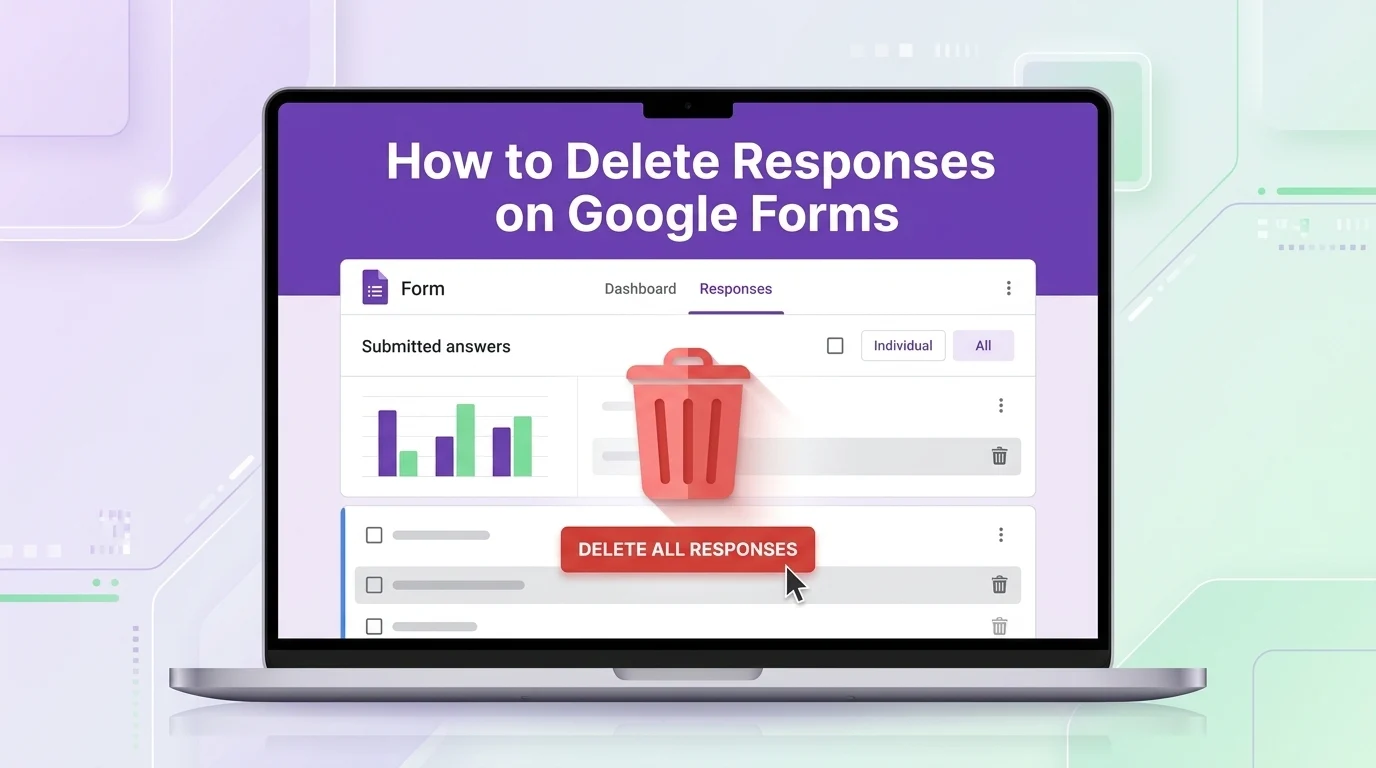
To delete responses on Google Forms, go to the “Responses” tab, click the three-dot menu, and select “Delete all responses.” For individual entries, click the trash can icon next to the specific response, or unlink the form from its spreadsheet for a fresh start.
You just finished collecting RSVPs for your party, and now you’re stuck staring at a messy spreadsheet full of test entries and duplicate names. Or maybe you sent out a work survey and realized the questions were totally wrong after 50 people already replied. We have all been there, and it is honestly a vibe killer.
Knowing how to delete responses on Google Forms is a superpower for anyone who works with data, plans events, or runs a business. It is not just about cleaning up a mess; it is about maintaining your privacy and making sure your data is actually useful. Whether you are a student, a teacher, or a corporate boss, you need a clean slate sometimes.
The good news? You do not need to be a tech genius to figure this out. In fact, the process is way simpler than you think, and once you know the shortcuts, you will feel like a total pro. Let’s dive into the best hacks, tips, and methods to clear your forms without breaking a sweat.
Funny Responses
- My digital eraser is ready.
- Example: Use this when you are about to clear a bunch of embarrassing test submissions.
- Meaning: A playful way to announce you are starting the cleanup process.
- Bye bye, data!
- Example: Perfect for when you are deleting a form that got way too many troll answers.
- Meaning: A lighthearted farewell to the information you no longer need.
- Ctrl + Z for life, please.
- Example: Use this when you realize you accidentally deleted the wrong row and need to undo it.
- Meaning: Joking about wanting a universal undo button for mistakes.
- Decluttering my digital closet.
- Example: Ideal for when you are purging old forms to make the dashboard look neat.
- Meaning: Comparing data cleanup to organizing your messy room.
- This form is so last season.
- Example: Use when you are deleting an old survey to make room for a new one.
- Meaning: Justifying the deletion by saying the old content is outdated.
- Ghosting the responses.
- Example: When you delete replies without reading them because you do not care.
- Meaning: Using dating slang to describe ignoring data.
- Hasta la vista, baby.
- Example: A dramatic way to say goodbye to a long list of responses.
- Meaning: A pop culture reference to terminating the data.
- My OCD is satisfied now.
- Example: When you delete the messy duplicate entries to make the sheet look perfect.
- Meaning: Expressing relief at finally having a clean dataset.
- The purge has begun.
- Example: Use this when you are doing a massive cleanup of multiple forms.
- Meaning: A dramatic, movie-style reference to the deletion process.
- Oops, I did it again.
- Example: When you accidentally delete a response you actually needed to keep.
- Meaning: A humorous nod to making a clumsy mistake.
- Data diet in progress.
- Example: When you are reducing file size by deleting old responses.
- Meaning: Comparing deletion to losing weight for your digital files.
- Clean sweep!
- Example: Celebrating the end of the deletion task.
- Meaning: A phrase indicating the job is done and the mess is gone.
Brutal Responses
- Just hit delete already.
- Example: Telling a friend to stop hesitating and clear their form data.
- Meaning: Encouraging immediate action without overthinking.
- That data is useless.
- Example: When reviewing a form full of spam entries that need to go.
- Meaning: A direct way to justify removing low-quality information.
- No one needs that info.
- Example: When deleting fields that are irrelevant to the current project.
- Meaning: Highlighting the unimportance of the data being removed.
- Stop hoarding responses.
- Example: Addressing someone who keeps old surveys for no reason.
- Meaning: Confronting the habit of holding onto unnecessary digital clutter.
- Hit the trash can.
- Example: A literal instruction for someone struggling to find the delete button.
- Meaning: Directing someone to the most obvious solution.
- Wipe it clean.
- Example: When you want to start over completely from scratch.
- Meaning: A command to reset the form to zero responses.
- Zero out the list.
- Example: When you want the spreadsheet to be totally empty.
- Meaning: A technical way to say delete everything.
- Let it go.
- Example: A reference to the popular song to help someone move on from data.
- Meaning: Advising someone to stop clinging to old responses.
- Kill the duplicates.
- Example: When you need to remove redundant entries but keep the originals.
- Meaning: A strong command to remove extra copies.
- Terminate the test run.
- Example: When you are done testing the form and need to remove the dummy data.
- Meaning: Ending the test phase by deleting the evidence.
- Clear the clutter.
- Example: When your dashboard is too messy to read.
- Meaning: Removing the noise to focus on what matters.
- Peace out.
- Example: A quick way to say goodbye to the data forever.
- Meaning: A casual and final farewell.
Polite Responses
- Could you please clear that?
- Example: Politely asking a colleague to delete their test entries.
- Meaning: A gentle request for action.
- I would appreciate it if you removed this.
- Example: When you need someone to clean up a form they messed up.
- Meaning: A formal way to ask for deletion without being rude.
- Would you mind deleting those?
- Example: Asking a team member to remove outdated responses.
- Meaning: A courteous inquiry to get help with cleanup.
- It would be best to remove them.
- Example: Suggesting a course of action to a client.
- Meaning: A diplomatic way to recommend deletion.
- Please disregard the previous entries.
- Example: When you have already deleted the data and are informing the team.
- Meaning: Notifying others that the old data is gone.
- Kindly clear the sheet.
- Example: A formal instruction in an email.
- Meaning: A straightforward but respectful command.
- I suggest deleting the duplicates.
- Example: Offering advice during a meeting about data quality.
- Meaning: Providing a helpful recommendation.
- Thank you for clearing that.
- Example: Acknowledging someone who just deleted the data.
- Meaning: Showing gratitude for the action taken.
- Let us start fresh.
- Example: Proposing to delete everything and begin again.
- Meaning: A positive spin on the deletion process.
- We should remove the spam.
- Example: Discussing strategy with a co-worker.
- Meaning: Suggesting a necessary cleanup task.
- Please delete the test data.
- Example: Clear instructions to an assistant.
- Meaning: A precise request.
- I apologize for the error, let’s clear it.
- Example: Taking responsibility and fixing a mistake by deleting the wrong data.
- Meaning: Owning up to a mistake and correcting it.
Professional Responses
- We are resetting the dataset.
- Example: Announcing a data reset in a corporate meeting.
- Meaning: A formal statement about starting over.
- We have purged the invalid entries.
- Example: Reporting to a manager about data hygiene.
- Meaning: Confirming that bad data has been removed.
- We are scrubbing the records.
- Example: Describing the process of cleaning a database.
- Meaning: Using technical jargon for deleting and cleaning.
- Please archive the form before deletion.
- Example: Following company protocol for document retention.
- Meaning: A procedural step to ensure safety before deleting.
- We need to clear the queue.
- Example: In a customer service setting regarding support tickets.
- Meaning: Processing and removing items from a list.
- We are performing a data cleanup.
- Example: General description of the task during a status update.
- Meaning: A professional summary of the activity.
- The form has been reset to factory settings.
- Example: Informing a client that the form is ready for new data.
- Meaning: Indicating a complete wipe.
- Let’s remove the anomalous data points.
- Example: In an analytics discussion.
- Meaning: Removing outliers that skew the results.
- We are enforcing data retention policies.
- Example: During a compliance audit.
- Meaning: Deleting data according to legal requirements.
- The temporary data is being removed.
- Example: Explaining that a test phase is over.
- Meaning: Clearing out short-term information.
- We have cleaned the spreadsheet.
- Example: Simple status update to a team.
- Meaning: Confirming the data is tidy.
- Let’s initiate a hard delete.
- Example: Specific technical instruction in IT.
- Meaning: Permanently removing data without a backup.
Creative Responses
- Time for a digital spring cleaning.
- Example: Planning a session to organize all your online files.
- Meaning: A seasonal metaphor for cleaning.
- Shredding the paper trail.
- Example: Deleting documents that contain sensitive information.
- Meaning: Using a physical metaphor for digital deletion.
- Resetting the timeline.
- Example: When you want to undo a week of data collection.
- Meaning: A sci-fi reference to changing history.
- Nuking the site.
- Example: In a gaming context or casual talk about starting over.
- Meaning: A dramatic exaggeration of the deletion process.
- Making it rain… a clean slate.
- Example: A playful way to announce a new beginning.
- Meaning: Rhyming slang for a fresh start.
- Poof, it’s gone.
- Example: Using a magic metaphor when deleting something quickly.
- Meaning: Imitating a magic trick.
- Hitting the magic eraser.
- Example: Pretending the delete button is a magical tool.
- Meaning: Making the task feel fun and easy.
- Rebooting the matrix.
- Example: Joking about resetting reality.
- Meaning: A movie reference for a total reset.
- Sending the data to the recycle bin in the sky.
- Example: A humorous euphemism for permanent deletion.
- Meaning: A silly way to describe data loss.
- Triggering the self-destruct sequence.
- Example: When you need to delete something urgently.
- Meaning: A dramatic action movie reference.
- Clearing the cache of the past.
- Example: A poetic way to say you are moving on.
- Meaning: A metaphorical cleanup of history.
- Turning over a new leaf.
- Example: When you are ready to start collecting fresh data.
- Meaning: Idiom for a fresh start.
Sarcastic Responses
- Oh great, more data to delete.
- Example: When you see a huge list of responses you have to remove.
- Meaning: Expressing annoyance at the workload.
- Because I have nothing better to do.
- Example: When someone asks you to clean up a form for them.
- Meaning: Sarcastically agreeing to help.
- Love spending my time on this.
- Example: When you are stuck doing tedious cleanup work.
- Meaning: Sarcastic enthusiasm for a boring task.
- My favorite hobby is clicking trash cans.
- Example: When you have been deleting rows for an hour.
- Meaning: Irony about a repetitive task.
- Thanks for the extra work.
- Example: To someone who submitted a spam response.
- Meaning: Sarcastically thanking someone for creating a mess.
- I really enjoy losing important data.
- Example: After accidentally deleting a response you needed.
- Meaning: Sarcasm regarding a mistake.
- Best day ever.
- Example: When the system crashes while you are deleting data.
- Meaning: Heavy sarcasm about a bad situation.
- Wow, this is thrilling.
- Example: Commenting on the excitement of data management.
- Meaning: Irony about a mundane task.
- You shouldn’t have.
- Example: When someone sends you a form to clean up.
- Meaning: Sarcastic gratitude for an unwanted gift.
- I live for spreadsheets.
- Example: When you have to manually delete 500 rows.
- Meaning: Sarcasm about the joy of repetitive work.
- Could this get any better?
- Example: When the delete button freezes.
- Meaning: Questioning if the situation can get worse.
- I am having so much fun.
- Example: Deleting thousands of test entries.
- Meaning: The exact opposite of what you actually feel.
Cute Responses
- Making space for new memories.
- Example: When you are ready to collect fresh responses.
- Meaning: A sweet way to say you are moving forward.
- A little digital cleanup!
- Example: Feeling good after organizing your forms.
- Meaning: Positively framing the deletion task.
- Goodbye, old stuff.
- Example: Talking to your computer as you delete data.
- Meaning: A playful farewell to old files.
- Tidy desk, tidy mind.
- Example: Feeling accomplished after a cleanup.
- Meaning: Connecting digital cleanliness with mental peace.
- Fresh start vibes.
- Example: Excitement about starting over with a clean form.
- Meaning: Expressing excitement for the future.
- Matching my messy room, no more!
- Example: When you finally fix your messy dashboard.
- Meaning: Being happy about fixing a messy situation.
- Gotta catch ’em all… in the trash.
- Example: A Pokemon reference to collecting bad data.
- Meaning: Using pop culture to make the task fun.
- I am a wizard at this.
- Example: When you figure out a shortcut to delete data quickly.
- Meaning: Feeling magical about your efficiency.
- Cleaning up my act.
- Example: A pun on improving your behavior.
- Meaning: A playful way to say you are organizing.
- Bye, clutter!
- Example: Waving at the screen as you delete data.
- Meaning: Friendly goodbye to the digital mess.
- Squeaky clean.
- Example: Describing the form after you have deleted everything.
- Meaning: Indicates the item is clean and ready.
- All gone!
- Example: A cheerful announcement of completion.
- Meaning: Expressing joy that the task is finished.
Dramatic Responses
- The end is near!
- Example: When you are about to delete a form you worked on for months.
- Meaning: Exaggerating the importance of the deletion.
- Nothing will ever be the same.
- Example: After deleting a huge project.
- Meaning: Pretending the data loss is a life-changing event.
- I can’t believe I just did that.
- Example: Realizing you hit delete when you shouldn’t have.
- Meaning: Experiencing genuine shock.
- The final countdown.
- Example: Watching the progress bar as you delete data.
- Meaning: Creating suspense around the task.
- Everything is gone.
- Example: When the screen shows zero responses.
- Meaning: Stating the facts with high emotion.
- I am ruined.
- Example: After accidentally deleting important info.
- Meaning: Overreacting to a simple mistake.
- Why is life so hard?
- Example: When you can’t figure out how to delete one specific response.
- Meaning: Being overly dramatic about a tech issue.
- A piece of me has died.
- Example: Deleting a form that took all day to make.
- Meaning: Joking about emotional attachment to work.
- Save my soul.
- Example: Begging a tech-savvy friend to help you delete data.
- Meaning: A dramatic plea for assistance.
- I am in the dark here.
- Example: When you can’t find the delete button.
- Meaning: Exaggerating your confusion.
- This is my endgame.
- Example: Finding the final response to delete.
- Meaning: Treating the task like a movie finale.
- Goodbye, sweet world.
- Example: A dramatic send-off to the data.
- Meaning: A playful farewell.
Chill and Casual Responses
- Just clearing things up.
- Example: A simple response to a co-worker asking what you are doing.
- Meaning: Keeping the explanation brief.
- Time to clean house.
- Example: When you are tidying up your digital files.
- Meaning: A common phrase for organizing.
- Deleting some junk.
- Example: When you are removing spam responses.
- Meaning: Dismissing the data as unimportant.
- Taking out the trash.
- Example: When the delete button is the only option.
- Meaning: A relaxed metaphor for deletion.
- All done.
- Example: Confirming you finished the task.
- Meaning: A simple statement of completion.
- That was easy.
- Example: When the shortcut worked perfectly.
- Meaning: Expressing pleasant surprise.
- No worries.
- Example: When someone asks if you minded deleting the data.
- Meaning: Reassuring them it was not a problem.
- Easy peasy.
- Example: A cheerful way to confirm the deletion worked.
- Meaning: Rhyming slang for something simple.
- No big deal.
- Example: Downplaying the effort it took.
- Meaning: Indicating it was not hard.
- Sorted.
- Example: One-word confirmation of completion.
- Meaning: British slang for fixed or done.
- Done and dusted.
- Example: When the form is completely clean.
- Meaning: Finished and finalized.
- Cool cool cool.
- Example: A laid-back response to a successful deletion.
- Meaning: General agreement and satisfaction.
Confident Responses
- I have deleted the data.
- Example: A definitive statement to a supervisor.
- Meaning: Showing certainty in your action.
- Consider it done.
- Example: When someone asks you to clean the form.
- Meaning: A strong promise to complete the task.
- I took care of it.
- Example: Confirming the error has been fixed.
- Meaning: Asserting control over the situation.
- The form is clean now.
- Example: Reporting the status of the task.
- Meaning: Declaring success.
- I know how to handle this.
- Example: Reassuring a confused friend.
- Meaning: Projecting expertise.
- That is not a problem.
- Example: When asked if you can clear the database.
- Meaning: Dismissing any difficulty.
- I am on it.
- Example: Starting the cleanup process immediately.
- Meaning: Showing proactive action.
- Easy fix.
- Example: When the solution is obvious.
- Meaning: Minimalizing the complexity of the task.
- Leave it to me.
- Example: Taking responsibility for the deletion.
- Meaning: Delegating the task to yourself.
- It is already handled.
- Example: When someone asks too late.
- Meaning: Showing efficiency.
- I have got the hang of this.
- Example: After learning the process.
- Meaning: Displaying mastery.
- No backup needed.
- Example: When you are sure you want to delete permanently.
- Meaning: Showing decisive confidence.
Emotional Responses
- Letting go is hard.
- Example: When deleting a form with sentimental value.
- Meaning: Acknowledging the emotional weight.
- Goodbye, memories.
- Example: When clearing an old event sign-up.
- Meaning: Feeling nostalgic about the past.
- I feel lighter already.
- Example: Experiencing relief after deleting clutter.
- Meaning: Associating cleanliness with a better mood.
- It hurts to see it go.
- Example: Deleting positive feedback you worked hard for.
- Meaning: Feeling sadness at the loss.
- A necessary evil.
- Example: Accepting that you have to delete bad data.
- Meaning: Viewing the task as unfortunate but required.
- I didn’t want to do this.
- Example: Deleting a project due to budget cuts.
- Meaning: Expressing reluctance.
- But it was for the best.
- Example: Justifying the deletion after it’s done.
- Meaning: Finding peace with the decision.
- End of an era.
- Example: Shutting down a long-running survey.
- Meaning: Marking a significant transition.
- I am attached to this data.
- Example: Hesitating to delete older forms.
- Meaning: Feeling a connection to the information.
- Don’t make me do it.
- Example: Procrastinating on the cleanup.
- Meaning: Dreading the task.
- Okay, deep breath.
- Example: Preparing to hit the delete button.
- Meaning: Steadying yourself for a hard action.
- And it’s done.
- Example: A sigh of relief after the task.
- Meaning: Resignation and completion.
Sweet Responses
- Clearing the way for good things.
- Example: When preparing a form for a new project.
- Meaning: Optimism about the future.
- Just making things nice for you.
- Example: Cleaning up a shared form for a partner.
- Meaning: Doing it out of care.
- I hope this helps.
- Example: After clearing a colleague’s spreadsheet.
- Meaning: Showing support.
- A clean start for us.
- Example: Resetting a shared sign-up sheet.
- Meaning: Focus on teamwork.
- I took care of the mess.
- Example: Removing spam so others don’t see it.
- Meaning: Being helpful and protective.
- No need to thank me.
- Example: When someone says thanks for the cleanup.
- Meaning: Humble acceptance of praise.
- Consider it a favor.
- Example: Doing the dirty work for a friend.
- Meaning: Framing it as a nice gesture.
- All neat and pretty.
- Example: Presenting the clean form to a client.
- Meaning: Emphasizing aesthetics.
- I made it look brand new.
- Example: After deleting all the old responses.
- Meaning: Being proud of the result.
- Anything for you.
- Example: To a crush or close friend who asked for help.
- Meaning: Affectionate willingness to help.
- Just looking out for you.
- Example: Deleting embarrassing data before anyone sees it.
- Meaning: Acting protectively.
- Glad to help.
- Example: When you genuinely enjoy making things cleaner.
- Meaning: Positive reinforcement.
Clever Responses
- Gone in a flash.
- Example: When the process takes less than a second.
- Meaning: Highlighting the speed.
- Out with the old.
- Example: When you are ready for new responses.
- Meaning: A classic idiom.
- The invisible man approach.
- Example: When the data disappears without a trace.
- Meaning: Describing the disappearance.
- Digital detox.
- Example: When you need to clear out the system.
- Meaning: A modern term for cleanup.
- Vanishing act.
- Example: Deleting the data like a magician.
- Meaning: Comparing it to a magic trick.
- The kill switch has been flipped.
- Example: A dramatic way to say deletion is complete.
- Meaning: A technical metaphor.
- Data eviction.
- Example: Removing a row from the spreadsheet.
- Meaning: Comparing data to tenants.
- Terminated.
- Example: A sci-fi reference when you hit delete.
- Meaning: A cool way to say it is gone.
- Memory wipe successful.
- Example: When the form looks like it never had responses.
- Meaning: A robot-style confirmation.
- Target acquired… and eliminated.
- Example: When you find a specific row to delete.
- Meaning: Action movie style.
- System reboot.
- Example: Starting fresh after a full deletion.
- Meaning: Comparing it to restarting a computer.
- Clean slate protocol.
- Example: Initiating the deletion process.
- Meaning: A formal-sounding way to say “start over.”
FAQs
What does this phrase mean?
“How to delete responses on Google Forms” simply refers to the process of removing collected data from a form you have created.
Can I delete only one response?
Yes, you can! Just open the specific response and click the small trash can icon to remove that individual entry.
Is it possible to recover deleted responses?
Usually, no. Once you hit delete, the data is gone. You would need to use a browser extension or have linked it to a sheet that you haven’t updated yet.
Does deleting responses affect my Google Sheet?
If your form is linked to a spreadsheet, deleting responses in the form might not delete them in the sheet. You may need to edit the sheet separately.
Can I automate this?
Not natively. You have to manually click delete. However, you can delete all responses at once to save time.
Conclusion
Cleaning up your digital workspace is not just a chore; it is a way to keep your life organized and your data safe. Whether you choose a funny, polite, or direct approach, knowing how to delete responses on Google Forms gives you the control you need. It clears the clutter and lets you focus on the information that actually matters.
So, go ahead and try one of these methods today. Feel the satisfaction of a clean dashboard and a fresh start. If this guide helped you, share it with a friend who is struggling with a messy form. Save it for later and use it whenever you need to reset your data. You have got this!
