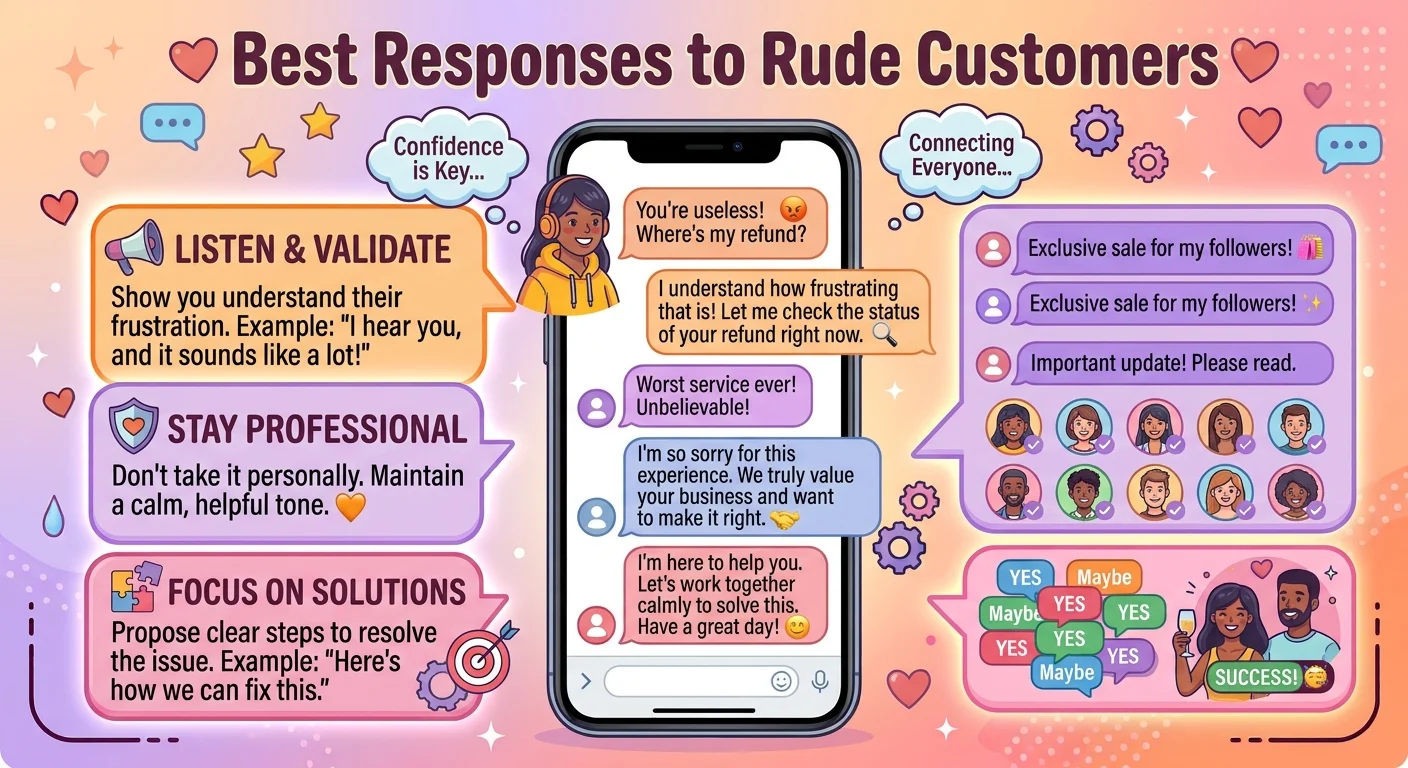
The best responses to rude customers are calm, professional one-liners that shut down disrespect without escalating the situation. Try: “I want to help you, but I need us to speak respectfully,” “Let me get a manager who can better assist you,” “I understand your frustration, but yelling won’t solve this faster,” “I’m ending this conversation until we can be civil,” or “I’ll do everything I can to fix this for you.”
You know that sinking feeling when a customer goes from zero to full-on meltdown in seconds? Whether you’re working retail, handling DMs, managing a restaurant, or running customer support, rude customers are an unavoidable part of the job. They snap, they yell, they type in all caps, and suddenly you’re standing there wondering how your day went sideways so fast.
Here’s the thing: you don’t have to absorb disrespect just because someone’s having a bad day. The best responses to rude customers protect your peace, keep your job safe, and sometimes even flip the entire interaction around. Knowing what to say (and what NOT to say) can be the difference between a full-blown scene and a calm, professional shutdown.
This guide is packed with ready-to-use replies for every mood, tone, and situation. Whether you want to stay professional, get a little witty, or firmly hold your ground, we’ve got you covered. Save this list. You’ll need it more than you think.
Funny Responses to Rude Customers
• “Sir, this is a place of business, not a WWE match.”
Example: When a customer starts raising their voice and getting theatrical over a minor issue.
Meaning: Uses humor to point out how dramatic they’re being without directly insulting them.
• “I get paid to help you, not to be your emotional punching bag.”
Example: Said with a polite smile when someone starts taking their bad day out on you.
Meaning: Lightly reminds them of boundaries while keeping things professional.
• “Wow, and I thought my Monday was rough.”
Example: When a customer is complaining aggressively about something small.
Meaning: Defuses tension by making a self-deprecating joke that shifts the energy.
• “Let me just check if my magic wand is working today.”
Example: When someone demands something impossible or unreasonable.
Meaning: Playfully calls out their unrealistic expectations without being confrontational.
• “You know what? You’re right. Let me fix that for you. Just kidding, but I will help.”
Example: When a customer is being unnecessarily sarcastic first.
Meaning: Matches their energy briefly before redirecting to actual help.
• “I’m sorry, my mind-reading app crashed. Can you tell me what’s wrong?”
Example: When a customer expects you to know exactly what they want without explaining.
Meaning: A playful way to ask for clarity without sounding annoyed.
• “I see we’re having a main character moment today.”
Example: When someone is acting like the entire world revolves around their problem.
Meaning: A Gen Z friendly way to call out self-centered behavior with humor.
• “That sounds like a ‘you’ problem, but I’m here to make it a ‘we’ solution.”
Example: When a customer blames you for something outside your control.
Meaning: Acknowledges the issue while staying committed to helping.
• “If yelling got things done faster, I’d have a megaphone by now.”
Example: When someone is escalating the volume instead of explaining the issue.
Meaning: Gently points out that volume doesn’t equal progress.
• “Good news: I can help. Bad news: You have to be nice to me first.”
Example: When a customer is being rude right out of the gate.
Meaning: Sets a playful but firm boundary about respectful communication.
• “Hold on, let me consult my ‘Dealing with Difficult People’ handbook.”
Example: When someone is being particularly unreasonable and you need a beat to breathe.
Meaning: Lightens the mood and signals that you’re handling their behavior with humor.
• “You know, I was having a great day. Then you walked in. But hey, let’s fix this!”
Example: Said with genuine warmth to a customer who’s clearly in a bad mood.
Meaning: Uses humor to acknowledge tension before pivoting to solutions.
Brutal Responses to Rude Customers (Use With Caution)
• “I’m here to help you, but I’m not here to be disrespected.”
Example: When a customer crosses the line with personal insults.
Meaning: A firm, non-negotiable boundary statement that shuts down disrespect instantly.
• “I’ll wait while you take a breath and try that again.”
Example: When someone speaks to you in a condescending or aggressive tone.
Meaning: Calmly calls out their behavior and gives them a chance to reset.
• “If you continue speaking to me like that, I will end this conversation.”
Example: When a customer is being verbally abusive and won’t calm down.
Meaning: A clear consequence that puts the ball in their court.
• “You don’t have to like the policy, but you do have to respect me.”
Example: When a customer is angry about rules and taking it out on you.
Meaning: Separates the issue from the person and enforces basic respect.
• “I’m going to need you to lower your voice or I can’t continue.”
Example: When a customer is yelling in a public space.
Meaning: A direct, professional way to de-escalate without matching their energy.
• “I want to resolve this for you, but I can’t do that if you’re attacking me.”
Example: When a customer is blaming you personally for a company issue.
Meaning: Redirects the conversation from personal attacks to solutions.
• “This conversation is over until you can speak to me like a person.”
Example: When you’ve tried everything and the customer refuses to be civil.
Meaning: A final boundary that protects your mental health and dignity.
• “I’m happy to transfer you to someone who can handle this. But first, let’s try again.”
Example: When a customer is being unreasonable but you want to give one last chance.
Meaning: Offers an out while giving them an opportunity to correct course.
• “You can be upset. You can’t be disrespectful.”
Example: When a customer tries to justify their rudeness with their frustration.
Meaning: Validates their emotion while drawing a clear line on behavior.
• “I’ve been patient. I’ve been polite. I’ve been professional. Now I need you to meet me halfway.”
Example: When you’ve endured a lot and it’s time to firmly address the dynamic.
Meaning: Acknowledges your own effort while demanding mutual respect.
• “The answer is still no, but the way you’re asking me won’t change that.”
Example: When a customer thinks being aggressive will get them a different result.
Meaning: Reinforces the decision while calling out unproductive behavior.
• “I’m going to step away for a moment and let you decide how you want to proceed.”
Example: When you need to remove yourself from an escalating situation.
Meaning: Gives you space while making it clear the ball is in their court.
Polite Responses to Rude Customers
• “I understand you’re frustrated, and I want to help. Let’s figure this out together.”
Example: When a customer is upset but hasn’t crossed the line into disrespect.
Meaning: Validates their feelings while keeping the focus on resolution.
• “I’m sorry you’re having a tough time. What can I do to make this better for you?”
Example: When a customer is clearly stressed and taking it out on you.
Meaning: Redirects their negative energy into a constructive question.
• “I hear you. Let me see what I can do.”
Example: When someone is venting and you need a simple, calming response.
Meaning: Shows you’re listening without promising something you can’t deliver.
• “Thank you for your patience. I know this isn’t ideal.”
Example: When a customer is waiting and getting antsy.
Meaning: Acknowledges their experience and buys you time.
• “I completely understand. Let me get someone who can help you better than I can.”
Example: When a customer is too escalated for you to handle alone.
Meaning: A graceful way to escalate while making them feel heard.
• “I appreciate you bringing this to our attention.”
Example: When a customer is complaining loudly but you need to stay professional.
Meaning: Turns their complaint into feedback and takes the sting out of the interaction.
• “I’m here to help, and I’ll do my best to resolve this for you.”
Example: When a customer is being demanding but you want to stay positive.
Meaning: Reassures them that you’re on their side without matching their energy.
• “Let me look into that for you right away.”
Example: When a customer is impatient and you need to buy time gracefully.
Meaning: Shows urgency and action while giving yourself breathing room.
• “I understand this is frustrating. Here’s what I can do for you.”
Example: When you need to redirect an angry customer toward a solution.
Meaning: Pivots from complaint mode to problem-solving mode.
• “I want to make sure I get this right for you. Can you tell me more?”
Example: When a customer is being vague and irritable.
Meaning: Encourages them to communicate clearly while showing you care.
• “I’m sorry for the inconvenience. Let’s get this sorted out.”
Example: When a customer is annoyed by a genuine mistake.
Meaning: Owns the issue without accepting abuse and moves toward a fix.
• “I appreciate your understanding. I’ll take care of this personally.”
Example: When a customer has been mildly rude but you want to extend goodwill.
Meaning: Rewards their cooperation and reinforces positive behavior.
Professional Responses to Rude Customers
• “I want to help you resolve this. Let’s keep our conversation productive.”
Example: In a corporate or formal setting when a customer is becoming unprofessional.
Meaning: Redirects the conversation back to the issue at hand.
• “I understand your concern. Let me escalate this to the appropriate team.”
Example: When a customer’s issue is beyond your authority.
Meaning: Shows you’re taking action and gets them the help they need.
• “I’m documenting this interaction and will follow up with a supervisor.”
Example: When a customer is being threatening or abusive.
Meaning: Signals that there will be accountability and consequences.
• “I want to ensure we find a resolution. What outcome are you hoping for?”
Example: When a customer is angry but hasn’t clearly stated what they want.
Meaning: Focuses the conversation on solutions instead of complaints.
• “I understand this is a priority for you. Here’s what we can do.”
Example: When a customer is being demanding in a formal business setting.
Meaning: Acknowledges urgency while setting realistic expectations.
• “I’ll need to review our policy on this. Can I put you on a brief hold?”
Example: When you need to step away from an aggressive customer.
Meaning: Buys you time to regroup and get support.
• “I’m happy to help, but I need to ask that we maintain a professional tone.”
Example: When a customer is being disrespectful in a business environment.
Meaning: A direct but polished boundary statement.
• “Your feedback is important. Let me make sure it’s properly recorded.”
Example: When a customer is complaining loudly and you need to redirect.
Meaning: Validates their input and documents the interaction.
• “I want to resolve this in a way that works for both of us.”
Example: When a customer is being difficult but you need a solution.
Meaning: Frames the conversation as a collaboration, not a battle.
• “I’m going to transfer you to a manager who can better address this.”
Example: When a customer demands someone higher up or you’re done being the target.
Meaning: A clean exit that gives the customer what they want.
• “I understand you’re unhappy. Let me connect you with someone who can help.”
Example: When a customer is too escalated for a standard resolution.
Meaning: Escalates the situation while maintaining professionalism.
• “Thank you for your feedback. I’ll make sure it’s passed along.”
Example: When a customer is being critical and you need a neutral closing statement.
Meaning: Ends the interaction gracefully without engaging further.
Sarcastic Responses to Rude Customers (For Your Inner Monologue)
• “Oh, absolutely. Let me bend the laws of physics for you.”
Example: When a customer demands something that’s literally impossible.
Meaning: A sarcastic way to point out the absurdity of their request.
• “I’m sorry, I forgot to bring my cape today.”
Example: When a customer expects you to perform miracles on demand.
Meaning: Playfully reminds them that you’re human, not a superhero.
• “You’re right. The customer is always right. Even when they’re screaming.”
Example: Said to a coworker after a particularly rough interaction.
Meaning: A venting joke that acknowledges the absurdity of the “customer is always right” rule.
• “Let me drop everything and cater to your every whim.”
Example: When a customer acts like they’re your only priority.
Meaning: A sarcastic callout that’s better said to yourself than out loud.
• “Wow, you must be exhausted from carrying all that entitlement.”
Example: Said internally when a customer is being outrageously demanding.
Meaning: A humorous way to process the frustration without saying it to their face.
• “I’ll get right on that. Right after I finish my other 47 tasks.”
Example: When a customer demands immediate attention for something non-urgent.
Meaning: A sarcastic reminder that you have other responsibilities.
• “I see you’ve completed your Karen training.”
Example: Said to a coworker after dealing with a difficult customer.
Meaning: A funny, internet-friendly way to vent about entitled behavior.
• “Please, tell me more about how the world owes you.”
Example: When a customer is acting like everything should be handed to them.
Meaning: A sarcastic way to point out their unreasonable expectations.
• “I’ll alert the media immediately.”
Example: When a customer acts like their complaint is breaking news.
Meaning: A dry, humorous way to undercut their sense of importance.
• “You’re right. I’ll personally call corporate and demand a policy change.”
Example: Said internally when a customer expects you to rewrite the rules.
Meaning: A sarcastic way to acknowledge their unreasonable request without engaging.
• “Thank you for your feedback. I’ll be sure to cry about it later.”
Example: Said to yourself after a customer leaves a nasty comment.
Meaning: A funny, cathartic way to process rude feedback.
• “I’m sorry, my ‘customer is always right’ button is broken today.”
Example: When a customer is being unreasonable and you need a laugh.
Meaning: A humorous way to acknowledge the disconnect between policy and reality.
Confident Responses to Rude Customers
• “I’m happy to help you. I’m not happy to be spoken to like that.”
Example: When a customer is being disrespectful but you want to keep the door open.
Meaning: A bold, confident boundary that makes it clear you won’t tolerate disrespect.
• “I know my worth, and I know you need my help. Let’s start over.”
Example: When a customer is being condescending and you want to reset the tone.
Meaning: A confident statement that puts you on equal footing.
• “I can fix the problem. I can’t fix your attitude.”
Example: When a customer is being rude about something you can actually solve.
Meaning: A direct callout that separates the issue from the behavior.
• “I’m the person who can help you. Treat me like it.”
Example: When a customer is being dismissive or belittling.
Meaning: A confident reminder of your value and the respect you deserve.
• “I’ll do my job. You do yours. Respect goes both ways.”
Example: When a customer thinks they can treat you however they want.
Meaning: Sets a clear expectation of mutual respect.
• “I don’t need you to like me. I need you to be respectful.”
Example: When a customer is being rude and you’re done trying to please them.
Meaning: A confident, no-nonsense statement that prioritizes respect over approval.
• “I’m here to help. But I’m not here for the disrespect.”
Example: When a customer is being aggressive and you need to draw a line.
Meaning: A clear, confident boundary statement.
• “You can be upset. You can’t talk to me like that.”
Example: When a customer thinks their frustration gives them a pass on rudeness.
Meaning: Validates their emotion while firmly holding your ground.
• “I’ll resolve the issue. I won’t tolerate the tone.”
Example: When a customer is being rude but you want to stay solution-focused.
Meaning: A confident, balanced statement that separates behavior from outcome.
• “I’m not the enemy here. I’m the person who can fix this.”
Example: When a customer is treating you like the problem instead of the solution.
Meaning: A confident reminder that you’re on their side.
• “I’m happy to escalate this. But I need you to be respectful first.”
Example: When a customer is being aggressive and demanding a manager.
Meaning: A confident way to set terms for the interaction.
• “I know this is frustrating. I also know I deserve to be treated with respect.”
Example: When a customer is being difficult and you need to advocate for yourself.
Meaning: A confident, balanced statement that holds space for both.
Creative Responses to Rude Customers
• “Let me take off my superhero cape and put on my problem-solving hat.”
Example: When a customer expects you to handle everything like it’s effortless.
Meaning: A playful way to acknowledge their expectations while getting to work.
• “Plot twist: We both want the same thing. Let’s act like it.”
Example: When a customer is acting like you’re the obstacle.
Meaning: Reframes the conversation as a collaboration with a fun twist.
• “I’m going to need you to switch from attack mode to teamwork mode.”
Example: When a customer is being aggressive but you want to reset the dynamic.
Meaning: A creative, gentle callout that encourages cooperation.
• “Let’s treat this like a puzzle we solve together, not a fight we win.”
Example: When a customer is being combative over a solvable issue.
Meaning: Reframes the interaction as a shared challenge.
• “I hear you. Now let me translate that into a solution.”
Example: When a customer is ranting and you need to redirect to action.
Meaning: A creative way to acknowledge their frustration and pivot to problem-solving.
• “Every angry customer is just a plot twist away from a happy ending.”
Example: Said to yourself to reframe a tough interaction.
Meaning: A fun, optimistic reminder that resolutions are possible.
• “Let’s press pause on the drama and hit play on the solution.”
Example: When a customer is being unnecessarily dramatic.
Meaning: A creative, lighthearted way to redirect the energy.
• “You’re the main character in your story. Let me help write a better ending.”
Example: When a customer is frustrated and you want to be empathetic.
Meaning: Validates their perspective while offering a path forward.
• “Plot twist: We’re actually on the same team.”
Example: When a customer treats you like the villain.
Meaning: A fun way to remind them that you’re there to help.
• “Let’s turn this customer service call into a success story.”
Example: When a customer starts the conversation with hostility.
Meaning: A creative reframe that focuses on positive outcomes.
• “I’m going to level with you: I can’t read minds, but I can solve problems.”
Example: When a customer expects you to know what they need.
Meaning: A playful, honest way to ask for clarity.
• “Hold on, I’m putting on my ‘Dealing with Plot Twists’ hat.”
Example: When a customer surprises you with a new complaint mid-resolution.
Meaning: A creative way to stay calm and keep things light.
Chill and Casual Responses to Rude Customers
• “I got you. Let’s fix this.”
Example: When a customer is mildly annoyed and you want to keep things low-key.
Meaning: A simple, reassuring response that shows you’re on it.
• “No worries. We’ll figure it out.”
Example: When a customer is being a little difficult but not aggressive.
Meaning: A chill way to diffuse tension and show confidence.
• “Yeah, that’s annoying. Let’s get it sorted.”
Example: When a customer is complaining and you want to validate without escalating.
Meaning: A casual acknowledgment that normalizes their frustration.
• “I hear you. Give me a sec.”
Example: When a customer is being impatient and you need a moment.
Meaning: A relaxed, straightforward way to buy time.
• “All good. Let’s see what we can do.”
Example: When a customer is mildly upset and you want to keep it casual.
Meaning: A reassuring response that shows you’re not stressed.
• “I feel you. Let me check on that.”
Example: When a customer is frustrated and you want to show empathy quickly.
Meaning: A chill way to acknowledge their feelings and take action.
• “Hey, it’s not a big deal. We’ll handle it.”
Example: When a customer is overreacting to a small issue.
Meaning: A calm, casual way to bring down the energy.
• “I’m on it. Hang tight.”
Example: When a customer is waiting and you need a quick response.
Meaning: A relaxed, confident way to show you’re working on it.
• “Okay, so here’s what we’re gonna do.”
Example: When a customer is being demanding and you want to take control casually.
Meaning: A chill way to redirect the conversation toward action.
• “No stress. Let’s make it right.”
Example: When a customer is annoyed but not explosive.
Meaning: A calm, friendly way to reassure them.
• “I gotcha. Let me sort this out.”
Example: When a customer is being a little rude but you want to stay easygoing.
Meaning: A casual way to show you’re handling it without matching their energy.
• “We’re good. Let me take care of it.”
Example: When a customer is slightly agitated and you want to de-escalate.
Meaning: A relaxed, confident response that puts them at ease.
Emotional Responses to Rude Customers
• “I understand this means a lot to you. I want to help make it right.”
Example: When a customer is emotionally invested in the outcome.
Meaning: Shows genuine empathy and a commitment to resolution.
• “It sounds like this has been really frustrating. I’m here to help.”
Example: When a customer is venting about a long-standing issue.
Meaning: Validates their emotional experience and offers support.
• “I can see how much this matters to you. Let’s work on it together.”
Example: When a customer is upset and you want to show you care.
Meaning: Acknowledges their feelings and invites collaboration.
• “I know this isn’t easy. I’m going to do my best to make it better.”
Example: When a customer is clearly stressed and you want to offer comfort.
Meaning: A reassuring, empathetic response that builds trust.
• “I’m really sorry you’re going through this. Let me help.”
Example: When a customer is emotional about a problem.
Meaning: A warm, genuine expression of empathy.
• “You deserve to be heard. I’m listening.”
Example: When a customer feels ignored or dismissed.
Meaning: Validates their need for attention and respect.
• “I can tell this has been weighing on you. I want to fix it.”
Example: When a customer is emotionally exhausted by the issue.
Meaning: Shows deep empathy and a commitment to resolution.
• “It’s okay to be upset. Let’s figure this out together.”
Example: When a customer is emotional but open to help.
Meaning: Normalizes their feelings and offers a partnership.
• “I hear how much this has affected you. Let’s make it right.”
Example: When a customer is sharing a personal impact.
Meaning: Shows you’re taking their experience seriously.
• “I’m here for you. Let’s get through this.”
Example: When a customer is feeling overwhelmed.
Meaning: A comforting, supportive response that builds trust.
• “I get it. This is hard. Let me help you through it.”
Example: When a customer is emotionally drained.
Meaning: A warm, empathetic way to offer support.
• “I’m not going anywhere until we solve this.”
Example: When a customer feels abandoned or ignored.
Meaning: A reassuring promise that builds confidence.
Clever Responses to Rude Customers
• “I can solve the problem. But I need you to be part of the solution.”
Example: When a customer is being difficult but the fix requires their cooperation.
Meaning: A smart way to reframe the conversation as teamwork.
• “You catch more flies with honey. And you get better service too.”
Example: When a customer is being rude and you want to gently call it out.
Meaning: A clever reminder that kindness gets better results.
• “I’m the person standing between you and the solution. Let’s be friends.”
Example: When a customer is treating you like the problem.
Meaning: A witty way to remind them that you’re on their side.
• “I can match your energy. But I’d rather match your needs to a solution.”
Example: When a customer is being hostile and you want to redirect.
Meaning: A clever, non-confrontational way to take the high road.
• “The faster we get past the attitude, the faster we get to the answer.”
Example: When a customer is being slow to cooperate because they’re stuck on being mad.
Meaning: A smart way to nudge them toward action.
• “I’m here to help. But I can’t do that if you’re fighting me.”
Example: When a customer is being resistant to solutions.
Meaning: A clever way to point out the contradiction in their behavior.
• “Let’s trade the yelling for a little teamwork.”
Example: When a customer is escalating and you want to reset.
Meaning: A creative way to redirect the energy.
• “I’m not the problem. I’m the person who can fix it.”
Example: When a customer is blaming you unfairly.
Meaning: A smart, confident way to reassert your role.
• “You want results? I want results. Let’s stop fighting and start solving.”
Example: When a customer is stuck in complaint mode.
Meaning: A clever reframe that focuses on shared goals.
• “I’ve got two ears and one solution. Let’s use them both.”
Example: When a customer is talking over you.
Meaning: A witty way to ask for a chance to help.
• “The best way to get what you want is to let me help you get it.”
Example: When a customer is being combative.
Meaning: A clever reminder that cooperation gets results.
• “I can’t control the problem. I can control how we solve it. Let’s go.”
Example: When a customer is stuck on blame.
Meaning: A smart way to shift focus from blame to action.
Sweet Responses to Rude Customers
• “I’m really sorry you’re having a rough day. Let me see what I can do.”
Example: When a customer is being rude but clearly going through something.
Meaning: Extends kindness even when it’s not returned.
• “I want to make this better for you. Can you help me understand?”
Example: When a customer is frustrated and you want to show you care.
Meaning: A gentle, empathetic way to ask for clarity.
• “I know this isn’t what you expected. Let’s find a way to make it right.”
Example: When a customer is disappointed and taking it out on you.
Meaning: Acknowledges their feelings and offers hope.
• “You deserve to be treated well. Let me do that for you.”
Example: When a customer is being rude but you want to model kindness.
Meaning: A sweet way to set a positive tone.
• “I’m here for you. Let’s work through this together.”
Example: When a customer feels alone in their frustration.
Meaning: A warm, supportive response that builds connection.
• “I’m sorry this has been so stressful. Let me help lighten the load.”
Example: When a customer is overwhelmed and lashing out.
Meaning: A kind, caring way to offer support.
• “I want you to leave happy. Let’s make that happen.”
Example: When a customer is being difficult but you want to end on a good note.
Meaning: A sweet, solution-focused response.
• “I hear you. I see you. Let’s fix this.”
Example: When a customer feels invisible or ignored.
Meaning: A gentle, validating way to show you’re paying attention.
• “Thank you for sticking with me. I’ll do my best for you.”
Example: When a customer has been waiting or is getting impatient.
Meaning: A kind way to show appreciation and commitment.
• “I know you’re frustrated. I’m going to take care of this for you.”
Example: When a customer is being rude but you want to stay kind.
Meaning: A reassuring, sweet way to take control.
• “You’re not alone in this. Let me help.”
Example: When a customer feels like no one cares.
Meaning: A warm, supportive statement that builds trust.
• “I’m going to make this right. You have my word.”
Example: When a customer is upset and needs reassurance.
Meaning: A sweet, genuine promise that builds confidence.
Dramatic Responses to Rude Customers (For Venting)
• “Oh, the drama! The betrayal! The injustice of it all!”
Example: Said to a coworker after a particularly theatrical customer leaves.
Meaning: A humorous way to mock the overreaction you just endured.
• “I didn’t know we were auditioning for a soap opera today.”
Example: Said internally when a customer is being wildly dramatic.
Meaning: A funny way to process the absurdity of the situation.
• “Someone call the Oscar committee. This performance is incredible.”
Example: Said to yourself when a customer is being over-the-top.
Meaning: A dramatic, sarcastic way to vent your frustration.
• “I’m going to need a nap and a raise after this one.”
Example: Said to a coworker after a rough customer interaction.
Meaning: A relatable, dramatic way to express exhaustion.
• “Well, that was a whole movie.”
Example: Said after a customer finally leaves.
Meaning: A dramatic, humorous way to summarize an intense interaction.
• “I’ve just been through an emotional rollercoaster. And I didn’t even get a ticket.”
Example: Said to a coworker after a customer meltdown.
Meaning: A funny, dramatic way to describe the experience.
• “I’m adding ‘therapist’ to my resume after today.”
Example: Said after a customer trauma-dumps on you.
Meaning: A dramatic, relatable way to vent.
• “The audacity! The sheer audacity!”
Example: Said internally when a customer is being outrageously unreasonable.
Meaning: A dramatic, meme-friendly way to react to their behavior.
• “I deserve a medal for not losing my cool today.”
Example: Said to a coworker after a tough shift.
Meaning: A dramatic, funny way to acknowledge your patience.
• “That customer just took me on a journey I didn’t sign up for.”
Example: Said after a long, exhausting interaction.
Meaning: A relatable, dramatic way to express the experience.
• “I’m going to need a moment to recover from that.”
Example: Said after a customer finally leaves.
Meaning: A dramatic, humorous way to acknowledge the toll.
• “If this were a movie, I’d be the hero. And they’d be the villain.”
Example: Said to yourself after a particularly rough interaction.
Meaning: A dramatic, empowering way to reframe the experience.
FAQs
What does it mean when a customer is rude?
It usually means they’re frustrated, stressed, or feeling powerless. Their behavior is about their own emotions, not about you. Don’t take it personally.
Is it ever okay to be rude back?
No. Matching their energy will only escalate things. Stay calm, set boundaries, and protect your peace. You can be firm without being rude.
How do I stay calm when a customer is yelling at me?
Take a deep breath, remind yourself it’s not about you, and focus on the solution. If needed, step away or ask for backup.
What should I do if I feel unsafe?
Remove yourself from the situation immediately and get a manager or security. Your safety comes first, always.
Can I refuse to serve a rude customer?
In many cases, yes. If they’re being abusive, you have the right to end the conversation or escalate. Check your company policy for specifics.
Is humor ever appropriate?
It depends on the situation and the customer. A light joke can defuse tension, but it can also backfire. Use your judgment and read the room.
What if my manager tells me to just take it?
Advocate for yourself. Explain how the behavior is affecting you and ask for support. If the environment is toxic, consider whether it’s the right place for you.
How do I respond to rude comments online?
Stay professional and calm. Don’t engage with trolls. Address legitimate complaints, ignore the rest, and screenshot anything threatening.
Conclusion
Rude customers are a part of life, but they don’t have to ruin your day. The best responses to rude customers are the ones that protect your peace, keep your job safe, and sometimes even flip the script on the interaction. Whether you go funny, professional, confident, or sweet, the key is to stay calm, set boundaries, and never absorb disrespect that isn’t yours to carry.
Save this list. Screenshot it. Share it with a coworker who needs it. The next time someone comes at you sideways, you’ll be ready with the perfect reply. You’ve got this, and you deserve to be treated with respect. Now go out there and handle it like the pro you are.
