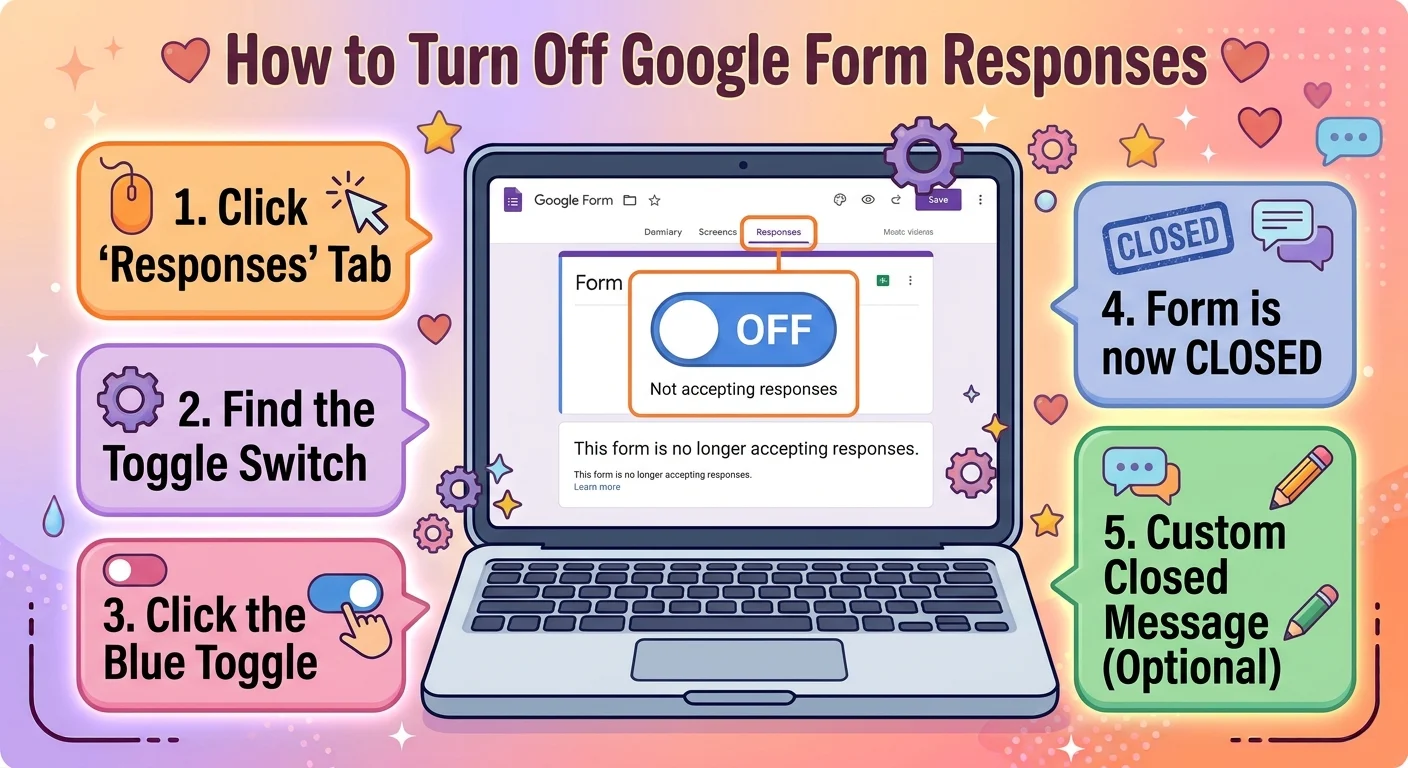
Open your Google Form, go to the Responses tab, click the three-dot menu, and select Turn off responses. You can also toggle Accepting responses off, close the form, remove the share link, or set a response limit with an add-on.Turn off responses, toggle Accepting responses off, close the form, remove the share link, set a response limit with an add-on.
You finally built the perfect Google Form, shared the link, and watched responses roll in. Then the signup fills up, the feedback window closes, or the group chat starts sending test entries at midnight. That is exactly when knowing how to turn off Google Form responses saves your inbox, your sanity, and your data.
Whether you are running a work survey, a classroom quiz, an event RSVP, or a client intake form, you need a clean way to stop new submissions without deleting answers you already collected. The right setting keeps your form professional and your results under control. The wrong click can leave the form open longer than you planned. Below are ready-to-use answers, steps, and tone-friendly replies for every situation.
1. Quick and Direct Responses
- Open the Responses tab and toggle Accepting responses off. Example: Use this when you need to stop new entries fast. Meaning: It closes the form to new submissions while keeping old answers.
- Click the three-dot menu in Responses and choose Turn off responses. Example: Use this when the toggle is hard to spot. Meaning: It instantly stops new responses from coming in.
- Open the form editor and check the Responses tab first. Example: Use this when you inherited a form from someone else. Meaning: It shows the current collection status clearly.
- Toggle Accepting responses off when the deadline hits. Example: Use this when a survey window closes. Meaning: It keeps existing data safe and stops fresh entries.
- Use Turn off responses from the menu for a quick close. Example: Use this when you are on a desktop browser. Meaning: It is the fastest official switch.
- Confirm the live form says it is no longer accepting responses. Example: Use this when you want to double-check closure. Meaning: It verifies the form is truly closed.
- Save your form after changing response settings. Example: Use this when editing a shared team form. Meaning: It keeps settings consistent for everyone.
- Refresh the live form link after closing it. Example: Use this when respondents say the link still works. Meaning: It checks the real live state.
- Close the form tab only after the toggle is off. Example: Use this when multitasking between tabs. Meaning: It prevents missed settings.
- Use the same Responses tab to reopen later. Example: Use this when a new response round opens. Meaning: It gives you control without rebuilding the form.
- Share a short note that responses are closed. Example: Use this when a group keeps asking about the link. Meaning: It reduces confusion and extra messages.
- Keep the form file instead of deleting it. Example: Use this when you need old answers later. Meaning: It preserves your data and form structure.
2. Step by Step Responses
- Step one is opening your form in Google Forms. Example: Use this when you are starting from scratch. Meaning: It puts you in the right editing space.
- Step two is clicking the Responses tab at the top. Example: Use this when you cannot find the toggle. Meaning: It leads you to response controls.
- Step three is finding the Accepting responses switch. Example: Use this when you want a simple close. Meaning: It shows whether the form is open.
- Step four is toggling Accepting responses to off. Example: Use this when you need an immediate stop. Meaning: It blocks new submissions.
- Step five is opening the three-dot menu for more options. Example: Use this when the toggle is missing. Meaning: It gives you the Turn off responses option.
- Step six is selecting Turn off responses. Example: Use this when you want the official close command. Meaning: It closes the form in one action.
- Step seven is checking the confirmation message. Example: Use this when you want proof it worked. Meaning: It confirms the form stopped accepting entries.
- Step eight is testing the share link in a private window. Example: Use this when you need certainty. Meaning: It shows what respondents see.
- Step nine is updating anyone who has the link. Example: Use this when a team is waiting on responses. Meaning: It prevents wasted submissions.
- Step ten is saving the form name and date. Example: Use this when managing many forms. Meaning: It keeps your records clear.
- Step eleven is reopening only when you are ready. Example: Use this when a new round starts. Meaning: It avoids accidental early entries.
- Step twelve is downloading responses before big changes. Example: Use this when you plan to edit or archive. Meaning: It protects your collected data.
3. Desktop Responses
- Open the form in a desktop browser for full controls. Example: Use this when the mobile view feels cramped. Meaning: It shows all response settings clearly.
- Click Responses at the top of the form editor. Example: Use this when you are on a laptop. Meaning: It takes you straight to collection controls.
- Use the Accepting responses toggle on desktop. Example: Use this when you need a quick close. Meaning: It stops new entries instantly.
- Open the three-dot menu next to the toggle. Example: Use this when you want the Turn off responses command. Meaning: It reveals the official close option.
- Select Turn off responses and confirm the change. Example: Use this when a deadline has passed. Meaning: It closes the form cleanly.
- Check the live form in a new browser tab. Example: Use this when you want to see the respondent view. Meaning: It confirms the closed message appears.
- Use Chrome or another modern browser for smooth settings. Example: Use this when buttons look unresponsive. Meaning: It avoids display glitches.
- Zoom out if the Responses menu is hidden. Example: Use this when using a small laptop screen. Meaning: It makes all controls visible.
- Keep the Responses tab open while editing. Example: Use this when making quick changes. Meaning: It saves time and reduces mistakes.
- Download a CSV before closing long-running forms. Example: Use this when you need a backup. Meaning: It protects your answers.
- Bookmark the form editor for fast access. Example: Use this when managing daily signups. Meaning: It speeds up future closes.
- Reopen from the same Responses tab when needed. Example: Use this when a second round begins. Meaning: It keeps your workflow simple.
4. Mobile Responses
- Use a mobile browser for the full Google Forms view. Example: Use this when the app hides response controls. Meaning: It gives you access to the toggle.
- Tap the Responses tab in the mobile browser. Example: Use this when you are away from a laptop. Meaning: It opens response settings.
- Switch to desktop site if the toggle is missing. Example: Use this when mobile layout feels limited. Meaning: It reveals the full control panel.
- Tap Accepting responses to turn collection off. Example: Use this when you need a fast mobile close. Meaning: It stops new entries from your phone.
- Open the three-dot menu for Turn off responses. Example: Use this when the toggle is not visible. Meaning: It gives you the official close option.
- Refresh the live form after closing on mobile. Example: Use this when you want to confirm the change. Meaning: It shows the respondent view.
- Close extra tabs to avoid saving the wrong form. Example: Use this when managing several forms. Meaning: It prevents mix-ups.
- Use Wi-Fi for a stable settings update. Example: Use this when the toggle will not stick. Meaning: It helps changes save properly.
- Check the form again after a minute. Example: Use this when mobile loading feels slow. Meaning: It confirms the setting saved.
- Send yourself the form link before closing. Example: Use this when you need to test later. Meaning: It keeps the link handy.
- Avoid deleting the form on mobile by accident. Example: Use this when cleaning up apps. Meaning: It protects your data.
- Reopen responses from the same mobile browser tab. Example: Use this when a new round starts. Meaning: It keeps control in your hand.
5. Google Workspace Responses
- Open the form from Google Drive in your Workspace account. Example: Use this when managing a team form. Meaning: It ensures you have edit access.
- Check the Responses tab as the form owner. Example: Use this when a shared form needs closing. Meaning: It confirms you can change settings.
- Toggle Accepting responses off for the whole form. Example: Use this when a company survey ends. Meaning: It stops all new entries at once.
- Use Turn off responses from the three-dot menu. Example: Use this when you need a formal close. Meaning: It applies the official closed state.
- Tell collaborators before closing a shared form. Example: Use this when a team relies on live entries. Meaning: It prevents surprise and confusion.
- Check permissions if the toggle is grayed out. Example: Use this when you cannot change settings. Meaning: It helps you find the right access level.
- Ask the form owner to close it if you are an editor. Example: Use this when your role is limited. Meaning: It gets the change made correctly.
- Keep a copy of responses in Google Sheets. Example: Use this when you need a team backup. Meaning: It protects shared data.
- Update the form description with a closed notice. Example: Use this when people still open the link. Meaning: It sets expectations clearly.
- Use a separate form for the next round. Example: Use this when you need clean reporting. Meaning: It keeps old and new data apart.
- Archive the form after the project ends. Example: Use this when the survey is finished. Meaning: It keeps Drive organized.
- Reopen only with owner approval. Example: Use this when a late entry is requested. Meaning: It keeps team control clear.
6. Classroom Responses
- Open the quiz or assignment form in Google Forms. Example: Use this when class submissions are done. Meaning: It puts you in the right place to close it.
- Go to Responses and toggle Accepting responses off. Example: Use this when the due date passes. Meaning: It stops late entries.
- Use Turn off responses for a firm deadline. Example: Use this when students keep submitting after time. Meaning: It makes the deadline clear.
- Tell students the form is closed in class. Example: Use this when everyone needs the update. Meaning: It reduces confusion.
- Post the closed notice in your classroom stream. Example: Use this when students ask about the link. Meaning: It gives one clear answer.
- Check the form link after closing it. Example: Use this when you want to see the student view. Meaning: It confirms the closed message.
- Keep existing responses for grading. Example: Use this when you need all submitted work. Meaning: It protects student records.
- Reopen for absent students only when policy allows. Example: Use this when a student was excused. Meaning: It keeps fairness clear.
- Use a new form for retakes or makeups. Example: Use this when you need separate results. Meaning: It keeps grades organized.
- Download responses before changing the form. Example: Use this when you plan to edit questions. Meaning: It protects old answers.
- Add a note that late entries need direct contact. Example: Use this when exceptions are possible. Meaning: It gives students a next step.
- Close the form before sharing final grades. Example: Use this when grading is complete. Meaning: It prevents new entries during review.
7. Event Signup Responses
- Close the form when the guest limit is reached. Example: Use this when an event fills up. Meaning: It stops extra signups.
- Toggle Accepting responses off after the RSVP deadline. Example: Use this when you need final numbers. Meaning: It locks the guest list.
- Use Turn off responses for a clean cutoff. Example: Use this when vendors need a headcount. Meaning: It gives you a fixed list.
- Update the event page with a sold-out note. Example: Use this when people still click the link. Meaning: It sets clear expectations.
- Keep the form for waitlist planning. Example: Use this when you may reopen spots. Meaning: It saves you from rebuilding.
- Download the guest list before closing. Example: Use this when you need check-in sheets. Meaning: It protects your planning data.
- Check the live link after the change. Example: Use this when you want to confirm the closed message. Meaning: It shows what guests see.
- Send a confirmation to people who signed up. Example: Use this when the list is final. Meaning: It keeps communication clear.
- Use a separate form for the waitlist. Example: Use this when demand is high. Meaning: It keeps main signups clean.
- Reopen only if capacity changes. Example: Use this when more space becomes available. Meaning: It keeps numbers accurate.
- Add a closing date in the form description. Example: Use this when planning ahead. Meaning: It reduces last-minute questions.
- Archive the signup after the event. Example: Use this when the event is over. Meaning: It keeps your files tidy.
8. Feedback Survey Responses
- Close the survey when the feedback window ends. Example: Use this when you have enough replies. Meaning: It stops new data from mixing with old data.
- Use Accepting responses off for a simple stop. Example: Use this when the survey period is over. Meaning: It closes collection without deleting answers.
- Use Turn off responses for an official close. Example: Use this when you need a clear end date. Meaning: It marks the survey as closed.
- Download results before closing long surveys. Example: Use this when you need a backup. Meaning: It protects your feedback data.
- Tell respondents the survey is now closed. Example: Use this when a team expects the link. Meaning: It prevents confusion.
- Check the form link after closing it. Example: Use this when you want to see the closed message. Meaning: It confirms the change.
- Keep the form for next quarter. Example: Use this when you run repeat surveys. Meaning: It saves setup time.
- Duplicate the form for a new feedback round. Example: Use this when you need clean results. Meaning: It keeps rounds separate.
- Add a closing date in the description. Example: Use this when planning a campaign. Meaning: It sets expectations early.
- Review responses before reopening. Example: Use this when you may need follow-up questions. Meaning: It helps you improve the next round.
- Use a separate form for follow-up feedback. Example: Use this when you need deeper answers. Meaning: It keeps data organized.
- Archive old surveys after downloading. Example: Use this when your Drive gets crowded. Meaning: It keeps your workspace clean.
9. Privacy and Security Responses
- Turn off responses when you no longer need personal data. Example: Use this when collecting names or emails. Meaning: It limits new sensitive entries.
- Close the form after the stated privacy window. Example: Use this when your policy gives a deadline. Meaning: It keeps data collection transparent.
- Use Accepting responses off to stop new submissions. Example: Use this when a data review starts. Meaning: It freezes the data set.
- Download and store responses securely before closing. Example: Use this when you need a protected backup. Meaning: It keeps data safe.
- Remove the share link from public pages. Example: Use this when the form is closed. Meaning: It reduces accidental access.
- Check who has edit access to the form. Example: Use this when handling private answers. Meaning: It protects response settings.
- Tell respondents how long data will be kept. Example: Use this when privacy matters. Meaning: It builds trust.
- Use Turn off responses for a clear collection end. Example: Use this when a policy deadline hits. Meaning: It creates a clean stop point.
- Avoid sharing response sheets publicly. Example: Use this when exporting results. Meaning: It protects private answers.
- Delete test responses before closing if needed. Example: Use this when the data set must be clean. Meaning: It keeps reports accurate.
- Keep a record of when the form was closed. Example: Use this when privacy audits happen. Meaning: It supports accountability.
- Reopen only with a clear new purpose. Example: Use this when collecting more data later. Meaning: It keeps consent and expectations clear.
10. Professional Responses
- Use the official Turn off responses option for a clean close. Example: Use this in a workplace survey. Meaning: It shows a controlled process.
- Toggle Accepting responses off and note the close time. Example: Use this when reporting to a manager. Meaning: It creates a clear record.
- Tell stakeholders before closing a live form. Example: Use this when a team depends on entries. Meaning: It prevents surprise.
- Download responses before making major changes. Example: Use this when a project moves to review. Meaning: It protects business data.
- Use a closed message that matches your brand tone. Example: Use this on a client-facing form. Meaning: It keeps communication polished.
- Check the form link as a respondent would. Example: Use this before announcing closure. Meaning: It confirms the experience.
- Keep the form file for audit purposes. Example: Use this when records matter. Meaning: It preserves the setup history.
- Duplicate the form for the next intake cycle. Example: Use this when you need clean reporting. Meaning: It keeps cycles separate.
- Remove the link from emails and landing pages. Example: Use this when the form is closed. Meaning: It reduces stray submissions.
- Use a separate form for urgent exceptions. Example: Use this when late entries need review. Meaning: It keeps the main data clean.
- Reopen only with written approval. Example: Use this in formal workflows. Meaning: It keeps control clear.
- Archive the form after the final report. Example: Use this when the project closes. Meaning: It keeps your workspace organized.
11. Troubleshooting Responses
- If the toggle is missing, open the three-dot menu. Example: Use this when Accepting responses is hard to find. Meaning: It reveals the Turn off responses option.
- If the toggle is grayed out, check your edit access. Example: Use this when you cannot change settings. Meaning: It helps you find the permission issue.
- If the form still accepts entries, refresh the live link. Example: Use this when respondents say it is still open. Meaning: It checks the real state.
- If changes will not save, reload the form editor. Example: Use this when buttons feel stuck. Meaning: It resets the page.
- If mobile controls are hidden, switch to desktop site. Example: Use this when using a phone browser. Meaning: It shows the full panel.
- If you closed the wrong form, reopen it quickly. Example: Use this when managing several similar forms. Meaning: It limits disruption.
- If the closed message looks wrong, edit the form description. Example: Use this when you want a clearer notice. Meaning: It improves communication.
- If old answers are missing, check the response sheet link. Example: Use this when data seems lost. Meaning: It helps you find stored responses.
- If collaborators cannot see changes, ask them to refresh. Example: Use this when a team edits together. Meaning: It syncs their view.
- If the form link was shared widely, update the public post. Example: Use this when closing a popular form. Meaning: It reduces extra clicks.
- If you need a hard stop, remove the link as well. Example: Use this when closure must be firm. Meaning: It limits access from old posts.
- If nothing works, duplicate the form and close the original. Example: Use this when settings will not update. Meaning: It gives you a clean backup.
12. Advanced Settings Responses
- Use a response limit add-on when you need a cap. Example: Use this when only 50 entries are allowed. Meaning: It closes the form after the limit.
- Pair a response limit with a clear closed message. Example: Use this when demand is high. Meaning: It keeps expectations clear.
- Use form validation to reduce junk entries before closing. Example: Use this when collecting emails or phone numbers. Meaning: It improves data quality.
- Duplicate the form for each new round. Example: Use this when reporting must stay clean. Meaning: It keeps data sets separate.
- Use Google Sheets to monitor incoming responses. Example: Use this when you need live oversight. Meaning: It helps you close at the right time.
- Set a calendar reminder for the close date. Example: Use this when surveys run for weeks. Meaning: It prevents missed deadlines.
- Use a short link you can disable separately. Example: Use this when sharing on social media. Meaning: It gives you extra access control.
- Keep a master copy of the form. Example: Use this when you reuse surveys often. Meaning: It saves setup time.
- Test the closed form in incognito mode. Example: Use this when you need a clean check. Meaning: It shows the respondent view without cache.
- Use separate forms for signup and waitlist. Example: Use this when demand is high. Meaning: It keeps data organized.
- Document the close date in the form title or description. Example: Use this when many people share the link. Meaning: It reduces confusion.
- Review permissions before reopening. Example: Use this when a form holds sensitive data. Meaning: It keeps access controlled.
13. Polite Responses
- You can close the form from the Responses tab when you are ready. Example: Use this when helping a coworker. Meaning: It gives a calm, clear direction.
- The Accepting responses toggle is the simplest way to stop new entries. Example: Use this when someone wants a gentle explanation. Meaning: It points them to the easy option.
- If you prefer the menu, choose Turn off responses. Example: Use this when explaining a second option. Meaning: It keeps the help flexible.
- Your existing answers stay safe after you close the form. Example: Use this when someone worries about data loss. Meaning: It reassures them.
- You can reopen the form later from the same tab. Example: Use this when they need a future round. Meaning: It gives them confidence.
- Please let respondents know the form is closed. Example: Use this when a group keeps sharing the link. Meaning: It encourages clear communication.
- You may want to download responses before closing. Example: Use this when helping with data backup. Meaning: It protects their work.
- If the toggle is missing, try the three-dot menu. Example: Use this when someone is stuck. Meaning: It offers a quick fix.
- On mobile, desktop site view can make the setting easier. Example: Use this when helping a phone user. Meaning: It solves a common issue.
- You can use a separate form for late entries. Example: Use this when exceptions are needed. Meaning: It keeps the main data clean.
- A short closed notice in the description helps a lot. Example: Use this when people still open the link. Meaning: It improves clarity.
- You are welcome to reopen it when the next round starts. Example: Use this when planning ahead. Meaning: It keeps the process friendly.
14. Confident Responses
- Open Responses, toggle Accepting responses off, and you are done. Example: Use this when you need a fast, sure answer. Meaning: It gives a direct solution.
- Use the three-dot menu and hit Turn off responses. Example: Use this when someone wants the exact path. Meaning: It removes guesswork.
- Your old responses will stay exactly where they are. Example: Use this when someone fears losing data. Meaning: It reassures them clearly.
- The closed message is normal and means the form worked. Example: Use this when a respondent sees the notice. Meaning: It explains the outcome.
- You can reopen it any time from the same Responses tab. Example: Use this when planning another round. Meaning: It shows you are in control.
- If the toggle is not there, your access level is the issue. Example: Use this when helping a teammate. Meaning: It points to the real fix.
- Test the link after closing so you know it worked. Example: Use this when you want proof. Meaning: It confirms the setting.
- Download a backup before big edits. Example: Use this when protecting important data. Meaning: It is a smart move.
- A separate form is better for a new round. Example: Use this when reports must stay clean. Meaning: It keeps results organized.
- Remove the link from public posts after closing. Example: Use this when the form was shared widely. Meaning: It reduces extra entries.
- Keep the form file even after closing it. Example: Use this when you may reuse the questions. Meaning: It saves time later.
- You can close it now and still review every answer. Example: Use this when the deadline has passed. Meaning: It gives clear next steps.
15. Clear and Simple Responses
- Go to Responses and turn Accepting responses off. Example: Use this when you want the shortest answer. Meaning: It stops new entries.
- Click the three dots and choose Turn off responses. Example: Use this when you need the menu path. Meaning: It closes the form officially.
- Your existing answers are not deleted. Example: Use this when someone asks about data safety. Meaning: It clears up a common worry.
- The form will show a closed message to visitors. Example: Use this when explaining what respondents see. Meaning: It sets expectations.
- You can reopen it later if you need more answers. Example: Use this when planning a second round. Meaning: It shows the change is reversible.
- Use desktop view if the mobile toggle is hidden. Example: Use this when helping a phone user. Meaning: It gives a simple workaround.
- Download responses before closing if you need a backup. Example: Use this when data matters. Meaning: It protects your answers.
- Tell people the form is closed so they stop trying. Example: Use this when a group keeps asking. Meaning: It reduces confusion.
- Remove the link from old posts after closing. Example: Use this when the form was public. Meaning: It limits extra clicks.
- Use a new form for a new collection period. Example: Use this when you need clean results. Meaning: It keeps rounds separate.
- Check the live link once after closing. Example: Use this when you want to be sure. Meaning: It confirms the form is closed.
- Save the form for future use. Example: Use this when you run repeat surveys. Meaning: It saves you setup time.
FAQs
What does turning off responses mean?
It means the form stops accepting new entries. Old answers stay saved.
Is it permanent?
No. You can reopen the form later from the Responses tab.
Do existing responses stay?
Yes. Closing the form does not delete answers you already collected.
Can I turn it off on mobile?
Yes. Use a mobile browser and switch to desktop site if the toggle is hidden.
Do respondents see a message?
Yes. They usually see that the form is no longer accepting responses.
Can I limit the number of responses?
Google Forms does not have a native cap. You can use a response limit add-on.
What if the Accepting responses toggle is missing?
Check your edit access. If you are not the owner, ask the form owner to close it.
Is humor okay in a closed form notice?
A light friendly line works for casual forms. Keep it clear for work or school.
Conclusion
Turning off Google Form responses is a small click with a big payoff. It protects your data, keeps your signup list tidy, and stops test entries from sneaking in after the deadline. Use the official Turn off responses option, double-check the Accepting responses toggle, and reopen the form only when you are ready.
The clearer your settings, the more confident you look to respondents. Save this guide for the next survey, RSVP, quiz, or client form you share. Send it to a teammate who keeps asking how to close a form. Bookmark the steps, reuse the replies, and keep your response list clean from start to finish.
