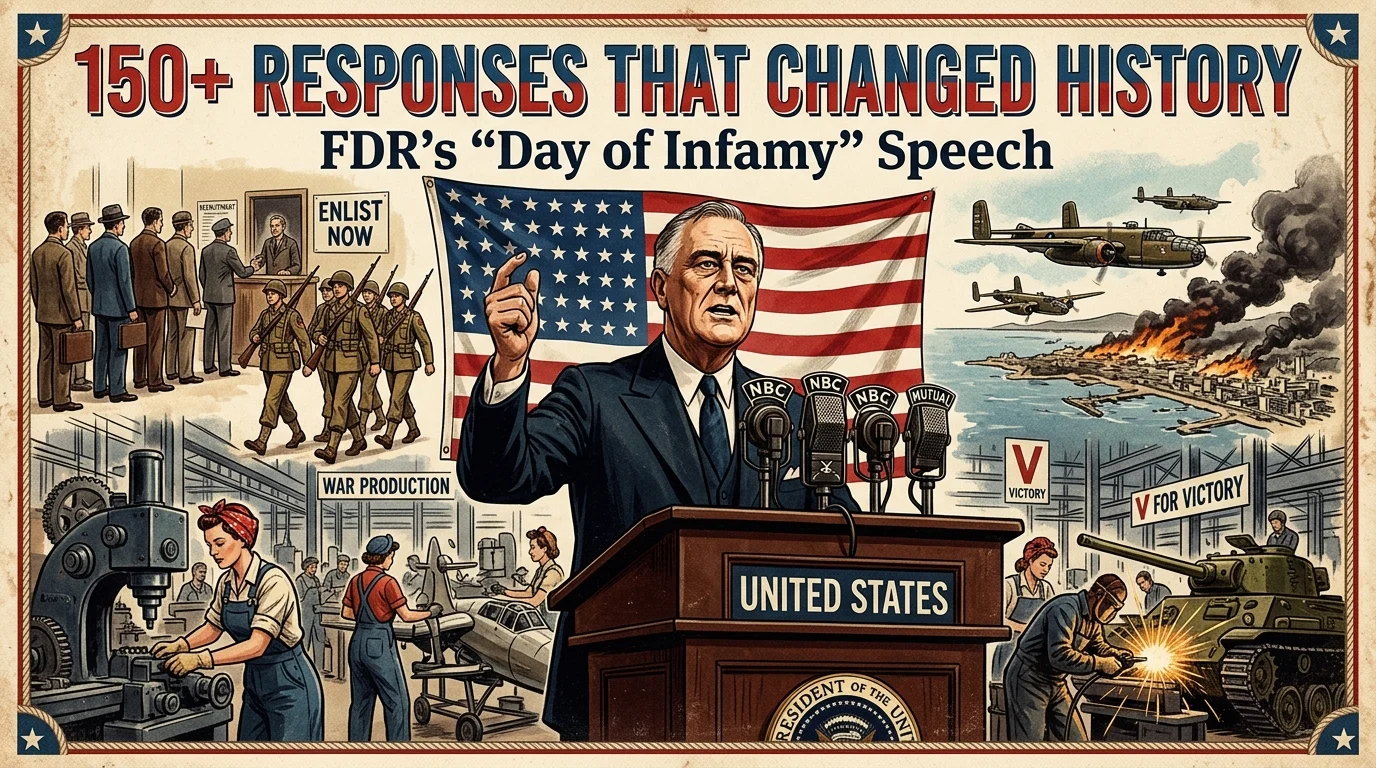
The US response to Pearl Harbor was swift and decisive, changing the course of world history. From FDR’s iconic “Day of Infamy” speech to immediate military mobilization, America’s reaction defined a generation. Declaration of war on Japan, FDR’s famous speech, military mobilization, the Doolittle Raid, and the Manhattan Project.
December 7, 1941 – a date that lives in infamy. When the Japanese attack on Pearl Harbor shocked the nation, America’s response wasn’t just about military action. It was about resilience, unity, and the birth of a superpower.
The US response to Pearl Harbor transformed a hesitant nation into a global force. From FDR’s powerful words to everyday citizens rolling up their sleeves, every American found their role in this historic moment. Understanding these responses helps us grasp how a country can turn tragedy into triumph.
The US response to Pearl Harbor wasn’t just about revenge – it was about rebuilding, redefining, and rising from the ashes stronger than ever.
Presidential Responses
“December 7, 1941 – a date which will live in infamy”
The most famous line from FDR’s address to Congress. This powerful opening immediately captured the nation’s outrage and determination.
“I ask that the Congress declare a state of war”
FDR’s formal request that changed everything. This direct appeal united the nation behind a common purpose.
“No matter how long it may take us to overcome this premeditated invasion”
FDR’s words that steeled the nation for a long conflict. This statement prepared Americans for the road ahead.
“Always will we remember the character of the onslaught against us”
FDR’s promise that the attack would never be forgotten. This ensured the nation’s memory would preserve the moment.
“With confidence in our armed forces, with the unbounding determination of our people”
FDR’s words of faith in American strength. This statement inspired confidence during uncertain times.
“We will gain the inevitable triumph”
FDR’s confident prediction of victory. This assurance rallied the nation when it needed hope most.
“The American people in their righteous might will win through to absolute victory”
FDR’s belief in the nation’s ultimate success. This statement anchored the country’s resolve.
“Hostilities exist. There is no blinking at the fact”
FDR’s honest acknowledgment of the situation. This clear-eyed view prepared Americans for what lay ahead.
“I believe I interpret the will of the Congress and of the people”
FDR’s confidence in national unity. This statement showed he knew the country stood behind him.
“The unprovoked and dastardly attack”
FDR’s powerful description that framed the attack. This language shaped how Americans understood the event.
“We are now in the midst of war, not for conquest, not for vengeance”
FDR’s statement of noble purpose. This framed the war as a righteous cause.
“The righteous might of our cause”
FDR’s final affirmation of moral conviction. This gave the war deeper meaning beyond just retaliation.
Congressional Responses
“I believe this is the greatest day in American history”
Senator Tom Connally’s dramatic statement. This captured the momentous nature of the declaration.
“We will fight until the last man”
Representative John Rankin’s pledge of commitment. This showed Congress’s determination.
“This is a challenge to civilization itself”
Senator Robert Taft’s framing of the attack. This elevated the conflict to a global struggle.
“The Japanese have handed us our greatest opportunity”
Senator Arthur Vandenberg’s strategic perspective. This recognized the attack as a turning point.
“We must win, and we will win”
House Speaker Sam Rayburn’s confident declaration. This set the tone for Congressional support.
“The attack has united the American people as never before”
Senator Alben Barkley’s observation of national unity. This highlighted the silver lining.
“We will prosecute this war with all the resources at our command”
Congress’s formal commitment to total war. This showed the nation’s full engagement.
“The enemy has made a terrible mistake”
Representative John Sparkman’s assessment. This framed Japan’s attack as a strategic error.
“America has never failed and she will not fail now”
Senator James Byrnes’s expression of national confidence. This reinforced American exceptionalism.
“We have been attacked and we will respond”
Congress’s simple but powerful pledge. This direct commitment unified the legislative branch.
“The vote will be unanimous for war”
The prediction that came true. This showed Congress’s complete unity behind the President.
“We will stand behind our President and our military”
Congress’s promise of full support. This ensured the war effort would have legislative backing.
Military Responses
“We are going to win this war”
General Douglas MacArthur’s immediate declaration. This confident statement inspired troops and civilians alike.
“The enemy has been given a temporary advantage”
Admiral Chester Nimitz’s assessment of the situation. This balanced view acknowledged the blow while maintaining hope.
“We will fight them on every front”
General George Marshall’s commitment to total war. This set the military’s aggressive strategy.
“The Pacific fleet will rise again”
Admiral Ernest King’s promise of rebuilding. This statement gave hope to the devastated Navy.
“We have the industrial capacity to outbuild any enemy”
General Henry Arnold’s confidence in production. This highlighted America’s greatest advantage.
“Our pilots will have their revenge”
General Hap Arnold’s promise to the Air Corps. This boosted morale among airmen.
“We must strike back quickly and decisively”
General Dwight Eisenhower’s strategic emphasis. This pushed for immediate offensive action.
“The Japanese have awakened a sleeping giant”
Admiral Yamamoto’s famous assessment (though from the Japanese perspective). This proved prophetic.
“We will take the fight to their homeland”
General Curtis LeMay’s aggressive vision. This foreshadowed the bombing campaigns to come.
“Our submarines will destroy their supply lines”
Admiral Charles Lockwood’s strategic commitment. This highlighted the importance of naval warfare.
“The Marines will lead the island-hopping campaign”
General Alexander Vandegrift’s pledge. This set the course for the Pacific strategy.
“Victory is the only option”
Admiral William Halsey’s uncompromising statement. This captured the military’s determined spirit.
Diplomatic Responses
“We will not negotiate with aggressors”
Secretary of State Cordell Hull’s firm stance. This rejected any compromise with Japan.
“The attack was a violation of international law”
Secretary Hull’s legal framing of the attack. This positioned the US on the right side of global norms.
“Our alliances will be strengthened through this crisis”
Undersecretary Sumner Welles’s strategic insight. This recognized the attack as an opportunity for coalition building.
“We will fight alongside our British allies”
US commitment to the existing alliance. This strengthened the Anglo-American partnership.
“The Atlantic Charter applies to the Pacific as well”
Franklin Roosevelt’s extension of alliance principles. This connected the European and Pacific wars.
“We will pursue unconditional surrender”
The Allied policy statement at Casablanca. This showed total commitment to victory.
“Our response must be proportional and just”
Secretary Hull’s emphasis on proportionality. This kept the US morally grounded.
“The world must know Japan’s aggression”
The diplomatic push for international condemnation. This isolated Japan globally.
“We will work with China to defeat our common enemy”
The alliance-building with China. This widened the coalition against Japan.
“Our diplomats will coordinate with all Allies”
Secretary Hull’s commitment to multilateralism. This ensured coordinated responses.
“We will expose Japanese war crimes”
The promise of accountability. This set the stage for postwar tribunals.
“Peace will come through victory, not negotiation”
The firm diplomatic position. This showed the US would settle for nothing less.
Public Address Responses
“This is a day of infamy for the American people”
FDR’s public framing of the attack. This captured the nation’s feeling of betrayal.
“We must work together to defeat our enemies”
The call for national unity in speeches. This emphasized collective effort.
“Every American has a role in this war”
The inclusion of civilians in the war effort. This made everyone feel part of the cause.
“Our democracy will prevail”
The ideological defense of American values. This framed the war as democracy vs. tyranny.
“The American people are resilient and strong”
The celebration of national character. This boosted morale across the country.
“We will rebuild our fleet and our nation”
The promise of recovery and growth. This looked beyond the immediate crisis.
“Our hearts are with those who lost loved ones”
The expression of collective grief. This honored the fallen and united the nation.
“We will never forget this attack”
The commitment to remembrance. This ensured the event would always be honored.
“This war will make us a stronger nation”
The optimistic vision of the future. This turned tragedy into opportunity.
“We must protect our shores from future attacks”
The push for homeland defense. This led to immediate security measures.
“Our young people will lead this fight”
The call to the next generation. This inspired enlistments and dedication.
“America has never failed, and we will not fail now”
The reaffirmation of national strength. This repeated confidence in American capability.
Press and Media Responses
“Japs Bomb Pearl Harbor”
The famous headline in the Honolulu Star-Bulletin. This immediate coverage shocked the nation.
“War! Oahu Bombed by Japanese Planes”
The extra edition headline that spread panic and resolve. This captured the urgency of the moment.
“The United States has entered the war”
The definitive news announcement. This changed everything for American readers.
“America’s Navy attacked without warning”
The framing of the attack as unprovoked. This increased public outrage.
“President Roosevelt to address the nation”
The announcement that everyone waited for. This built anticipation for FDR’s speech.
“Tokyo Radio claims victory”
The coverage of Japanese propaganda. This showed the enemy’s perspective.
“America’s response will be massive”
The prediction of military action. This prepared the public for war.
“The mainland is also at risk”
The warning that the war was coming to America. This increased urgency on the home front.
“The Pacific fleet suffers heavy losses”
The sobering news of casualties. This reported the true cost of the attack.
“America’s industrial might will defeat Japan”
The optimistic counterpoint to military losses. This focused on America’s strengths.
“The nation rallies behind the President”
The report of national unity. This showed the country was unified.
“This war will change everything”
The prophetic observation about the war’s impact. This recognized the scale of change.
Legislative Responses
“The War Powers Act will be passed immediately”
The promise of expanded executive authority. This gave the President the tools to fight.
“We will authorize unlimited defense spending”
Congressional approval of massive military budgets. This funded the entire war effort.
“Selective Service will be expanded”
The draft’s extension to meet military needs. This ensured enough troops for the war.
“Defense production will be prioritized”
Legislation shifting manufacturing to war needs. This transformed American industry.
“Lend-Lease will continue for all Allies”
The extension of support to other nations. This strengthened the global alliance.
“Enemy aliens will be subject to restrictions”
The legislative response to fears of domestic threats. This led to controversial policies.
“Military tribunals will handle enemy combatants”
The legal framework for dealing with prisoners. This set rules for the war.
“The budget will be tripled for defense”
Massive funding increases for the military. This showed total commitment.
“We will restrict non-essential industries”
The prioritization of war production. This ensured resources went where needed.
“Women will be recognized in the defense effort”
Legislative acknowledgment of women’s roles. This expanded the workforce.
“We will support our veterans and their families”
The promise of postwar support. This ensured the nation would care for its heroes.
“The Four Freedoms will guide our foreign policy”
The ideological framing of the war. This gave moral purpose to legislation.
Speech and Oratory Responses
“We have reason for a new faith in democracy”
A speech affirming democratic values. This counteracted enemy propaganda.
“The American people will not be intimidated”
A declaration of national courage. This rejected fear as a response.
“Our cause is just and our victory certain”
The assurance of moral and military success. This built confidence.
“We will fight not for conquest but for liberation”
The framing of the war as freeing others. This gave the war noble purpose.
“This generation has a rendezvous with destiny”
The call to fulfill America’s historical role. This inspired personal sacrifice.
“Our strength is in our unity”
The emphasis on collective effort. This highlighted the importance of working together.
“Freedom is worth any sacrifice”
The ultimate justification for war. This made the cost seem worthwhile.
“We will turn our factories into arsenals”
The promise of industrial transformation. This became the reality of American production.
“Our youth will prove themselves in battle”
The confidence in young soldiers. This inspired enlistment and morale.
“We will outlast any enemy through our resolve”
The belief in American determination. This emphasized staying power.
“Our values will triumph over tyranny”
The ideological victory in advance. This framed the war as good vs. evil.
“The future belongs to free nations”
The optimistic vision of postwar world. This gave meaning to the struggle.
Civilian and Home Front Responses
“Americans are volunteering in record numbers”
The rush to military service. This showed the nation’s immediate response.
“Women are filling factory jobs”
The transformation of the workforce. This expanded women’s roles significantly.
“Victory gardens will support the war effort”
The civilian contribution to food production. This involved everyone in the fight.
“War bonds will finance our victory”
The financial support from citizens. This funded the war through public investment.
“We will conserve resources for the troops”
The spirit of sacrifice at home. This showed unity with the fighting forces.
“Red Cross donations are overwhelming”
The charitable response to the crisis. This supported wounded soldiers.
“Schools are teaching children about the war”
The educational response to the conflict. This prepared the next generation.
“Communities are organizing defense committees”
The local response to the national threat. This created grassroots defense efforts.
“We will support our neighbors who have loved ones fighting”
The community support for military families. This built social solidarity.
“Factories are running 24/7”
The round-the-clock war production. This showed maximum effort.
“We are collecting scrap materials”
The recycling drive for war materials. This involved children and adults alike.
“Every American is doing their part”
The recognition of collective effort. This celebrated national unity.
Allied and Coalition Responses
“Britain stands with America”
Winston Churchill’s immediate declaration. This showed allyship from the start.
“We will fight alongside our American friends”
Churchill’s personal promise to FDR. This strengthened the special relationship.
“The British Empire joins the fight against Japan”
The extension of the war to all fronts. This was a global response.
“Our Commonwealth nations will support the US”
The collective commitment of British territories. This broadened the coalition.
“Australia and New Zealand stand ready”
The Pacific allies’ immediate support. This was crucial for regional defense.
“China will continue its fight”
Chiang Kai-shek’s reassurance of commitment. This maintained the Asian front.
“The Dutch East Indies join the Allied cause”
The support from Southeast Asian territories. This expanded the coalition.
“Free French forces will fight alongside America”
Charles de Gaulle’s commitment. This showed the resistance movement’s support.
“The Soviet Union reaffirms its commitment”
Stalin’s statement of continued alliance. This kept the European front active.
“We will coordinate our Pacific strategies”
The promise of military coordination. This unified Allied operations.
“Allied navies will work together”
The cooperation of fleets from multiple nations. This was crucial for naval success.
“We have a common enemy and a common goal”
The statement of unity among Allies. This reinforced the coalition purpose.
Long-Term Strategic Responses
“The Doolittle Raid will show our resolve”
The 1942 bombing of Tokyo. This was a direct response to Pearl Harbor’s humiliation.
“Island hopping will bring us to Japan”
The strategic plan for the Pacific. This was the path to victory.
“The Manhattan Project will end the war”
The secret weapon development. This was the ultimate response.
“We will rebuild the Pacific fleet”
The commitment to naval dominance. This ensured future strength.
“Naval strategy will emphasize aircraft carriers”
The strategic shift in naval thinking. This was learned from Pearl Harbor.
“We will break Japanese codes”
The intelligence response to the attack. This was crucial for future victories.
“Submarine warfare will destroy Japanese supply lines”
The undersea campaign against Japan. This starved the enemy of resources.
“We will train a massive military force”
The commitment to building the largest military. This ensured victory through numbers.
“Postwar Japan will be transformed”
The vision for reconstruction. This went beyond military victory.
“The United Nations will replace the League”
The institutional response to world peace. This created the postwar order.
“Nuclear weapons will change the world”
The recognition of a new era. This was the ultimate result of the response.
“America will become a global superpower”
The long-term consequence of the response. This shaped the rest of the century.
Propaganda and Cultural Responses
“Remember Pearl Harbor!”
The most famous propaganda slogan. This became the rallying cry for the entire war.
“Avenge December 7th!”
The call to revenge that motivated troops. This channeled anger into action.
“Keep ’em Firing!”
The production and support slogan. This urged maximum effort at home.
“We will win because we are Americans”
The pride-filled cultural statement. This built on American exceptionalism.
“Pearl Harbor – Never Forget”
The commitment to remembrance. This became a permanent mantra.
“Enlist Now!”
The recruitment propaganda response. This drove record volunteer numbers.
“Buy War Bonds!”
The financial response to funding the war. This involved every American.
“Loose Lips Sink Ships”
The cautionary propaganda about security. This prevented further intelligence leaks.
“We’re All in This Together”
The unity-focused message. This reinforced collective effort.
“America’s Answer – Production!”
The industrial response celebrated. This showed America’s greatest strength.
“The Rising Sun Will Set”
The cultural expression of victory. This framed the war as destiny.
“Freedom Will Win”
The ultimate propaganda message. This gave ideological meaning to sacrifice.
FAQs
What was the immediate US response to Pearl Harbor?
The US declared war on Japan on December 8, 1941, just one day after the attack. President Roosevelt delivered his famous “Day of Infamy” speech, and Congress voted almost unanimously to enter World War II. The military immediately began mobilizing for a two-front war.
Why was the US response to Pearl Harbor so significant?
The US response to Pearl Harbor transformed American foreign policy from isolationism to global engagement. It united the nation behind the war effort and created the “Arsenal of Democracy” that would defeat the Axis powers. This response changed America’s role in the world forever.
How did the US response to Pearl Harbor affect the war?
The US response to Pearl Harbor brought America into World War II with full force. American industrial production, military mobilization, and strategic planning were crucial to Allied victory. The response also led to the development of nuclear weapons, which ultimately ended the war.
What did the US response to Pearl Harbor mean for the Japanese?
The US response to Pearl Harbor meant total war against Japan. American forces would fight their way across the Pacific, conducting island-hopping campaigns, and eventually drop atomic bombs on Hiroshima and Nagasaki. Japan’s surprise attack had awakened a nation determined to achieve unconditional surrender.
Is the US response to Pearl Harbor still relevant today?
Yes, the US response to Pearl Harbor is still studied for lessons in crisis management, national unity, and strategic response. It demonstrated how a nation can turn tragedy into strength. The response shaped the modern world order and continues to influence American foreign policy.
Conclusion
The US response to Pearl Harbor stands as one of history’s most powerful examples of turning tragedy into triumph. From FDR’s stirring words to the quiet determination of factory workers, every American played a role in the national response. This moment transformed a reluctant nation into a global superpower.
Understanding these responses helps us appreciate the resilience and unity that defined the Greatest Generation. Their sacrifices and determination secured victory and built the world we live in today. The lessons from Pearl Harbor continue to inform how we face challenges.
Whether you’re studying history, looking for inspiration, or just want to understand how a nation responds to crisis, the US response to Pearl Harbor offers powerful examples. Save this guide, share it with fellow history enthusiasts, and never forget how Americans answered the call.
