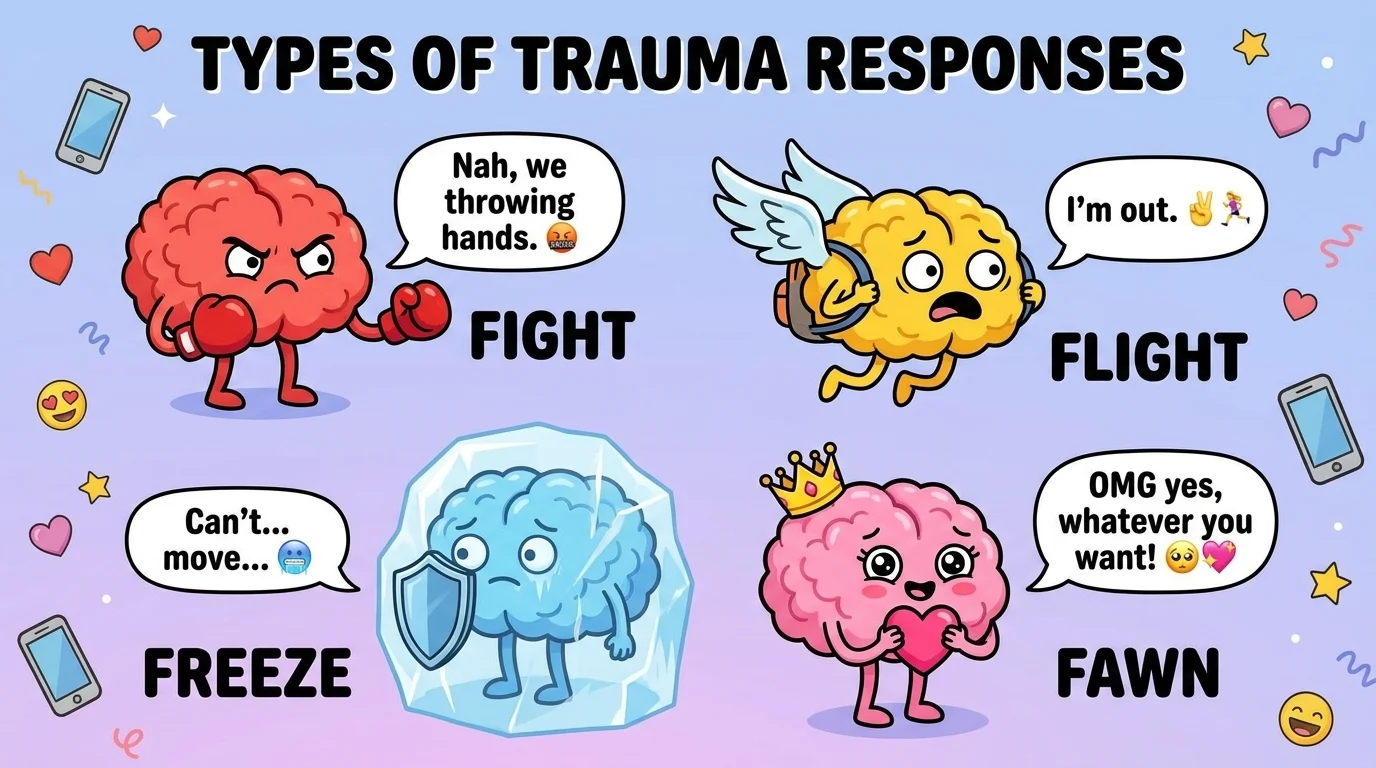
Trauma responses show up as fight, flight, freeze, or fawn in everyday texts. The best replies match the moment, like “That makes sense,” “I’m here,” “Take your time,” “You’re safe with me,” or “No pressure at all.”
Ever sent a text and instantly regretted it because the reply felt off? Maybe someone went quiet after you shared something real, or they laughed when you needed comfort. That awkward silence? It’s often one of the many types of trauma responses showing up in disguise.
Understanding how people react under stress changes everything. Some go quiet, some over-explain, and some crack jokes at the worst time. Knowing what to say back can turn a weird moment into a genuine connection.
This guide gives you 150+ ready-to-send replies for every mood, tone, and situation. Whether you’re texting a friend, a crush, or a coworker, you’ll find the perfect line to keep things real and relatable.
Funny Responses
- “So we’re just gonna pretend that didn’t happen? Cool, cool.”
- Example: Perfect for breaking the ice after an awkward silence in a group chat.
- Meaning: Lightens the mood without dismissing what happened.
- “My trauma response is making jokes. Wanna hear one?”
- Example: Use when you want to acknowledge your own coping style with humor.
- Meaning: Owns your reaction while keeping things playful.
- “Plot twist: we’re both awkward. Let’s move on.”
- Example: Great for when both of you are overthinking a conversation.
- Meaning: Normalizes the awkwardness and resets the vibe.
- “Brain said panic. I said LOL.”
- Example: Drop this when you catch yourself overreacting to a small thing.
- Meaning: Shows self-awareness with a side of charm.
- “Emotional damage? Never heard of her.”
- Example: Use when deflecting a heavy topic with meme energy.
- Meaning: Signals you’re not ready to go deep yet, and that’s okay.
- “I’m not ignoring you. I’m just buffering.”
- Example: Perfect for when someone calls out your slow replies.
- Meaning: Explains your silence in a way that’s funny and honest.
- “New coping mechanism just dropped: pretending I’m fine.”
- Example: Send this when you’re caught pretending everything’s okay.
- Meaning: Acknowledges your defense mechanism with a wink.
- “My therapist would love this conversation.”
- Example: Use when things get unexpectedly deep in a casual chat.
- Meaning: Adds humor while recognizing the emotional weight.
- “Fight or flight? I chose nap.”
- Example: Share when you’re avoiding conflict by disappearing.
- Meaning: Makes light of avoidance in a relatable way.
- “I’m fine. The shakiness is just my personality.”
- Example: Use after an anxiety spike you’re trying to brush off.
- Meaning: Keeps things light while hinting at the truth.
- “If I laugh, it’s not trauma. It’s cardio.”
- Example: Perfect for deflecting concern with a joke.
- Meaning: Uses humor to redirect attention from vulnerability.
- “Emotional support nap incoming. Do not disturb.”
- Example: Send when you need space after a heavy moment.
- Meaning: Communicates your need for a break in a cute way.
Brutal (Honest) Responses
- “That’s a trauma response. Let’s talk about it.”
- Example: Use when you want to call out someone’s coping pattern directly.
- Meaning: Confronts the issue with care but no sugarcoating.
- “You’re not fine. And that’s okay.”
- Example: Say this when someone keeps insisting they’re okay.
- Meaning: Gently challenges denial and invites honesty.
- “I see what you’re doing. You can stop now.”
- Example: Perfect for catching someone mid-deflection.
- Meaning: Signals awareness without being mean.
- “Pushing me away won’t make you feel safer.”
- Example: Use when someone isolates after conflict.
- Meaning: Names the pattern while showing you care.
- “You don’t have to perform being okay with me.”
- Example: Say this to a friend who masks their feelings.
- Meaning: Offers permission to be real.
- “Silence is your shield. I get it. But I’m still here.”
- Example: Use when someone goes quiet after a tough talk.
- Meaning: Acknowledges their defense while staying present.
- “That joke was your panic button.”
- Example: Call out a friend who deflects with humor.
- Meaning: Gently exposes the real emotion underneath.
- “You’re allowed to feel this. Stop apologizing.”
- Example: Perfect when someone keeps saying sorry for being upset.
- Meaning: Validates emotion without judgment.
- “I know you’re trying to protect yourself. But I’m not the threat.”
- Example: Use when someone projects past pain onto you.
- Meaning: Reassures while setting an honest boundary.
- “Avoidance is your comfort zone. I see it.”
- Example: Say this when someone keeps dodging important topics.
- Meaning: Names the behavior with compassion.
- “You can’t outrun your feelings. Trust me.”
- Example: Use when someone stays busy to avoid processing.
- Meaning: Shares hard truth from a caring place.
- “That wall you built? I’m not climbing it. I’m waiting here.”
- Example: Say this to someone who isolates during stress.
- Meaning: Shows patience while respecting their boundaries.
Flirty Responses
- “Trauma response? Or just an excuse to text me?”
- Example: Perfect for teasing a crush who’s acting distant.
- Meaning: Flips the mood with playful suspicion.
- “I’d be your safe space. Just saying.”
- Example: Use when someone opens up about their stress.
- Meaning: Offers comfort with a flirty edge.
- “You’re cute even when you’re spiraling.”
- Example: Send this when someone admits they’re freaking out.
- Meaning: Reassures while dropping a compliment.
- “Anxious attachment looks good on you.”
- Example: Use for someone who double-texts you.
- Meaning: Turns insecurity into an inside joke.
- “I’m not a trauma response. I’m a reward.”
- Example: Say this when someone tries to push you away.
- Meaning: Confidently reframes the dynamic.
- “You running? Or just playing hard to get?”
- Example: Perfect when someone goes cold after getting close.
- Meaning: Adds flirtation to a confusing situation.
- “I’ll be your fawn response. Want me to compliment you?”
- Example: Use when you want to lean into their people-pleasing.
- Meaning: Makes a heavy topic feel light and cheeky.
- “Fight, flight, or freeze? Nah. Choose me.”
- Example: Say this to someone hesitating about getting close.
- Meaning: Playfully redirects their anxiety.
- “Your trauma response is hot. There, I said it.”
- Example: Use with someone you’re comfortable flirting with.
- Meaning: Validates their coping with confident charm.
- “I make anxiety look adorable too. Match made.”
- Example: Perfect for bonding over shared anxious tendencies.
- Meaning: Creates connection through shared quirks.
- “I’d let you overthink about me all day.”
- Example: Use when someone admits they’re overanalyzing your texts.
- Meaning: Flirty permission to keep the energy going.
- “You’re not too much. You’re just enough to be interesting.”
- Example: Say this when someone worries about being clingy.
- Meaning: Reframes their worry into something attractive.
Polite Responses
- “I understand. Take all the time you need.”
- Example: Perfect when someone says they need space.
- Meaning: Respectful and kind, no pressure.
- “Thank you for sharing that with me.”
- Example: Use when someone opens up about their struggles.
- Meaning: Acknowledges vulnerability with grace.
- “No need to apologize. I’m glad you told me.”
- Example: Say this when someone over-apologizes for being emotional.
- Meaning: Removes shame from the conversation.
- “That sounds really hard. I’m here if you want to talk.”
- Example: Use when a friend describes a tough situation.
- Meaning: Offers support without pushing.
- “I appreciate your honesty. Truly.”
- Example: Perfect for when someone admits they’re struggling.
- Meaning: Validates their courage to share.
- “Please don’t feel pressured to reply right away.”
- Example: Send this when you sense someone is overwhelmed.
- Meaning: Removes pressure and shows consideration.
- “I’m sorry you’re going through that. Let me know how I can help.”
- Example: Use when someone shares they’re having a rough time.
- Meaning: Offers support in a respectful way.
- “Your feelings are valid. Thank you for trusting me.”
- Example: Say this when someone opens up about anxiety.
- Meaning: Affirms their experience with warmth.
- “I’m here whenever you’re ready. No rush.”
- Example: Perfect for someone who’s been distant.
- Meaning: Leaves the door open without demands.
- “That makes sense. Thank you for explaining.”
- Example: Use when someone describes their coping patterns.
- Meaning: Shows understanding without judgment.
- “I hear you. Let me know what you need from me.”
- Example: Say this when someone shares their needs.
- Meaning: Centers their comfort and preferences.
- “I respect your boundaries. Always.”
- Example: Use when someone sets limits on the conversation.
- Meaning: Reinforces trust and safety.
Professional Responses
- “Thank you for letting me know. Take the time you need.”
- Example: Perfect for a coworker who needs to step back.
- Meaning: Shows professionalism with compassion.
- “I understand. Let’s revisit this when you’re ready.”
- Example: Use in a work setting when someone needs a pause.
- Meaning: Respects boundaries while keeping things moving.
- “I appreciate your transparency. How can I support you?”
- Example: Say this to a colleague who shares they’re struggling.
- Meaning: Balances professionalism with care.
- “No problem at all. These things happen.”
- Example: Use when a team member misses a deadline due to stress.
- Meaning: Removes pressure and keeps morale high.
- “Let’s find a solution that works for you.”
- Example: Perfect for a manager responding to an employee’s needs.
- Meaning: Shows flexibility and leadership.
- “Your wellbeing comes first. We can adjust.”
- Example: Say this when someone needs accommodations.
- Meaning: Prioritizes health over productivity.
- “Thanks for flagging this. I’ll follow up accordingly.”
- Example: Use in email replies about workload concerns.
- Meaning: Keeps things professional and proactive.
- “I’m glad you felt comfortable sharing that.”
- Example: Say this in a one-on-one meeting.
- Meaning: Builds trust in a professional relationship.
- “Let’s schedule a check-in when things settle.”
- Example: Use when someone needs space but you want to stay connected.
- Meaning: Maintains connection without pressure.
- “We value your contributions. Take care of yourself.”
- Example: Perfect for HR or leadership responses.
- Meaning: Reinforces support and appreciation.
- “That’s completely understandable. Let’s regroup later.”
- Example: Use in a team chat when someone needs a break.
- Meaning: Shows empathy and flexibility.
- “I’m here to help however I can.”
- Example: Say this to a colleague who’s overwhelmed.
- Meaning: Offers support in a professional tone.
Creative Responses
- “Trauma response? More like a remix.”
- Example: Use when someone describes their coping in a funny way.
- Meaning: Reframes struggle as something uniquely theirs.
- “Your brain’s just running an old software update.”
- Example: Perfect for explaining triggers in a tech-savvy way.
- Meaning: Makes the concept feel less scary.
- “You’re not broken. You’re just in survival mode.”
- Example: Say this when someone feels stuck.
- Meaning: Reframes pain as a temporary state.
- “Plot twist: the trauma response is the main character.”
- Example: Use when joking about how anxiety runs the show.
- Meaning: Adds humor to a heavy reality.
- “Your nervous system is just being dramatic. It’ll chill.”
- Example: Say this when someone’s on edge.
- Meaning: Lightens the moment while acknowledging the truth.
- “You’re a limited edition. Trauma responses included.”
- Example: Perfect for reminding someone they’re one of a kind.
- Meaning: Celebrates uniqueness even in struggle.
- “Anxiety called. It wants its spotlight back.”
- Example: Use when someone’s overthinking takes over.
- Meaning: Adds levity to overwhelming moments.
- “You’re not a mess. You’re a masterpiece in progress.”
- Example: Say this to someone who feels broken.
- Meaning: Reframes struggle as growth.
- “Your brain is just trying to protect you. Say thanks.”
- Example: Use when someone’s frustrated with their reactions.
- Meaning: Encourages self-compassion.
- “Trauma response? Sounds like a band name.”
- Example: Perfect for breaking tension with a laugh.
- Meaning: Turns heavy topics into something shared.
- “You’re not overreacting. You’re under-supported.”
- Example: Say this when someone feels dismissed.
- Meaning: Validates their feelings and points to the real issue.
- “Your survival skills are unmatched. Respect.”
- Example: Use when someone shares how they’ve coped.
- Meaning: Honors their strength with creativity.
Sarcastic Responses
- “Wow, who knew trauma could be so versatile?”
- Example: Use when someone lists all their coping mechanisms.
- Meaning: Adds dry humor to a real topic.
- “Oh great, another personality trait unlocked.”
- Example: Perfect for when you discover a new trigger.
- Meaning: Makes light of the chaos.
- “Sure, let’s blame the brain. Classic.”
- Example: Say this when someone jokes about their reactions.
- Meaning: Playfully deflects with sarcasm.
- “Love that for us. Anxiety and all.”
- Example: Use in a group chat full of overthinkers.
- Meaning: Creates solidarity through sarcasm.
- “Who needs therapy when you have group chats?”
- Example: Perfect when friends start diagnosing each other.
- Meaning: Jokes about coping while acknowledging the need for real support.
- “Trauma response? No, that’s just my brand.”
- Example: Use when owning your quirks with a smirk.
- Meaning: Claims your patterns with confidence.
- “Fight, flight, or free therapy. I choose all three.”
- Example: Say this when someone calls out your chaos.
- Meaning: Keeps the mood playful and self-aware.
- “At this point, my trauma response deserves a name and a backstory.”
- Example: Use when you’re overthinking your own reactions.
- Meaning: Adds humor to self-reflection.
- “Oh, we’re doing vulnerability today? Fun.”
- Example: Perfect for when a chat gets unexpectedly deep.
- Meaning: Covers discomfort with sarcasm.
- “My brain’s defense mechanism? Making everything a joke.”
- Example: Say this after laughing at the wrong time.
- Meaning: Owns your coping style with wit.
- “Trauma response speedrun? Not the flex I wanted.”
- Example: Use when things escalate fast.
- Meaning: Jokes about spiraling while acknowledging it.
- “Great, another thing to unpack in therapy.”
- Example: Perfect for when a new issue shows up.
- Meaning: Adds humor to the journey.
Cute Responses
- “You’re not too much. You’re just enough with extra sparkle.”
- Example: Say this to someone who worries about being clingy.
- Meaning: Reframes their worry with warmth.
- “I like you even when your brain’s being weird.”
- Example: Use when someone admits they’re anxious.
- Meaning: Reassures them they’re still loved.
- “Your trauma response is valid. And so are you.”
- Example: Perfect for a soft moment of support.
- Meaning: Combines reassurance with affection.
- “You’re my favorite person to overthink with.”
- Example: Say this to a partner who shares your anxiety.
- Meaning: Bonds over shared quirks.
- “You don’t have to be okay for me to care.”
- Example: Use when someone tries to hide their feelings.
- Meaning: Offers unconditional support.
- “I’m proud of you for surviving. And for being you.”
- Example: Say this to someone who’s been through it.
- Meaning: Celebrates resilience with warmth.
- “Your brain’s just being extra. I still like you.”
- Example: Perfect for lightening up a heavy moment.
- Meaning: Reassures without dismissing.
- “You’re safe with me. Anxiety and all.”
- Example: Use when someone needs reassurance.
- Meaning: Creates a space of trust.
- “I’m your safe place. No fighting or fleeing needed.”
- Example: Say this when someone’s in survival mode.
- Meaning: Comforts with care.
- “You’re doing better than you think. Promise.”
- Example: Perfect for moments of self-doubt.
- Meaning: Boosts confidence with kindness.
- “Your brain’s just being protective. I get it.”
- Example: Use when someone explains their triggers.
- Meaning: Validates their defenses with empathy.
- “I see you. All of you. And I’m staying.”
- Example: Say this to someone who fears abandonment.
- Meaning: Reassures them of your presence.
Dramatic Responses
- “So we’re just out here surviving and thriving? Okay.”
- Example: Use when acknowledging someone’s chaos.
- Meaning: Adds flair to their reality.
- “My trauma response should be in movies. It’s that dramatic.”
- Example: Say this when your reaction is over the top.
- Meaning: Owns it with theatrical confidence.
- “I’m not avoiding you. I’m just protecting my peace. Dramatically.”
- Example: Use when you need space but want to be extra.
- Meaning: Adds drama to your boundary.
- “The audacity of my own brain to betray me like this.”
- Example: Perfect for when anxiety hits out of nowhere.
- Meaning: Makes a big deal in a fun way.
- “This isn’t a trauma response. It’s a performance.”
- Example: Say this to own your flair for the dramatic.
- Meaning: Turns your reaction into art.
- “You think I’m joking? This is my origin story.”
- Example: Use when describing how your brain works.
- Meaning: Claims your chaos with confidence.
- “I’m not spiraling. I’m taking my thoughts on a tour.”
- Example: Perfect for when you’re overthinking loudly.
- Meaning: Makes anxiety sound exciting.
- “My survival mode? It’s cinematic.”
- Example: Say this when someone notices your intensity.
- Meaning: Celebrates your drama with pride.
- “Cue the dramatic music. We’re talking about feelings.”
- Example: Use when a conversation goes deep fast.
- Meaning: Adds flair to vulnerability.
- “This is my villain era. Except I’m the victim and the villain.”
- Example: Perfect for self-deprecating moments.
- Meaning: Makes fun of internal conflict.
- “I don’t have trauma. I have a spectacular backstory.”
- Example: Say this when telling your life story.
- Meaning: Reframes pain as narrative.
- “Anxiety? More like an Oscar-worthy performance.”
- Example: Use when you’re overthinking dramatically.
- Meaning: Turns stress into something showcase-worthy.
Chill and Casual Responses
- “Happens to the best of us.”
- Example: Use when someone admits they’re stressed.
- Meaning: Normalizes their reaction without fuss.
- “No worries. We’re good.”
- Example: Say this when someone cancels last minute.
- Meaning: Keeps the vibe light and easy.
- “Take your time. I’m not going anywhere.”
- Example: Perfect for when someone needs space.
- Meaning: Offers patience without pressure.
- “Totally get it. Do your thing.”
- Example: Use when someone says they’re overwhelmed.
- Meaning: Keeps things chill and supportive.
- “It’s all good. Life happens.”
- Example: Say this when someone apologizes for being distant.
- Meaning: Reassures them without making it weird.
- “We’re vibing. No stress.”
- Example: Use to set a relaxed tone.
- Meaning: Creates a low-pressure atmosphere.
- “I’m here when you’re ready. No rush.”
- Example: Perfect for a friend who’s been off the grid.
- Meaning: Keeps the door open casually.
- “That’s fair. I get it.”
- Example: Say this when someone explains their feelings.
- Meaning: Acknowledges without overcomplicating.
- “Totally normal. Don’t worry about it.”
- Example: Use when someone calls themselves out.
- Meaning: Removes shame in a laid-back way.
- “You’re good. Let’s just chill.”
- Example: Perfect for de-escalating tension.
- Meaning: Resets the vibe effortlessly.
- “That’s so relatable. Been there.”
- Example: Use when someone shares their experience.
- Meaning: Shows solidarity casually.
- “No big deal. We’ll figure it out.”
- Example: Say this when things go sideways.
- Meaning: Keeps energy calm and solution-focused.
Confident Responses
- “You’re not a burden. You’re human.”
- Example: Say this when someone apologizes for needing support.
- Meaning: Reframes their insecurity with certainty.
- “I know what I bring. You’re safe with me.”
- Example: Use when someone doubts your intentions.
- Meaning: Assures them with self-assurance.
- “Your trauma response doesn’t scare me. I’ve got this.”
- Example: Perfect when someone warns you about their patterns.
- Meaning: Shows strength without arrogance.
- “You’re allowed to be a work in progress. So am I.”
- Example: Say this when someone feels unworthy.
- Meaning: Normalizes growth with confidence.
- “I’m not here to fix you. I’m here to stay.”
- Example: Use when someone fears abandonment.
- Meaning: Offers loyalty without savior complex.
- “Your chaos doesn’t rattle me. I’ve got my own.”
- Example: Say this when someone opens up about their struggles.
- Meaning: Shows understanding with confidence.
- “I don’t run from the hard stuff. I lean in.”
- Example: Perfect for relationships built on trust.
- Meaning: Demonstrates emotional maturity.
- “You don’t have to be okay for me to want you.”
- Example: Use when someone shows their messy side.
- Meaning: Reassures with certainty.
- “I’m choosing you. Even on the hard days.”
- Example: Say this to someone who fears rejection.
- Meaning: Reinforces commitment with confidence.
- “Your tears don’t make you weak. They make you real.”
- Example: Perfect for moments of vulnerability.
- Meaning: Reframes emotion as strength.
- “You’re not falling apart. You’re just being honest.”
- Example: Use when someone feels like they’re breaking down.
- Meaning: Validates their experience with poise.
- “I’ve got the space. You bring the feelings.”
- Example: Say this to someone afraid to open up.
- Meaning: Creates safe space with confidence.
Emotional Responses
- “I hear you. Your feelings matter to me.”
- Example: Say this when someone shares their hurt.
- Meaning: Validates them with care.
- “That sounds really heavy. I’m here for you.”
- Example: Use when someone opens up about pain.
- Meaning: Offers support without pressure.
- “Thank you for trusting me with that.”
- Example: Perfect when someone shares something personal.
- Meaning: Honors their vulnerability.
- “You’re not alone in this. I promise.”
- Example: Say this to someone who feels isolated.
- Meaning: Reassures with presence.
- “I’m sorry you’re going through that. I care about you.”
- Example: Use when someone describes a struggle.
- Meaning: Offers compassion with honesty.
- “Take your time. Feelings don’t have a schedule.”
- Example: Perfect for someone processing something big.
- Meaning: Removes pressure with empathy.
- “Your pain is real. And so is my support.”
- Example: Say this when someone minimizes their hurt.
- Meaning: Affirms them with warmth.
- “I see how hard you’re trying. That counts.”
- Example: Use when someone feels like they’re failing.
- Meaning: Recognizes effort with sincerity.
- “You don’t have to go through this alone.”
- Example: Perfect for someone isolating themselves.
- Meaning: Offers connection with care.
- “It’s okay to not be okay. I’m not going anywhere.”
- Example: Say this during a tough conversation.
- Meaning: Provides steadiness in chaos.
- “I’m here. Whatever you need.”
- Example: Use when someone is struggling but won’t ask for help.
- Meaning: Makes support clear and simple.
- “Your feelings make sense. You make sense.”
- Example: Perfect for moments of doubt.
- Meaning: Affirms their reality with kindness.
Sweet Responses
- “You’re doing better than you think. I’m so proud of you.”
- Example: Say this when someone doubts their progress.
- Meaning: Boosts confidence with love.
- “I love that you trust me with this.”
- Example: Use when someone opens up about something personal.
- Meaning: Honors the moment with warmth.
- “Your brain’s just being protective. You’re safe.”
- Example: Perfect for moments of anxiety.
- Meaning: Reassures with tenderness.
- “You don’t have to apologize for being human.”
- Example: Say this when someone says sorry too often.
- Meaning: Removes shame with kindness.
- “I’m so glad you’re here. Exactly as you are.”
- Example: Use when someone feels like they don’t belong.
- Meaning: Affirms their worth.
- “I’ll always make space for you. No matter what.”
- Example: Perfect for someone who fears abandonment.
- Meaning: Shows unconditional care.
- “You make the world better just by being in it.”
- Example: Say this when someone feels invisible.
- Meaning: Offers love without condition.
- “I wish you could see yourself the way I do.”
- Example: Use during moments of self-doubt.
- Meaning: Offers a loving perspective.
- “Your heart is safe here. Always.”
- Example: Say this when someone’s been hurt before.
- Meaning: Creates a space of trust.
- “You’re not too much for me. Ever.”
- Example: Perfect for someone who feels overwhelming.
- Meaning: Reassures with softness.
- “I hope you know how much you matter.”
- Example: Use when someone needs a reminder.
- Meaning: Offers love with sincerity.
- “You deserve kindness. Especially from yourself.”
- Example: Say this when someone’s being hard on themselves.
- Meaning: Encourages self-love.
Clever Responses
- “Trauma response? Or just another Tuesday?”
- Example: Use when someone’s chaos becomes routine.
- Meaning: Makes light of a tough reality.
- “Your brain’s just running an outdated script. Time to update.”
- Example: Perfect for explaining triggers with wit.
- Meaning: Reframes the pattern with humor.
- “Fight, flight, or freeze? I choose to overthink.”
- Example: Say this when your anxiety takes the wheel.
- Meaning: Adds cleverness to self-awareness.
- “You’re not broken. You’re just running an old version of yourself.”
- Example: Use when someone feels stuck.
- Meaning: Reframes struggle with intelligence.
- “Your nervous system’s just being extra dramatic. Classic.”
- Example: Perfect for lightening heavy moments.
- Meaning: Adds wit to emotional awareness.
- “That’s not a flaw. That’s a feature.”
- Example: Say this when someone points out their quirks.
- Meaning: Reframes imperfections as strengths.
- “You’re not too sensitive. You’re just well-tuned.”
- Example: Use when someone apologizes for being emotional.
- Meaning: Validates their sensitivity with smarts.
- “Your trauma response is like a boomerang. It always comes back.”
- Example: Say this when the same patterns repeat.
- Meaning: Names the cycle with cleverness.
- “Anxiety’s just your brain being overprotective. Cute, right?”
- Example: Perfect for a lighthearted take.
- Meaning: Adds charm to a tough topic.
- “You’re not overthinking. You’re just thinking with extra layers.”
- Example: Use when someone gets stuck in their head.
- Meaning: Reframes overthinking with wit.
- “Your brain’s just being extra. Tell it to chill.”
- Example: Say this when anxiety spikes.
- Meaning: Offers a clever way to cope.
- “You’re not a mess. You’re a puzzle worth solving.”
- Example: Use when someone feels complicated.
- Meaning: Adds charm to self-compassion.
Mysterious Responses
- “You’d be surprised what I understand.”
- Example: Use when someone assumes you won’t get it.
- Meaning: Leaves them curious about your depth.
- “I know more than I let on.”
- Example: Perfect for when someone underestimates you.
- Meaning: Adds intrigue without revealing too much.
- “Some things don’t need to be said.”
- Example: Say this when words feel unnecessary.
- Meaning: Keeps the vibe mysterious.
- “Let’s just say I get it more than you think.”
- Example: Use when someone’s guarded about their feelings.
- Meaning: Signals understanding without overexplaining.
- “You’re not the only one with layers.”
- Example: Perfect for building intrigue.
- Meaning: Invites curiosity about your own story.
- “There’s more to this than meets the eye.”
- Example: Say this when a conversation feels surface-level.
- Meaning: Adds depth without details.
- “You’ll figure it out. Eventually.”
- Example: Use when you want to leave them guessing.
- Meaning: Keeps the energy intriguing.
- “The quiet ones always surprise you.”
- Example: Perfect for when you’ve been listening more than talking.
- Meaning: Adds mystery to your calm.
- “Trust the process. Or don’t. Up to you.”
- Example: Say this when someone’s overthinking.
- Meaning: Keeps it cool and collected.
- “I see more than you know.”
- Example: Use when you’ve noticed something unspoken.
- Meaning: Adds intrigue without pressure.
- “Let’s just leave it at that.”
- Example: Perfect when you don’t want to explain.
- Meaning: Keeps the energy mysterious.
- “You’ll understand someday. Maybe.”
- Example: Say this when you’re keeping things vague.
- Meaning: Adds curiosity with a hint of playfulness.
The “Therapy” Response (Self-Aware)
- “I’m working on it. That counts.”
- Example: Use when someone points out your patterns.
- Meaning: Shows growth with self-compassion.
- “My therapist said the same thing. So valid.”
- Example: Perfect for acknowledging your own journey.
- Meaning: Normalizes therapy with humor.
- “I’m not there yet. But I’m trying.”
- Example: Say this when you haven’t fully healed.
- Meaning: Reframes progress as ongoing.
- “Healing isn’t linear. I’m allowed to have bad days.”
- Example: Use when you’re being hard on yourself.
- Meaning: Reminds you growth includes setbacks.
- “I’m aware of my patterns. Still working on them.”
- Example: Say this when someone calls out your behavior.
- Meaning: Shows self-awareness and humility.
- “This is a work in progress. Please be patient.”
- Example: Use when you feel like you’re falling short.
- Meaning: Asks for grace with honesty.
- “I see the pattern now. That’s progress.”
- Example: Say this when you catch yourself in a loop.
- Meaning: Celebrates awareness as growth.
- “I’m unlearning a lot. Bear with me.”
- Example: Use when old habits resurface.
- Meaning: Acknowledges the process with honesty.
- “My brain’s just being extra. I’m handling it.”
- Example: Perfect for self-aware moments.
- Meaning: Owning your coping with confidence.
- “Growth isn’t pretty. But it’s happening.”
- Example: Say this when you’re mid-breakthrough.
- Meaning: Reframes struggle as progress.
- “I’m doing the work. Even when it’s hard.”
- Example: Use when someone asks how you’re doing.
- Meaning: Shows commitment to healing.
- “I’m not fixed. I’m healing. And that’s enough.”
- Example: Perfect for reminding yourself of progress.
- Meaning: Celebrates the journey over perfection.
FAQs
What does “types of trauma responses” actually mean?
Trauma responses are the ways our brains and bodies react to overwhelming stress. The main types are fight, flight, freeze, and fawn. Knowing them helps you understand yourself and others better.
How do I know if someone is flirting or just being nice?
Watch for extra attention, playful teasing, or personal questions. If their replies feel a little warmer than usual, there’s a chance they’re flirting. Trust your gut.
Can trauma responses show up at work?
Absolutely. A coworker who over-explains, people-pleases, or shuts down might be running on old survival patterns. Being patient and professional goes a long way.
What if I don’t actually mean the supportive thing I’m saying?
You can still offer a kind reply without overcommitting. Something like “I hear you” or “That sounds tough” works. You don’t have to fix everything.
Is humor okay when talking about trauma responses?
Yes, when used appropriately. Humor can ease tension and build connection. Just make sure it doesn’t feel dismissive. Match the mood and stay kind.
Conclusion
Conversations shape connections, and how you reply can leave a lasting impression. Whether you’re responding with humor, warmth, or honesty, the right words can make someone feel seen and supported. Now you’ve got over 150 options to pick from, so there’s always something that fits the moment.Try mixing up your replies depending on the vibe. A funny line can break the ice, while a sweet response can offer comfort. The more you practice, the more natural it becomes.
Save this list for the moments you’re stuck and need a little inspo.Share it with a friend who always overthinks their texts, or keep it for yourself as a go-to cheat sheet. You’ve got this, and your conversations are about to get a whole lot smoother
