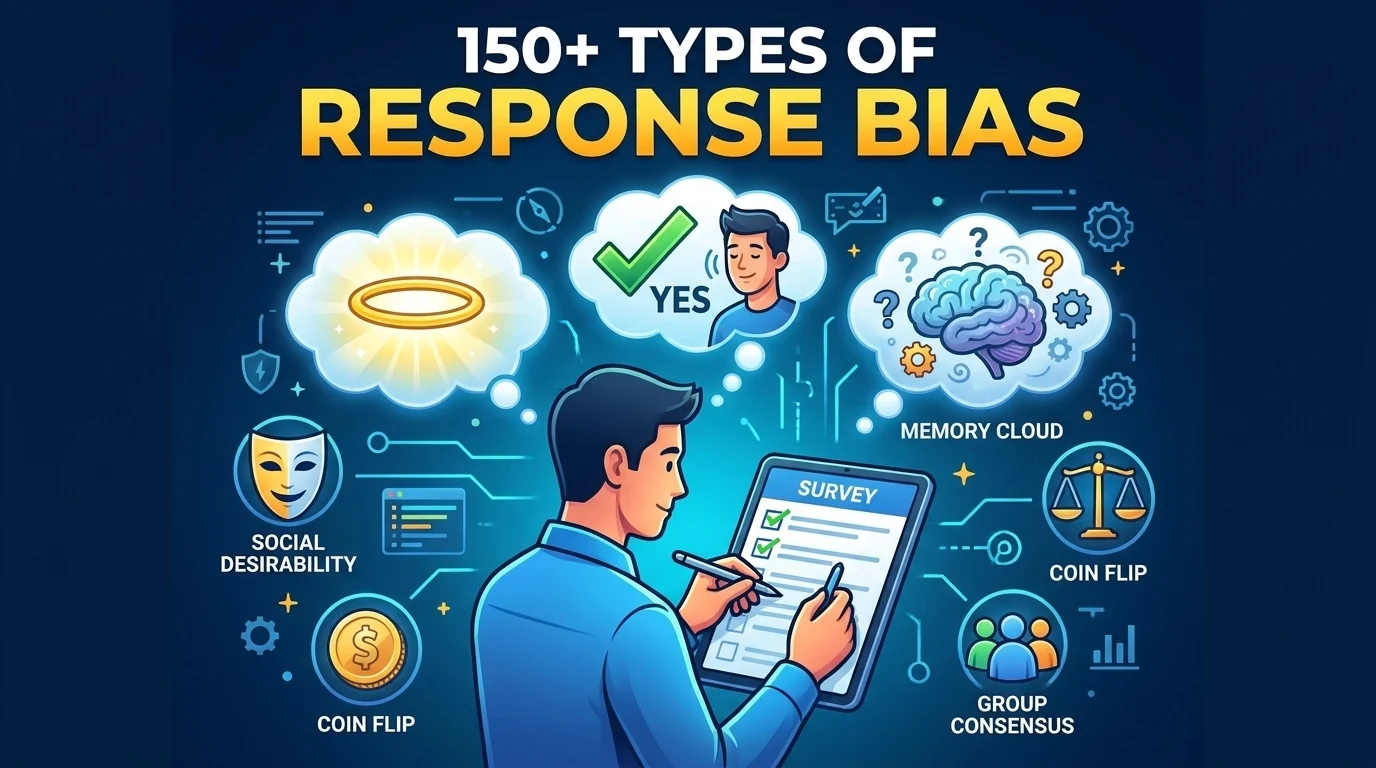
The most common types of response bias include social desirability bias, acquiescence bias, demand characteristics, extreme responding bias, and central tendency bias. These biases shape how people answer questions in surveys, polls, and even casual chats.
Ever filled out a survey and felt the urge to answer what sounded good instead of what was true? That is response bias in action. It pops up in job interviews, dating app chats, customer feedback forms, and even group texts with your friends. Understanding the different types of response bias helps you spot when answers are not as honest as they seem.
Whether you are a researcher, a marketer, or just someone who loves decoding human behavior, knowing these biases gives you an edge. It explains why your crush said “I am fine” when they were clearly not. It shows why people tick certain boxes on questionnaires just to get them done. Let us break down the most common types in a way that is fun, useful, and totally shareable.
Social Desirability Bias
- “I always recycle and never skip leg day.”
- Example: Someone answers a health survey and claims they exercise daily, even though they have not worked out in months.
- Meaning: This bias makes people present themselves in the best light to impress others.
- “I read to my kids every single night.”
- Example: A parent fills out a school questionnaire and overstates their involvement.
- Meaning: It reflects the desire to be seen as a perfect parent.
- “I have never told a lie.”
- Example: A participant in a honesty study gives an answer that is obviously untrue.
- Meaning: It shows people want to appear morally upright.
- “Of course I donate to charity every month.”
- Example: Someone in a focus group claims regular giving, but their bank statement says otherwise.
- Meaning: It is about looking generous rather than being accurate.
- “I eat five servings of veggies daily.”
- Example: A diet survey gets answers that do not match actual eating habits.
- Meaning: People want to seem healthy even when they are not.
- “I always follow the speed limit.”
- Example: A driving survey gets perfect answers from people with speeding tickets.
- Meaning: It is the urge to appear law-abiding.
- “I never gossip about coworkers.”
- Example: An office culture survey gets glowing self-reports.
- Meaning: It protects one’s social image.
- “I vote in every single election.”
- Example: A political poll gets inflated turnout claims.
- Meaning: It makes people feel like good citizens.
- “I floss twice a day, every day.”
- Example: A dental survey gets answers that dentists know are false.
- Meaning: It is about avoiding judgment.
- “I have never skipped a class.”
- Example: A student survey gets perfect attendance claims.
- Meaning: It helps maintain a responsible reputation.
- “I always return my shopping cart.”
- Example: A community survey gets saintly answers.
- Meaning: It shows the need for social approval.
- “I listen to educational podcasts only.”
- Example: A media survey gets highbrow answers that do not match playlist history.
- Meaning: It is about appearing cultured.
Acquiescence Bias
- “Yes, I agree with that statement.”
- Example: A respondent agrees with every item on a questionnaire, even contradictory ones.
- Meaning: This bias makes people say yes just to be agreeable.
- “Sure, that sounds good to me.”
- Example: Someone in a meeting nods along to every idea without thinking.
- Meaning: It avoids conflict and keeps things smooth.
- “I guess I like that brand.”
- Example: A customer gives positive ratings to every product in a survey.
- Meaning: It is easier to agree than to evaluate.
- “Yeah, I do that all the time.”
- Example: A person claims to perform a behavior just because the question suggested it.
- Meaning: It reflects a yes-saying habit.
- “Absolutely, I support that policy.”
- Example: A voter agrees with every proposed law in a poll.
- Meaning: It shows a lack of critical engagement.
- “Correct, I have experienced that.”
- Example: A patient agrees to every symptom on a checklist.
- Meaning: It leads to over-reporting.
- “True, I believe that too.”
- Example: A student agrees with every statement in a personality test.
- Meaning: It is about going with the flow.
- “Yep, that is me.”
- Example: A dating profile quiz gets yes answers to every trait.
- Meaning: It makes people seem agreeable but vague.
- “I agree with all of the above.”
- Example: A feedback form gets a blanket yes.
- Meaning: It saves mental effort.
- “Sure, why not.”
- Example: A friend agrees to every plan without real enthusiasm.
- Meaning: It is passive agreement.
- “Okay, I am in.”
- Example: A group chat gets a yes to every suggestion.
- Meaning: It avoids rocking the boat.
- “That works for me.”
- Example: A scheduling survey gets yes to every time slot.
- Meaning: It is a default response.
Demand Characteristics
- “I think I know what you want me to say.”
- Example: A participant in a study guesses the hypothesis and answers accordingly.
- Meaning: This bias makes people change behavior to fit perceived expectations.
- “I will act extra helpful because I am being watched.”
- Example: Someone in a lab study becomes unusually polite.
- Meaning: It is about performing for the researcher.
- “I should probably say I enjoyed the task.”
- Example: A subject gives positive feedback because the experimenter seems to want it.
- Meaning: It is people-pleasing in research settings.
- “Let me give the answer that makes me look smart.”
- Example: A quiz participant overthinks answers to match what they think is correct.
- Meaning: It is about meeting perceived demands.
- “I will pretend to be less nervous than I am.”
- Example: A job interview candidate hides anxiety because they think confidence is expected.
- Meaning: It is a performance based on cues.
- “I bet they want me to choose option A.”
- Example: A survey taker picks the first option because it feels like the intended answer.
- Meaning: It is guessing the researcher’s goal.
- “I will act more extroverted because the study is about socializing.”
- Example: An introvert forces small talk in a group experiment.
- Meaning: It is adapting to the study’s theme.
- “I should probably not admit I do not care.”
- Example: A participant feigns interest in a boring task.
- Meaning: It is hiding true feelings to fit in.
- “They seem to want a positive review.”
- Example: A product tester gives higher stars than deserved.
- Meaning: It is fulfilling an unspoken request.
- “I will answer faster because they seem impatient.”
- Example: A respondent rushes through questions to match the vibe.
- Meaning: It is picking up on subtle cues.
- “I think I am supposed to feel happy.”
- Example: A mood study gets fake smiles.
- Meaning: It is conforming to expected emotions.
- “Let me just give them what they want.”
- Example: A focus group participant agrees with the moderator.
- Meaning: It is surrendering to perceived demands.
Extreme Responding Bias
- “I absolutely love it or I absolutely hate it.”
- Example: A customer gives either 1 star or 5 stars, never in between.
- Meaning: This bias makes people choose extreme options on rating scales.
- “Everything is either amazing or terrible.”
- Example: A survey respondent uses only the ends of a Likert scale.
- Meaning: It reflects black-and-white thinking.
- “I never do that, ever.”
- Example: A frequency question gets a “never” when the truth is “sometimes.”
- Meaning: It is an all-or-nothing answer.
- “I always do that, no exceptions.”
- Example: A habit survey gets an “always” from someone who skips occasionally.
- Meaning: It exaggerates consistency.
- “That was the best meal of my life.”
- Example: A restaurant review is overly enthusiastic after one good bite.
- Meaning: It is extreme praise.
- “That was the worst experience ever.”
- Example: A minor inconvenience gets a dramatic one-star review.
- Meaning: It is extreme criticism.
- “I completely agree with every word.”
- Example: A debate response is totally one-sided.
- Meaning: It lacks nuance.
- “I strongly disagree with all of it.”
- Example: A policy survey gets a fierce rejection.
- Meaning: It is polarized thinking.
- “This is perfect in every way.”
- Example: A product rating ignores small flaws.
- Meaning: It is idealization.
- “This is a total disaster.”
- Example: A small mistake gets blown out of proportion.
- Meaning: It is catastrophizing.
- “I would give it a million stars if I could.”
- Example: An app review goes overboard.
- Meaning: It is exaggerated positivity.
- “I would rate it negative five if possible.”
- Example: A bad experience gets an extreme negative score.
- Meaning: It is intense dissatisfaction.
Central Tendency Bias
- “I will just pick the middle option.”
- Example: A respondent chooses neutral for every question.
- Meaning: This bias makes people avoid extremes and stay safe.
- “It is neither good nor bad.”
- Example: A movie review lands on three stars out of five.
- Meaning: It is a fence-sitting response.
- “I do not feel strongly either way.”
- Example: A political poll gets a moderate answer on a heated issue.
- Meaning: It avoids commitment.
- “Average is fine with me.”
- Example: A satisfaction survey gets a bland “okay.”
- Meaning: It is playing it safe.
- “I will just say sometimes.”
- Example: A frequency question gets a middle-of-the-road answer.
- Meaning: It is avoiding precision.
- “It was alright, I guess.”
- Example: A food review gives a lukewarm response.
- Meaning: It is reluctance to judge.
- “I have no strong opinion.”
- Example: A debate survey gets a shrug in text form.
- Meaning: It is disengagement.
- “Somewhere in the middle.”
- Example: A rating scale gets a default midpoint.
- Meaning: It is the safest choice.
- “I would say it is okay.”
- Example: A service review is neither glowing nor harsh.
- Meaning: It is moderate feedback.
- “Not great, not terrible.”
- Example: A performance review is perfectly average.
- Meaning: It is balanced but unhelpful.
- “I am neutral on that.”
- Example: A controversial topic gets a neutral stance.
- Meaning: It avoids taking sides.
- “It is what it is.”
- Example: A survey gets a resigned middle answer.
- Meaning: It is passive acceptance.
Non-Response Bias
- “I am not going to answer that.”
- Example: A survey gets skipped questions from a certain demographic.
- Meaning: This bias happens when people who do not respond differ from those who do.
- “I will just close the form.”
- Example: A long questionnaire gets abandoned halfway.
- Meaning: It leads to incomplete data.
- “I never pick up unknown numbers.”
- Example: A phone poll reaches only people who answer calls.
- Meaning: It skews the sample.
- “I do not do online surveys.”
- Example: An email survey gets low response from older adults.
- Meaning: It creates a gap in representation.
- “I am too busy to participate.”
- Example: A workplace survey gets responses only from those with free time.
- Meaning: It misses busy employees.
- “I will just ignore this email.”
- Example: A customer feedback request gets deleted.
- Meaning: It silences certain voices.
- “I do not trust polls.”
- Example: A political survey gets low turnout from skeptics.
- Meaning: It biases the results.
- “I will let someone else answer.”
- Example: A group survey gets only the loudest voices.
- Meaning: It underrepresents quiet people.
- “I never win anyway.”
- Example: A prize draw survey gets responses only from optimists.
- Meaning: It excludes the cynical.
- “I do not have time for this.”
- Example: A quick poll gets skipped by busy professionals.
- Meaning: It creates a time-based bias.
- “I will just not click the link.”
- Example: An online study gets low click-through.
- Meaning: It misses less tech-savvy people.
- “I am not interested.”
- Example: A research invitation gets declined.
- Meaning: It leads to voluntary response bias.
Question Order Bias
- “I answered differently because of the previous question.”
- Example: A survey asks about happiness, then about marriage, and answers shift.
- Meaning: This bias shows that earlier questions influence later ones.
- “That first question put me in a bad mood.”
- Example: A negative question makes subsequent ratings lower.
- Meaning: It is a carryover effect.
- “I forgot my original opinion after reading the next one.”
- Example: A long survey changes answers as people go.
- Meaning: It is context-dependent responding.
- “I feel like I should be consistent with my last answer.”
- Example: A respondent tries to match previous choices.
- Meaning: It is a consistency pressure.
- “The order made me think about things differently.”
- Example: A poll on immigration after a question on crime gets harsher answers.
- Meaning: It is priming.
- “I would have answered differently if that came first.”
- Example: A product survey gets different results based on question sequence.
- Meaning: It is order sensitivity.
- “I am just going to repeat my last answer.”
- Example: A respondent stops thinking and copies previous responses.
- Meaning: It is fatigue.
- “That question made me second-guess myself.”
- Example: A self-esteem survey gets lower scores after a comparison question.
- Meaning: It is contrast effect.
- “I am now thinking about the opposite.”
- Example: A question about dislikes before likes changes the likes.
- Meaning: It is a rebound effect.
- “I feel like the survey is leading me somewhere.”
- Example: A series of questions builds a narrative.
- Meaning: It is a funnel effect.
- “I am just clicking through now.”
- Example: A long survey gets random answers at the end.
- Meaning: It is respondent fatigue.
- “I cannot remember what I said before.”
- Example: A respondent contradicts earlier answers.
- Meaning: It is memory overload.
Leading Question Bias
- “The question made me feel like I should say yes.”
- Example: “Don’t you think our service is great?” gets more yes answers.
- Meaning: This bias comes from wording that pushes a certain answer.
- “I felt pressured to agree.”
- Example: A survey asks, “How much did you enjoy the event?” assuming enjoyment.
- Meaning: It is a loaded question.
- “That question was not neutral at all.”
- Example: “How often do you lie?” assumes everyone lies.
- Meaning: It is a presupposition.
- “I answered to match the tone.”
- Example: A positive question gets a positive answer.
- Meaning: It is emotional priming.
- “I felt like the answer was obvious.”
- Example: “Do you support saving the planet?” gets a yes.
- Meaning: It is a socially loaded question.
- “I did not want to look bad.”
- Example: “Why do you waste so much time?” makes people defensive.
- Meaning: It is accusatory wording.
- “The options were all one-sided.”
- Example: A multiple choice question has no negative options.
- Meaning: It is forced choice bias.
- “I just picked the one that sounded best.”
- Example: A brand survey uses glowing adjectives.
- Meaning: It is wording bias.
- “I felt like I had to agree to move on.”
- Example: A pop-up asks, “Are you sure you want to miss out?”
- Meaning: It is push polling.
- “The question assumed I already do it.”
- Example: “How often do you exercise?” assumes the person exercises.
- Meaning: It is a leading assumption.
- “I answered the opposite just to rebel.”
- Example: An aggressive question gets a defiant answer.
- Meaning: It is reactance.
- “I felt manipulated.”
- Example: A survey uses guilt to get a response.
- Meaning: It is coercive questioning.
Recall Bias
- “I think it happened last week, maybe.”
- Example: A health survey asks about symptoms from months ago.
- Meaning: This bias is about inaccurate memories.
- “I do not remember exactly, but I will guess.”
- Example: A dietary recall gets vague estimates.
- Meaning: It is memory error.
- “I probably did that more than I actually did.”
- Example: A exercise survey gets overestimated activity.
- Meaning: It is social desirability mixed with recall.
- “I forgot about that completely.”
- Example: A customer survey misses an important detail.
- Meaning: It is omission.
- “I am not sure if it was Tuesday or Wednesday.”
- Example: A timeline question gets fuzzy answers.
- Meaning: It is temporal confusion.
- “I remember it differently now.”
- Example: A witness statement changes over time.
- Meaning: It is memory reconstruction.
- “I only remember the big things.”
- Example: A survey misses small but important behaviors.
- Meaning: It is selective recall.
- “I think I did it more often than I did.”
- Example: A frequency question gets inflated numbers.
- Meaning: It is telescoping.
- “I do not recall that at all.”
- Example: A follow-up survey gets a blank.
- Meaning: It is forgetting.
- “My memory is a bit hazy.”
- Example: A past experience survey gets uncertain answers.
- Meaning: It is low confidence recall.
- “I will just approximate.”
- Example: A time-use survey gets rough guesses.
- Meaning: It is estimation error.
- “I think it was better than it was.”
- Example: A vacation review gets rosy memories.
- Meaning: It is rosy retrospection.
Halo Effect Bias
- “They are nice, so everything they do must be good.”
- Example: A customer rates a product highly because the salesperson was friendly.
- Meaning: This bias lets one positive trait color all judgments.
- “I like them, so I will rate their work higher.”
- Example: A manager gives a good review because they like the employee.
- Meaning: It is personal liking affecting evaluation.
- “They are attractive, so they must be smart too.”
- Example: A hiring panel overrates a candidate’s skills.
- Meaning: It is the physical attractiveness halo.
- “That brand is cool, so their new product must be great.”
- Example: A loyal fan gives a five-star review without trying it.
- Meaning: It is brand halo.
- “They went to a good school, so they are competent.”
- Example: A recruiter overlooks red flags.
- Meaning: It is prestige bias.
- “The first answer was good, so the rest must be too.”
- Example: A survey respondent gives high marks throughout.
- Meaning: It is a global impression.
- “They are famous, so their opinion matters.”
- Example: A celebrity endorsement sways ratings.
- Meaning: It is fame halo.
- “I like their voice, so I trust them.”
- Example: A podcast host gets higher trust ratings.
- Meaning: It is vocal halo.
- “They are well-dressed, so they are professional.”
- Example: A consultant gets a higher rating.
- Meaning: It is appearance halo.
- “They smiled at me, so they must be kind.”
- Example: A survey rates a stranger as more generous.
- Meaning: It is warmth halo.
- “They are funny, so they are probably smart.”
- Example: A comedian gets overrated on intelligence.
- Meaning: It is humor halo.
- “I had one good experience, so all future ones will be good.”
- Example: A customer keeps buying despite issues.
- Meaning: It is halo persistence.
Confirmation Bias in Responses
- “I only see the answers that match what I already think.”
- Example: A researcher interprets ambiguous data as supporting their hypothesis.
- Meaning: This bias is about seeking confirming evidence.
- “I will ignore the parts that do not fit.”
- Example: A survey respondent skips questions that challenge their view.
- Meaning: It is selective attention.
- “That proves I was right.”
- Example: A poll result is celebrated by one side only.
- Meaning: It is interpretation bias.
- “I knew it all along.”
- Example: A person claims they predicted an outcome after the fact.
- Meaning: It is hindsight bias.
- “I will only share the good reviews.”
- Example: A business highlights positive feedback.
- Meaning: It is cherry-picking.
- “I do not believe that study because it goes against my beliefs.”
- Example: A respondent dismisses evidence.
- Meaning: It is disconfirmation bias.
- “I will ask questions that get the answers I want.”
- Example: A pollster words questions to confirm a viewpoint.
- Meaning: It is loaded questioning.
- “I will remember the hits and forget the misses.”
- Example: A psychic’s correct guesses are remembered.
- Meaning: It is selective memory.
- “I will interpret that as agreement.”
- Example: A neutral comment is seen as supportive.
- Meaning: It is projection.
- “I will look for flaws in the other side.”
- Example: A debate watcher nitpicks the opponent.
- Meaning: It is motivated reasoning.
- “I will only trust sources that agree with me.”
- Example: A news consumer stays in an echo chamber.
- Meaning: It is source bias.
- “I will see what I want to see.”
- Example: A person reads a vague horoscope as accurate.
- Meaning: It is subjective validation.
Courtesy Bias
- “I do not want to be rude, so I will say it was good.”
- Example: A guest tells a host the meal was great even if it was bland.
- Meaning: This bias is about being polite over honest.
- “I will give a positive rating to avoid conflict.”
- Example: A customer rates a service highly to avoid awkwardness.
- Meaning: It is conflict avoidance.
- “I will not complain because they tried hard.”
- Example: A patient does not report a bad experience.
- Meaning: It is empathy over accuracy.
- “I will just say it was fine.”
- Example: A survey gets a “fine” when the truth is “poor.”
- Meaning: It is minimizing negativity.
- “I do not want to hurt their feelings.”
- Example: A friend gives a fake compliment on a creative project.
- Meaning: It is kindness bias.
- “I will agree even if I do not.”
- Example: A diner says the food was good to please the chef.
- Meaning: It is social harmony.
- “I will not give a low score because it feels mean.”
- Example: A teacher avoids harsh grades.
- Meaning: It is leniency bias.
- “I will say thank you and move on.”
- Example: A customer accepts a flawed product without complaint.
- Meaning: It is passive acceptance.
- “I will focus on the positive parts.”
- Example: A reviewer highlights one good thing and ignores the rest.
- Meaning: It is Pollyanna bias.
- “I do not want to seem difficult.”
- Example: A respondent gives neutral answers to avoid trouble.
- Meaning: It is image management.
- “I will just smile and nod.”
- Example: A focus group participant agrees with everything.
- Meaning: It is non-confrontational.
- “I will say it was okay to be nice.”
- Example: A hotel review is overly generous.
- Meaning: It is courtesy over candor.
Hostility Bias
- “I am going to give a bad rating no matter what.”
- Example: A customer takes out frustration on a survey.
- Meaning: This bias is about negative reactions unrelated to the service.
- “I do not trust anyone, so I will answer negatively.”
- Example: A poll gets low trust scores from a cynical respondent.
- Meaning: It is generalized suspicion.
- “I will complain about everything.”
- Example: A reviewer finds faults in every detail.
- Meaning: It is nitpicking.
- “I will assume the worst.”
- Example: A respondent interprets neutral questions as attacks.
- Meaning: It is hostile attribution.
- “I will punish them with my answers.”
- Example: A bad experience leads to exaggerated negative feedback.
- Meaning: It is retaliation.
- “I do not believe anything they say.”
- Example: A survey gets complete distrust.
- Meaning: It is cynicism.
- “I will give them a piece of my mind.”
- Example: A feedback form gets an angry rant.
- Meaning: It is venting.
- “I will rate them low because I am in a bad mood.”
- Example: A restaurant review reflects personal stress.
- Meaning: It is mood bias.
- “I will not give them any credit.”
- Example: A employee survey ignores positive changes.
- Meaning: It is negativity bias.
- “I will answer in the most negative way possible.”
- Example: A scale gets the lowest option every time.
- Meaning: It is extreme negativity.
- “I will assume they are lying.”
- Example: A research study gets hostile skepticism.
- Meaning: It is distrust.
- “I will make them regret asking.”
- Example: A survey invitation gets a rude response.
- Meaning: It is aggression.
Ambiguity Bias
- “I am not sure what that question meant, so I will guess.”
- Example: A vague survey item gets random answers.
- Meaning: This bias comes from unclear wording.
- “That could mean two different things.”
- Example: A respondent interprets “family” as immediate or extended.
- Meaning: It is semantic ambiguity.
- “I will answer based on my own definition.”
- Example: A health survey gets inconsistent answers about “exercise.”
- Meaning: It is subjective interpretation.
- “I do not know what they are asking.”
- Example: A double-barreled question confuses the respondent.
- Meaning: It is question complexity.
- “I will just pick something.”
- Example: A poorly worded item gets a random response.
- Meaning: It is satisficing.
- “That word is too vague.”
- Example: “Often” means different things to different people.
- Meaning: It is frequency ambiguity.
- “I am not sure if that includes me.”
- Example: A demographic question misses a category.
- Meaning: It is exclusion ambiguity.
- “I will skip it because I do not understand.”
- Example: A technical question gets no answer.
- Meaning: It is comprehension failure.
- “I will answer the way I think they mean.”
- Example: A respondent guesses the intent.
- Meaning: It is assumed meaning.
- “That scale is not clear.”
- Example: A Likert scale lacks labels.
- Meaning: It is format ambiguity.
- “I will ask for clarification.”
- Example: A participant raises their hand in a study.
- Meaning: It is active clarification.
- “I will just go with my gut.”
- Example: An ambiguous question gets an intuitive answer.
- Meaning: It is heuristic processing.
Anchoring Bias in Responses
- “I will start with the first number I saw.”
- Example: A salary question gets anchored by a low initial offer.
- Meaning: This bias is about relying on the first piece of information.
- “That initial rating changed my answer.”
- Example: A survey shows a high number before asking for a estimate.
- Meaning: It is anchor effect.
- “I will adjust from the starting point.”
- Example: A respondent uses a suggested range to answer.
- Meaning: It is insufficient adjustment.
- “The first option seemed reasonable.”
- Example: A multiple choice question gets more picks for option A.
- Meaning: It is primacy effect.
- “I will compare everything to that first example.”
- Example: A product review is influenced by the first review read.
- Meaning: It is comparative anchoring.
- “I will not go too far from that number.”
- Example: A negotiation gets stuck near the opening bid.
- Meaning: It is anchor constraint.
- “That high price made the lower one seem cheap.”
- Example: A decoy pricing strategy works.
- Meaning: It is contrast anchoring.
- “I will use that as my reference point.”
- Example: A survey on spending uses a suggested amount.
- Meaning: It is reference dependence.
- “I will just split the difference.”
- Example: A compromise answer is influenced by two anchors.
- Meaning: It is midpoint anchoring.
- “That first impression stuck with me.”
- Example: A interview rating is biased by the first answer.
- Meaning: It is halo anchoring.
- “I will not question the starting value.”
- Example: A respondent accepts a suggested baseline.
- Meaning: It is anchor acceptance.
- “I will answer relative to that.”
- Example: A happiness survey uses a previous question as anchor.
- Meaning: It is relative judgment.
FAQs
What are types of response bias?
They are different ways people answer questions inaccurately, often due to social pressure, memory, or question wording.
Which type of response bias is most common?
Social desirability bias is one of the most common, especially in surveys about sensitive topics.
Can response bias be flirty?
Not really. It is a research term. But in dating, someone might give socially desirable answers to impress.
How do I avoid response bias in my survey?
Use neutral wording, ensure anonymity, and test your questions with a small group first.
Is humor okay when discussing response bias?
Yes, light humor makes the topic easier to understand and share.
Conclusion
Understanding the different types of response bias is like getting a secret decoder ring for human behavior. It explains why your friend says “I am fine” when they are not, and why online reviews can be wildly misleading. Once you know these biases, you can spot them in surveys, conversations, and even your own answers.
So go ahead and share this guide with your curious friends. Save it for your next research project. Try out a few of these insights in your daily life. The more you know, the better you can decode what people really mean. Happy bias-spotting!
