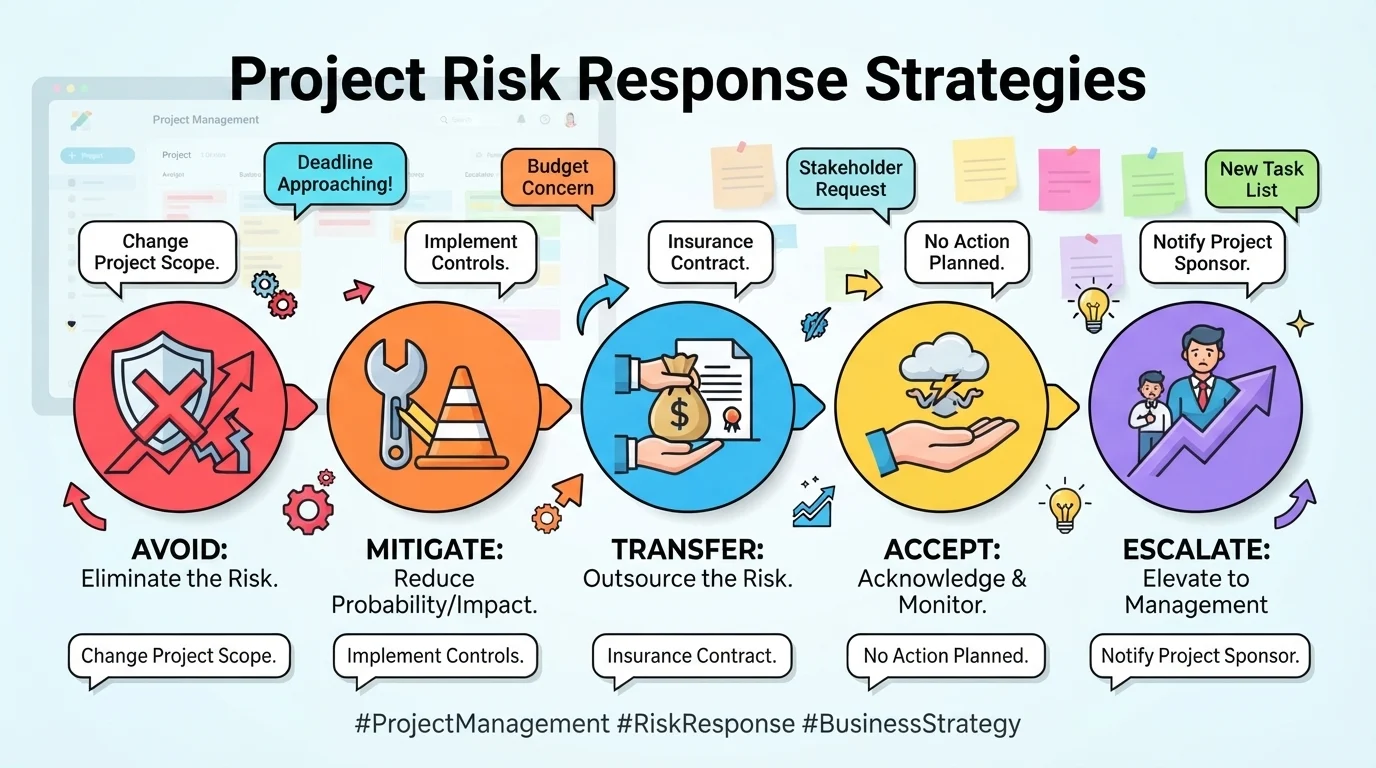
Risk response strategies are the plans you use to handle threats and opportunities before they wreck your project or your peace. The top five are avoid, mitigate, transfer, accept, and escalate.
Risk response strategies are not just boring project management words. They are the difference between a small hiccup and a full meltdown at work, in life, and in your group chat. When someone asks how you will handle a problem, your answer says a lot about how you think.
Maybe you are in a meeting, replying to a client, or texting your teammate about a deadline that just got wrecked. The right response can calm the room, buy you time, or make you look like the person who actually has a clue. This guide gives you ready-to-use lines for every risk vibe.
Funny Risk Response Strategies
- Let’s just pretend that risk does not exist and hope for the best.
Example: Saying this in a team meeting when someone brings up a minor issue.
Meaning: A joke to lighten the mood before you actually address the risk. - We will handle it with thoughts and prayers.
Example: Using this when a low-priority risk pops up on the radar.
Meaning: A funny way to say you have no real plan yet. - Put it on the risk register and hope it gets scared.
Example: Replying to a coworker who asks how you will deal with a new threat.
Meaning: A playful take on documenting risks without solving them. - Our risk response strategy is vibes. Strong vibes.
Example: Saying this when your team has no budget for a real solution.
Meaning: A humorous way to admit you are improvising. - Let’s avoid it by never leaving our houses again.
Example: Joking about a risk that feels too big to handle.
Meaning: A dramatic but funny way to suggest avoidance. - I will mitigate it with coffee and a very calm face.
Example: Texting your work bestie before a tough client call.
Meaning: A funny way to say you are coping, not solving. - Transfer it to Dave. Dave loves risk.
Example: Saying this when a teammate jokes about passing the buck.
Meaning: A humorous way to mention risk transfer without being serious. - We accept this risk like we accept our group chat chaos.
Example: Responding to a small risk that everyone has ignored for weeks.
Meaning: A funny comparison to normal life chaos. - Let’s escalate it to the universe.
Example: Joking when a problem feels completely out of your hands.
Meaning: A silly way to say you need higher powers. - Our strategy is to panic early and often.
Example: Saying this during a brainstorming session about project threats.
Meaning: A humorous way to describe poor risk planning. - We will just call it a plot twist and move on.
Example: Texting your team when an unexpected issue ruins the plan.
Meaning: A funny way to reframe a risk as a story beat. - If it goes wrong, we blame Mercury retrograde.
Example: Joking about a risk with no clear cause.
Meaning: A playful way to dodge responsibility.
Brutal Risk Response Strategies
- We kill this risk before it kills the project.
Example: Saying this in a steering committee when a threat is serious.
Meaning: A direct way to prioritize risk elimination. - No plan means no mercy. Fix it today.
Example: Telling your team after a risk review reveals gaps.
Meaning: A harsh push for immediate action. - We either avoid it or we own the failure.
Example: Responding to a risk that leadership keeps ignoring.
Meaning: Forces a clear decision and accountability. - Hope is not a risk response strategy.
Example: Saying this when someone suggests waiting and seeing.
Meaning: A blunt reminder to use real risk planning. - If we cannot mitigate it, we cut it.
Example: Discussing a risky feature that may not ship on time.
Meaning: A decisive approach to scope reduction. - Transfer it or terminate it. Your choice.
Example: Telling a vendor that the risk is now their problem.
Meaning: Puts the pressure on someone else to act. - We do not accept risks we cannot survive.
Example: Saying this in a budget meeting about a major threat.
Meaning: Sets a hard limit on what the team can tolerate. - Stop documenting. Start fixing.
Example: Replying to a manager who keeps adding risks to a spreadsheet.
Meaning: Pushes for action over paperwork. - This risk is not a pet. We do not keep it.
Example: Joking but serious when a known issue keeps hanging around.
Meaning: A firm way to say unresolved risks must go. - Own it, solve it, or step aside.
Example: Telling a team member who keeps avoiding a critical risk.
Meaning: Demands responsibility and movement. - We are not gambling with the deadline.
Example: Responding to a risky shortcut that could delay launch.
Meaning: Rejects unnecessary risk-taking. - If it fails, it fails loudly. Then we fix it.
Example: Saying this when a risk is unavoidable and must be monitored.
Meaning: A tough but realistic acceptance of consequences.
Professional Risk Response Strategies
- Let’s document the risk and assign an owner.
Example: Saying this in a project kickoff meeting.
Meaning: A standard professional step for risk accountability. - We will mitigate this with a backup plan.
Example: Responding to a supplier delay risk.
Meaning: Shows a clear, professional response to reduce impact. - I recommend we transfer this risk to a vendor.
Example: Discussing a technical risk outside your team’s expertise.
Meaning: A formal way to shift risk through contracts or insurance. - The team will monitor this risk weekly.
Example: Replying to a stakeholder who wants regular updates.
Meaning: A professional commitment to tracking. - We should avoid this by changing the scope.
Example: Saying this when a feature creates legal exposure.
Meaning: A formal suggestion to remove the risk source. - Let’s accept the risk and set a contingency budget.
Example: Responding to a low-impact risk that is too costly to fix.
Meaning: A professional way to acknowledge and prepare. - I will escalate this to the steering committee.
Example: Saying this when a risk exceeds your authority.
Meaning: A formal path for higher-level decisions. - We need a risk response plan by Friday.
Example: Replying to a manager during a project review.
Meaning: Sets a clear professional deadline. - Let’s review the probability and impact first.
Example: Saying this before choosing a response strategy.
Meaning: A logical, professional starting point. - The mitigation steps are already in the project plan.
Example: Responding to a stakeholder who asks about readiness.
Meaning: Shows the risk is already being managed. - We will communicate updates through the risk log.
Example: Replying to a client who wants transparency.
Meaning: A professional way to keep everyone informed. - This risk is now closed. No further action needed.
Example: Saying this after a threat has passed.
Meaning: A formal closure of a risk item.
Strategic Risk Response Strategies
- We avoid the risk by choosing a different market.
Example: Discussing expansion plans with leadership.
Meaning: A strategic move to sidestep a major threat. - We mitigate by diversifying our suppliers.
Example: Responding to supply chain uncertainty.
Meaning: Reduces dependence on a single source. - We transfer the risk through a strategic partnership.
Example: Negotiating a joint venture for a high-cost project.
Meaning: Shares risk with a partner. - We accept the risk because the upside is huge.
Example: Deciding to launch in a volatile region.
Meaning: A calculated strategic bet. - We exploit the opportunity hidden in this risk.
Example: Turning a competitor’s weakness into your advantage.
Meaning: Uses risk as a chance for growth. - We escalate to the board for a strategic decision.
Example: Saying this when a risk affects company direction.
Meaning: Moves the decision to top leadership. - We build a contingency plan for the worst case.
Example: Preparing for a regulatory change.
Meaning: A strategic safety net. - We reduce risk by phasing the rollout.
Example: Launching a product in stages instead of all at once.
Meaning: Limits exposure while learning. - We share the risk with a key client.
Example: Structuring a contract with shared penalties.
Meaning: Aligns incentives and reduces solo exposure. - We pivot before the risk becomes a crisis.
Example: Changing strategy when early warning signs appear.
Meaning: A proactive strategic shift. - We invest in resilience instead of quick fixes.
Example: Spending on cybersecurity before a breach.
Meaning: A long-term strategic response. - We track leading indicators, not just lagging ones.
Example: Monitoring customer churn before revenue drops.
Meaning: Uses early data to guide strategy.
Creative Risk Response Strategies
- Let’s turn the risk into a feature.
Example: When a product limitation becomes a selling point.
Meaning: A creative reframe of a threat. - We could gamify the mitigation plan.
Example: Motivating a team to complete risk tasks.
Meaning: Uses fun to drive risk action. - What if we prototype the worst-case scenario?
Example: Testing a failure before it happens.
Meaning: A creative way to learn and prepare. - Let’s crowdsource the risk response.
Example: Asking the whole company for ideas.
Meaning: Brings diverse thinking to a problem. - We can create a risk response playbook as a comic.
Example: Making training more memorable.
Meaning: Uses storytelling for risk awareness. - Let’s run a pre-mortem and imagine the failure.
Example: Before launching a big project.
Meaning: A creative exercise to surface hidden risks. - We could make the risk visible with a dashboard.
Example: Showing real-time threat levels to everyone.
Meaning: Uses visual design to improve response. - Let’s assign a mascot to our risk process.
Example: Making risk reviews less boring.
Meaning: A creative way to build culture. - We can trade this risk for a different one.
Example: Swapping a high-impact risk for a low-impact one.
Meaning: A creative negotiation approach. - Let’s write a letter from the future about how we solved it.
Example: Team workshop on risk planning.
Meaning: Uses backward thinking to find solutions. - We could build a risk response chatbot.
Example: Helping employees find the right action fast.
Meaning: A creative automation of risk guidance. - Let’s celebrate the risks we close.
Example: Recognizing team members who solve threats.
Meaning: Reinforces positive risk behavior.
Sarcastic Risk Response Strategies
- Oh sure, let’s just ignore it and see what happens.
Example: Saying this when someone dismisses a clear risk.
Meaning: A sarcastic way to point out bad planning. - Great idea. Let’s add it to the list of things we never fix.
Example: Replying to a manager who keeps postponing risk work.
Meaning: Highlights neglect with sarcasm. - Our risk strategy is a sticky note. Very advanced.
Example: Joking about a weak risk process.
Meaning: Mocks inadequate planning. - Sure, we will mitigate it with a strongly worded email.
Example: Responding to a risk that needs real action.
Meaning: Sarcastically points out empty responses. - Let’s transfer it to the intern. They have free time.
Example: Joking about passing off a risk unfairly.
Meaning: A sarcastic take on bad delegation. - We accept the risk because who needs sleep anyway?
Example: Saying this during a crunch period.
Meaning: A sarcastic way to acknowledge overwork. - Escalate it. Maybe the CEO loves surprises.
Example: Replying to a risk that should have been handled earlier.
Meaning: Sarcastically suggests dumping the problem upward. - Let’s avoid it by pretending we never saw it.
Example: Joking about a risk that is already obvious.
Meaning: A sarcastic comment on avoidance. - Our contingency plan is to update our resumes.
Example: Saying this when a project looks doomed.
Meaning: A dark but funny take on poor risk management. - We will monitor it until it becomes a disaster.
Example: Replying to a team that refuses to act early.
Meaning: Sarcastically criticizes delayed response. - The risk register is now a novel. Still no solutions.
Example: Joking about too much documentation.
Meaning: Points out action is missing. - Let’s form a committee to discuss forming a committee.
Example: Saying this when risk decisions keep getting delayed.
Meaning: Sarcastically calls out slow bureaucracy.
Cautious Risk Response Strategies
- Let’s avoid the risk until we have more data.
Example: Discussing a new market entry.
Meaning: A careful approach to uncertainty. - We should mitigate slowly and test each step.
Example: Rolling out a new process.
Meaning: Reduces chance of unintended harm. - I recommend a small pilot before full transfer.
Example: Testing a vendor relationship.
Meaning: A cautious way to shift risk. - Let’s accept only the risks we can monitor.
Example: Reviewing low-level project threats.
Meaning: Sets safe boundaries for acceptance. - We need a backup plan before we escalate.
Example: Preparing for a leadership decision.
Meaning: Ensures options are ready. - Let’s document every assumption first.
Example: Starting a risk workshop.
Meaning: A cautious step to avoid blind spots. - We should set a trigger point for action.
Example: Defining when a risk becomes critical.
Meaning: Avoids delayed responses. - Let’s keep a contingency reserve untouched.
Example: Budgeting for unexpected issues.
Meaning: A cautious financial safeguard. - We need legal review before we proceed.
Example: Handling a contract risk.
Meaning: Reduces compliance exposure. - Let’s check with stakeholders before deciding.
Example: Responding to a risk with broad impact.
Meaning: A careful, inclusive approach. - We should rehearse the response plan.
Example: Before a major product launch.
Meaning: Ensures readiness without panic. - Let’s review this risk again next week.
Example: Saying this for a risk that is not urgent yet.
Meaning: A cautious commitment to ongoing monitoring.
Confident Risk Response Strategies
- We will avoid this risk with a clear scope change.
Example: Saying this in a project meeting.
Meaning: Shows decisive action. - We can mitigate this. We have done harder things.
Example: Responding to a tough technical risk.
Meaning: Builds confidence in the team. - Transfer it. We know the right partner.
Example: Handling a specialized risk.
Meaning: Shows certainty in the chosen strategy. - We accept it and we own the outcome.
Example: Deciding to move forward despite uncertainty.
Meaning: A confident acceptance of responsibility. - Escalate it. We need a fast decision.
Example: When a risk blocks progress.
Meaning: Confidently pushes for action. - Our response plan is ready. Let’s execute.
Example: Before a known risk event.
Meaning: Shows preparation and control. - We will not let this risk slow us down.
Example: Motivating a team during a setback.
Meaning: A confident commitment to momentum. - This risk is manageable. Here is how.
Example: Explaining a response to leadership.
Meaning: Confidently outlines a solution. - We have already built the contingency.
Example: Responding to a stakeholder concern.
Meaning: Shows proactive confidence. - We will turn this risk into an advantage.
Example: Using a market shift to improve position.
Meaning: A confident strategic reframe. - No panic. We have a plan for this.
Example: Calming a team during a crisis.
Meaning: Projects confidence and stability. - We will close this risk by Friday.
Example: Setting a firm deadline for mitigation.
Meaning: A confident commitment to resolution.
Collaborative Risk Response Strategies
- Let’s solve this risk together.
Example: Kicking off a cross-team meeting.
Meaning: Encourages shared ownership. - Who else needs to be in this conversation?
Example: When a risk touches multiple departments.
Meaning: Brings the right people to the table. - We can share the mitigation work.
Example: Dividing tasks for a complex risk.
Meaning: Makes the response faster and fairer. - Let’s align on the risk before we act.
Example: Starting a workshop with stakeholders.
Meaning: Builds common understanding. - I will own this part if you own that part.
Example: Splitting a risk response plan.
Meaning: Creates clear accountability. - Let’s ask the client how they want to handle it.
Example: For a risk that affects a customer.
Meaning: Includes the client in the response. - We should co-create the contingency plan.
Example: Working with partners on a backup.
Meaning: Builds shared commitment. - Let’s transfer this risk to a trusted partner.
Example: When another team has better expertise.
Meaning: Uses collaboration to reduce exposure. - Can we escalate this together?
Example: When a risk needs leadership support.
Meaning: Shows unity in asking for help. - Let’s document the decision as a team.
Example: After a risk response meeting.
Meaning: Ensures everyone remembers the plan. - We will review the risk in our next stand-up.
Example: Keeping a risk visible across teams.
Meaning: Maintains collaborative monitoring. - Your idea plus my idea equals a better plan.
Example: Combining two risk responses.
Meaning: Values teamwork in problem-solving.
Analytical Risk Response Strategies
- Let’s calculate the probability and impact first.
Example: Starting a risk assessment.
Meaning: Uses data to guide response. - We should compare avoid versus mitigate.
Example: Evaluating two options for a threat.
Meaning: A logical comparison of strategies. - What is the expected monetary value of this risk?
Example: Discussing financial exposure.
Meaning: Uses quantitative analysis. - Let’s run a Monte Carlo simulation.
Example: For a complex project schedule risk.
Meaning: Uses modeling to predict outcomes. - We need a sensitivity analysis.
Example: Identifying which risk matters most.
Meaning: Finds the biggest drivers of uncertainty. - Let’s rank risks by risk score.
Example: Prioritizing the risk register.
Meaning: Uses a consistent scoring method. - We should track leading indicators.
Example: Monitoring early signs of a supply issue.
Meaning: Provides early warning. - What does the historical data say?
Example: Reviewing past project failures.
Meaning: Uses past patterns to inform response. - Let’s model the best, worst, and likely case.
Example: Presenting scenarios to leadership.
Meaning: Shows a range of possible outcomes. - We need a decision tree for this risk.
Example: Choosing between two responses.
Meaning: Maps options and consequences. - Let’s measure the residual risk.
Example: After mitigation is applied.
Meaning: Checks what risk remains. - We will review the metrics monthly.
Example: For ongoing risk monitoring.
Meaning: Ensures data-driven follow-up.
Proactive Risk Response Strategies
- Let’s identify risks before they happen.
Example: Running a pre-mortem at project start.
Meaning: Prevents surprises. - We should mitigate now, not later.
Example: Fixing a small issue before it grows.
Meaning: Takes early action. - Let’s create a trigger for early escalation.
Example: Defining when to alert leadership.
Meaning: Ensures fast response. - We will build a contingency budget.
Example: Planning for unknown costs.
Meaning: Prepares financially for risk. - Let’s assign a risk owner today.
Example: During project kickoff.
Meaning: Ensures accountability. - We can avoid this by changing the design.
Example: Removing a dangerous feature early.
Meaning: Eliminates the risk source. - Let’s transfer the risk before it grows.
Example: Insuring a high-value asset.
Meaning: Shifts exposure early. - We should accept only small, monitored risks.
Example: Reviewing the risk appetite.
Meaning: Sets safe boundaries. - Let’s rehearse the response plan.
Example: Before a known high-risk event.
Meaning: Builds readiness. - We will monitor this risk weekly.
Example: For a risk with changing conditions.
Meaning: Keeps the response current. - Let’s document lessons learned now.
Example: After closing a risk.
Meaning: Improves future responses. - We can turn this risk into an opportunity.
Example: Using a change to innovate.
Meaning: Proactively seeks upside.
Practical Risk Response Strategies
- Let’s avoid it by simplifying the plan.
Example: Reducing project complexity.
Meaning: A practical way to remove risk. - We will mitigate with a backup supplier.
Example: Handling supply chain risk.
Meaning: A simple, effective reduction. - Transfer it through insurance.
Example: For liability risks.
Meaning: A practical way to shift financial exposure. - We accept it and move on.
Example: For a low-impact risk.
Meaning: Saves time and resources. - Escalate it to the project sponsor.
Example: When the team cannot decide.
Meaning: Moves the issue to the right level. - Let’s put a contingency plan in writing.
Example: For a known deadline risk.
Meaning: Makes the response actionable. - We need a clear risk owner.
Example: Assigning responsibility.
Meaning: Ensures someone is accountable. - Let’s set a review date.
Example: For a risk that is not urgent.
Meaning: Keeps it from being forgotten. - We will track this in the risk log.
Example: For ongoing visibility.
Meaning: A practical monitoring habit. - Let’s reduce the scope to reduce risk.
Example: When time is short.
Meaning: A practical trade-off. - We can test the response on a small scale.
Example: Before full implementation.
Meaning: Limits potential damage. - Let’s communicate the plan to everyone.
Example: After choosing a response.
Meaning: Ensures alignment and action.
Leadership Risk Response Strategies
- We will set the risk appetite clearly.
Example: In a leadership meeting.
Meaning: Defines how much risk is acceptable. - Let’s prioritize risks by strategic impact.
Example: Reviewing the top risk register.
Meaning: Focuses leaders on what matters. - We will fund the mitigation plan.
Example: Approving budget for risk reduction.
Meaning: Shows leadership commitment. - Let’s transfer this risk through a partnership.
Example: For a market entry risk.
Meaning: Uses strategy to share exposure. - We accept this risk for growth.
Example: Entering a new market.
Meaning: A calculated leadership decision. - We will escalate this to the board.
Example: For a risk with company-wide impact.
Meaning: Moves it to the highest level. - Let’s avoid this risk by exiting the segment.
Example: Leaving an unprofitable market.
Meaning: A bold strategic choice. - We need a crisis response team.
Example: For high-impact risks.
Meaning: Prepares leadership for fast action. - We will communicate transparently.
Example: During a public risk event.
Meaning: Builds trust with stakeholders. - Let’s review risk at every quarterly meeting.
Example: Making risk a standing agenda item.
Meaning: Keeps leadership engaged. - We will reward early risk reporting.
Example: Encouraging teams to speak up.
Meaning: Builds a healthy risk culture. - Let’s learn from this and improve.
Example: After a risk event.
Meaning: Turns experience into better strategy.
Beginner-Friendly Risk Response Strategies
- Start by writing down what could go wrong.
Example: For a new project.
Meaning: A simple first step in risk response. - Avoid the risk if you can remove the cause.
Example: Changing a plan to skip a known problem.
Meaning: Teaches the avoid strategy. - Mitigate by making the impact smaller.
Example: Adding a backup plan.
Meaning: Explains risk reduction. - Transfer the risk to someone else.
Example: Buying insurance.
Meaning: Introduces risk sharing. - Accept small risks and keep watching them.
Example: For minor issues.
Meaning: Teaches monitored acceptance. - Escalate when it is too big for you.
Example: Asking a manager for help.
Meaning: Shows when to ask for support. - Give each risk an owner.
Example: Assigning a teammate.
Meaning: Makes responsibility clear. - Set a date to review the risk.
Example: Adding it to a calendar.
Meaning: Prevents forgotten risks. - Write a simple response plan.
Example: One page with steps.
Meaning: Makes action easier. - Ask what could go right too.
Example: Looking for opportunities.
Meaning: Introduces positive risk response. - Practice your response before you need it.
Example: Running a small drill.
Meaning: Builds confidence. - Keep learning from every risk.
Example: After the project ends.
Meaning: Improves future responses.
Emergency Risk Response Strategies
- Activate the crisis plan now.
Example: During a major outage.
Meaning: Starts the emergency response. - Escalate to the incident commander.
Example: When a risk becomes a live crisis.
Meaning: Puts clear leadership in place. - Contain the impact first.
Example: Stopping a data breach from spreading.
Meaning: Limits immediate damage. - Communicate with stakeholders immediately.
Example: During a service disruption.
Meaning: Prevents rumors and panic. - Switch to the backup system.
Example: When the primary system fails.
Meaning: Uses a preplanned contingency. - Accept the short-term loss to protect the long term.
Example: Shutting down a feature to save the platform.
Meaning: Makes a tough emergency trade-off. - Transfer the emergency to experts.
Example: Calling in a specialized response team.
Meaning: Gets help fast. - Avoid further risk by pausing operations.
Example: Stopping a production line after a safety issue.
Meaning: Prevents more harm. - Mitigate with all available resources.
Example: Assigning every team to the response.
Meaning: Uses full capacity to reduce impact. - Document everything in real time.
Example: During an emergency response.
Meaning: Supports later review and learning. - Set a recovery timeline.
Example: After the immediate threat is contained.
Meaning: Gives the team a clear target. - Run a post-incident review.
Example: After the emergency is over.
Meaning: Turns the event into future prevention.
FAQs
What are risk response strategies?
They are plans for dealing with threats and opportunities. The main types are avoid, mitigate, transfer, accept, and escalate.
Are risk response strategies only for projects?
No. You can use them in business, personal finance, relationships, and everyday decisions.
Can risk response strategies be flirty?
Not really in a business context. But you can use playful language with a partner when talking about life risks.
How do I use these in a formal setting?
Stick to Professional, Strategic, or Analytical sections. Keep language clear and focused on action.
What if I do not actually mean the response I gave?
Then clarify quickly. Say you need more time or data before committing to a plan.
Is humor appropriate when discussing risk response strategies?
Yes, if the situation is low stakes and the audience is right. For serious risks, keep it professional.
Conclusion
Risk response strategies do not have to be boring or stressful. The right words can calm a room, buy you time, and show that you actually know what you are doing. Whether you are avoiding, mitigating, transferring, accepting, or escalating, your response shapes how people see your leadership. Try a few lines from this list in your next meeting, Slack message, or client call.
Save this guide for the moments when a risk pops up and your brain goes blank. Share it with your team, your work bestie, or anyone who needs a better risk plan. You have got this, and now you have the words to prove it.
