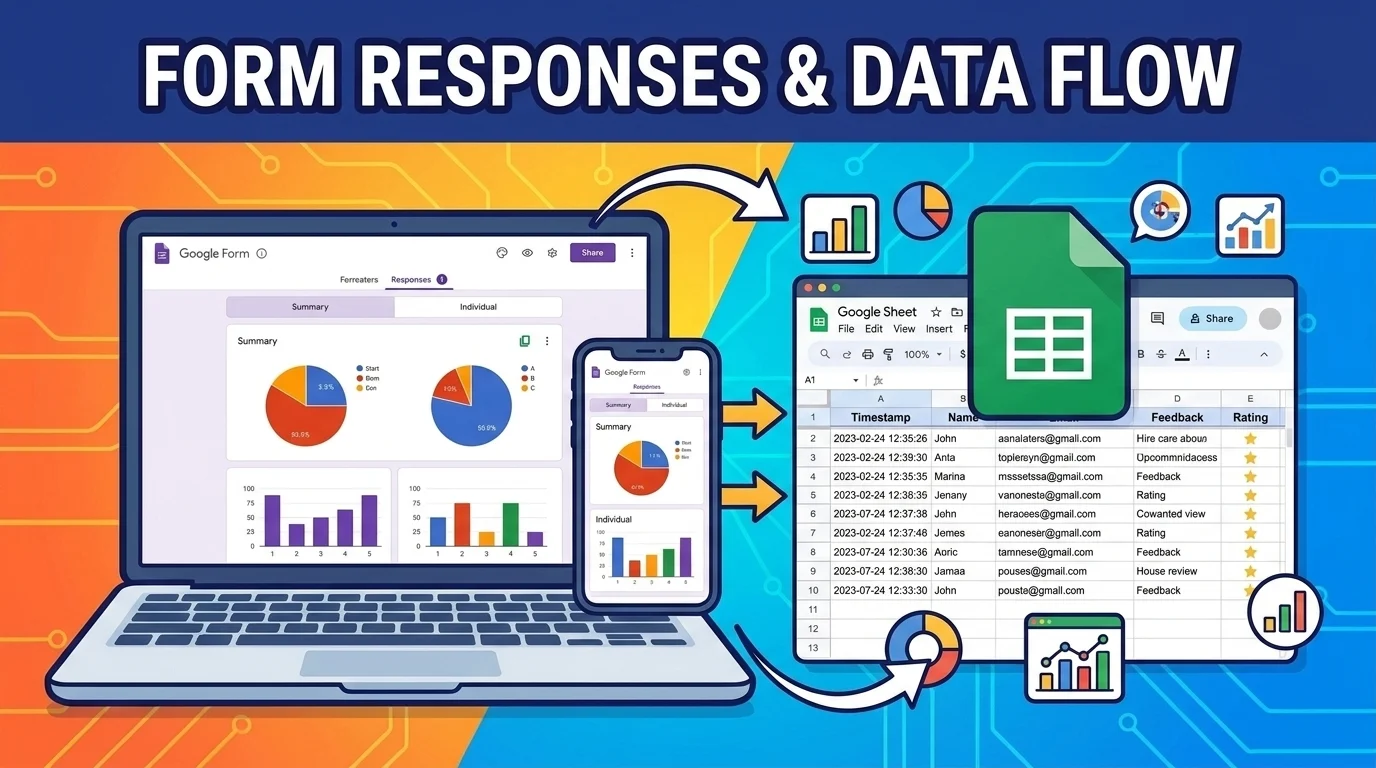
Open your Google Form, click the Responses tab, and choose Summary, Question, or Individual to see answers. Top alternatives: Google Sheets, email notifications, add-ons, mobile app, and shared drive access.
Knowing how to view google form responses is a basic skill that saves you from endless scrolling and panic. Whether you are a teacher collecting assignments or a small business tracking orders, those answers hold the real gold. The good news is Google gives you several built-in ways to see them fast.
You can check responses right inside the form, send them to a Google Sheet, or get alerts when new entries arrive. Each method fits a different vibe, from quick peeks to deep data dives. This guide breaks down 180+ practical tips so you always find what you need.
Beginner-Friendly Ways To View Google Form Responses
- Open The Responses Tab
Example: Click the Responses tab at the top of your form.
Meaning: This is the main place for all answers. - Use Summary View
Example: Select Summary to see charts and counts.
Meaning: Gives you a quick visual overview. - Switch To Question View
Example: Click Question to see answers grouped by each question.
Meaning: Helps you spot patterns per question. - Check Individual View
Example: Choose Individual to read one person’s full submission.
Meaning: Perfect for detailed review. - View On Mobile Browser
Example: Open the form in Chrome on your phone.
Meaning: Lets you check responses anywhere. - Use Google Forms App
Example: Install the app and open your form.
Meaning: Gives you a simple mobile dashboard. - Link To Google Sheets
Example: Click the green Sheets icon in Responses.
Meaning: Creates a live spreadsheet of all entries. - Sort Responses By Time
Example: In Sheets, sort the Timestamp column.
Meaning: Shows newest or oldest submissions first. - Search Within Responses
Example: Use Ctrl+F in Sheets to find a name.
Meaning: Finds specific answers fast. - Download As CSV
Example: In Sheets, go to File > Download > CSV.
Meaning: Lets you open data in Excel. - Print Responses
Example: Use Ctrl+P in the Responses tab.
Meaning: Gives you a physical copy. - Share With A Co-Admin
Example: Add a collaborator in the form settings.
Meaning: Lets others view responses too.
Desktop Methods To View Google Form Responses
- Open Forms On Desktop
Example: Go to docs.google.com/forms.
Meaning: Full features on a big screen. - Click Responses Tab
Example: It is next to Questions.
Meaning: Main entry point. - Use Summary Charts
Example: See pie charts for multiple choice.
Meaning: Quick insights. - View Question Breakdown
Example: Click each question to expand.
Meaning: See answer distribution. - Read Individual Entries
Example: Use arrows to move between people.
Meaning: Review one by one. - Open In Sheets
Example: Click the Sheets icon.
Meaning: Get raw data. - Use Sheets Filter
Example: Data > Create a filter.
Meaning: Sort and filter easily. - Freeze Header Row
Example: View > Freeze > 1 row.
Meaning: Keeps labels visible. - Add Conditional Formatting
Example: Format > Conditional formatting.
Meaning: Highlights key answers. - Create Pivot Tables
Example: Data > Pivot table.
Meaning: Summarizes large data. - Email Responses
Example: File > Email > Email as attachment.
Meaning: Shares data quickly. - Use Explore In Sheets
Example: Click Explore bottom right.
Meaning: Auto-generates charts.
Mobile Methods To View Google Form Responses
- Use Google Forms App
Example: Download from Play Store or App Store.
Meaning: Native mobile access. - Open Browser On Phone
Example: Go to forms.google.com.
Meaning: Works without app. - Tap Responses Tab
Example: At bottom or top depending on view.
Meaning: Shows all submissions. - Switch To Summary
Example: Tap Summary for charts.
Meaning: Mobile-friendly visuals. - Check Individual
Example: Tap Individual and swipe.
Meaning: Review one at a time. - Open In Sheets App
Example: Tap Sheets icon then open app.
Meaning: Edit data on phone. - Use Google Drive App
Example: Find the linked sheet in Drive.
Meaning: Another way to access. - Enable Desktop Site
Example: In Chrome menu, check Desktop site.
Meaning: Full features on mobile. - Take Screenshots
Example: Screenshot summary charts.
Meaning: Save quick proof. - Share Via WhatsApp
Example: Share sheet link with team.
Meaning: Fast collaboration. - Use Voice Search
Example: Say “open my form responses”.
Meaning: Hands-free access. - Check Offline
Example: Open Sheets offline if synced.
Meaning: View data without internet.
How To View Responses In Google Sheets
- Link Form To Sheets
Example: Responses > Link to Sheets.
Meaning: Creates live spreadsheet. - Open Linked Sheet
Example: Click the Sheets icon.
Meaning: See all responses in rows. - Use Timestamp Column
Example: Column A shows submission time.
Meaning: Track when answers came in. - Sort By Column
Example: Right-click header > Sort A to Z.
Meaning: Organize data. - Filter By Answer
Example: Data > Create a filter.
Meaning: Show only specific responses. - Use Query Function
Example: =QUERY(A:E,”select * where B=’Yes'”).
Meaning: Advanced filtering. - Create Charts
Example: Insert > Chart.
Meaning: Visualize data. - Share Sheet
Example: Click Share and add emails.
Meaning: Let others view. - Protect Ranges
Example: Data > Protect sheets and ranges.
Meaning: Prevent edits. - Set Notifications
Example: Tools > Notification settings.
Meaning: Get email alerts. - Download CSV
Example: File > Download > CSV.
Meaning: Use in other tools. - Use Add-Ons
Example: Extensions > Add-ons.
Meaning: Extend functionality.
How To View Responses In Real Time
- Open Linked Sheet
Example: Keep the sheet open in a tab.
Meaning: Updates appear live. - Use Google Sheets App
Example: Open sheet on phone.
Meaning: Real-time mobile view. - Enable Email Notifications
Example: In Forms, Responses > More > Get email notifications.
Meaning: Alerts for new responses. - Use Add-On Notifications
Example: Install Form Notifications add-on.
Meaning: Custom alerts. - Set Up Zapier
Example: Connect form to Zapier.
Meaning: Trigger real-time actions. - Use IFTTT
Example: Create applet for new form response.
Meaning: Automate alerts. - Check Summary Refresh
Example: Refresh the Responses tab.
Meaning: See latest counts. - Use Google Data Studio
Example: Connect sheet to Data Studio.
Meaning: Live dashboard. - Create A Webhook
Example: Use Apps Script to send data.
Meaning: Real-time integration. - Use Slack Integration
Example: Connect form to Slack.
Meaning: Get channel alerts. - Monitor With Sheets Filter
Example: Filter by latest timestamp.
Meaning: Focus on new entries. - Set Up Auto-Refresh
Example: Use a browser extension.
Meaning: Keeps data current.
How To View Responses For Quizzes And Tests
- Enable Quiz Mode
Example: Settings > Make this a quiz.
Meaning: Auto-grading. - Open Responses Tab
Example: See scores per student.
Meaning: Quick results. - View Summary
Example: See average score.
Meaning: Class performance. - Check Question View
Example: See which questions were missed.
Meaning: Identify tough topics. - Open Individual
Example: Review each student’s answers.
Meaning: Personalized feedback. - Release Scores
Example: Settings > Release grades.
Meaning: Students see results. - Email Results
Example: Use add-on to send scores.
Meaning: Saves time. - Export To Sheets
Example: Link to Sheets for gradebook.
Meaning: Track progress. - Use Conditional Formatting
Example: Highlight scores below 70.
Meaning: Spot at-risk students. - Create Pivot Table
Example: Summarize scores by class.
Meaning: Compare groups. - Share With Co-Teachers
Example: Add as collaborator.
Meaning: Team review. - Download CSV
Example: Save for school records.
Meaning: Backup data.
How To View Responses For Teachers And Educators
- Open Form Responses
Example: Click Responses tab.
Meaning: See all submissions. - Use Summary For Overview
Example: Check charts for common answers.
Meaning: Understand class trends. - View Individual For Grading
Example: Read each student’s work.
Meaning: Grade fairly. - Link To Google Classroom
Example: Share form as assignment.
Meaning: Auto-collect responses. - Use Sheets For Gradebook
Example: Export to Sheets.
Meaning: Manage grades. - Add Comment In Sheets
Example: Right-click cell > Comment.
Meaning: Give feedback. - Use Add-Ons For Rubrics
Example: Install GradeBook add-on.
Meaning: Standardize grading. - Filter By Student Name
Example: Use filter in Sheets.
Meaning: Find specific work. - Check Timestamps
Example: See who submitted late.
Meaning: Track deadlines. - Share With Parents
Example: Download PDF summary.
Meaning: Communicate progress. - Use Quiz Mode
Example: Auto-grade multiple choice.
Meaning: Saves time. - Archive Old Responses
Example: Make a copy of sheet.
Meaning: Keep records organized.
How To View Responses For Business And Client Forms
- Open Responses Tab
Example: See client inquiries.
Meaning: Central dashboard. - Use Sheets For CRM
Example: Link to Sheets and add columns.
Meaning: Track leads. - Set Email Notifications
Example: Get alerts for new orders.
Meaning: Respond fast. - Use Add-Ons For Invoices
Example: Install Form Publisher.
Meaning: Auto-generate docs. - Filter By Budget
Example: Use filter in Sheets.
Meaning: Prioritize leads. - Create Pivot Tables
Example: Summarize by service type.
Meaning: Spot demand. - Share With Sales Team
Example: Share sheet with permissions.
Meaning: Collaborate. - Use Zapier To Connect CRM
Example: Send data to Salesforce.
Meaning: Automate workflow. - Download CSV For Analysis
Example: Export to Excel.
Meaning: Deep dive. - Set Up Auto-Responder
Example: Use add-on to email clients.
Meaning: Instant reply. - Track Response Times
Example: Compare timestamp to follow-up.
Meaning: Improve service. - Protect Client Data
Example: Restrict sheet access.
Meaning: Keep info safe.
How To View Responses For Events And RSVPs
- Open Responses Tab
Example: See who is coming.
Meaning: Quick headcount. - Use Summary For Counts
Example: Check yes/no charts.
Meaning: Plan food and seats. - Link To Sheets
Example: Get full guest list.
Meaning: Manage details. - Filter By Dietary Needs
Example: Use filter in Sheets.
Meaning: Cater properly. - Sort By Name
Example: Sort column A to Z.
Meaning: Easy check-in. - Email Confirmation
Example: Use add-on to send invites.
Meaning: Confirm attendees. - Share With Event Team
Example: Share sheet with staff.
Meaning: Coordinate. - Create Name Tags
Example: Use add-on to merge data.
Meaning: Print badges. - Track Plus-Ones
Example: Add column in Sheets.
Meaning: Accurate count. - Use Google Calendar
Example: Import responses to Calendar.
Meaning: Schedule reminders. - Download CSV
Example: Save for venue.
Meaning: Share with vendors. - Check Late RSVPs
Example: Sort by timestamp.
Meaning: Update list.
How To View Responses For Surveys And Feedback
- Open Responses Tab
Example: See all feedback.
Meaning: Central place. - Use Summary Charts
Example: View average ratings.
Meaning: Quick insights. - Read Individual Comments
Example: Click Individual to read text.
Meaning: Understand sentiment. - Link To Sheets
Example: Export for analysis.
Meaning: Work with raw data. - Use Word Cloud Add-On
Example: Install add-on for text.
Meaning: Visualize common words. - Filter By Rating
Example: Filter low scores.
Meaning: Address complaints. - Create Pivot Table
Example: Summarize by demographic.
Meaning: Segment feedback. - Use Conditional Formatting
Example: Highlight negative comments.
Meaning: Spot issues. - Share With Team
Example: Share sheet with stakeholders.
Meaning: Collaborative review. - Download CSV
Example: Export to stats software.
Meaning: Advanced analysis. - Set Up Alerts
Example: Get email for new responses.
Meaning: Stay updated. - Archive Results
Example: Copy sheet monthly.
Meaning: Track trends.
How To View Responses With Email Notifications
- Enable In Forms
Example: Responses > More > Get email notifications.
Meaning: Basic alerts. - Use Add-On
Example: Install Form Notifications.
Meaning: Custom emails. - Set Frequency
Example: Choose immediate or daily digest.
Meaning: Control inbox. - Add Multiple Recipients
Example: Enter team emails.
Meaning: Share alerts. - Include Response Data
Example: Add-on can include answers.
Meaning: See details in email. - Use Filters
Example: Only notify for specific answers.
Meaning: Reduce noise. - Send To Slack
Example: Use Zapier to post.
Meaning: Team channel alerts. - Send To SMS
Example: Use IFTTT for text alerts.
Meaning: Mobile notifications. - Check Spam Folder
Example: Whitelist sender.
Meaning: Do not miss alerts. - Test Notification
Example: Submit a test response.
Meaning: Confirm setup. - Disable When Done
Example: Turn off notifications.
Meaning: Stop inbox clutter. - Use Google Apps Script
Example: Write custom trigger.
Meaning: Full control.
How To View Responses With Add-Ons And Integrations
- Open Add-Ons Menu
Example: Click three dots > Add-ons.
Meaning: Find tools. - Install Form Publisher
Example: Generate docs from responses.
Meaning: Automate paperwork. - Install Form Notifications
Example: Get custom alerts.
Meaning: Stay informed. - Use Zapier
Example: Connect to 5000+ apps.
Meaning: Automate workflows. - Use Make
Example: Build visual automation.
Meaning: Advanced integrations. - Connect To Slack
Example: Send responses to channel.
Meaning: Team visibility. - Connect To Trello
Example: Create cards from responses.
Meaning: Task management. - Connect To Mailchimp
Example: Add emails to list.
Meaning: Marketing automation. - Use Google Data Studio
Example: Build live dashboard.
Meaning: Visual reporting. - Use Apps Script
Example: Write custom code.
Meaning: Unlimited options. - Check Permissions
Example: Review add-on access.
Meaning: Keep data safe. - Remove Unused Add-Ons
Example: Uninstall from menu.
Meaning: Reduce clutter.
How To View Responses For Shared Forms And Teams
- Add Collaborators
Example: Click Send > Add collaborators.
Meaning: Share editing. - Set Permissions
Example: Choose Editor or Viewer.
Meaning: Control access. - Share Response Sheet
Example: Share linked Sheet separately.
Meaning: Let team view data. - Use Shared Drive
Example: Move form to shared drive.
Meaning: Central ownership. - Assign Roles
Example: One editor, many viewers.
Meaning: Manage workflow. - Use Comments
Example: Comment in Sheets.
Meaning: Discuss answers. - Set Notifications For Team
Example: Add team emails to alerts.
Meaning: Everyone updated. - Create A Dashboard
Example: Use Data Studio.
Meaning: Shared live view. - Protect Sensitive Columns
Example: Hide columns in Sheets.
Meaning: Privacy. - Track Changes
Example: File > Version history.
Meaning: See edits. - Export For Meetings
Example: Download PDF.
Meaning: Share in presentations. - Archive Shared Responses
Example: Make a copy.
Meaning: Keep backup.
How To View Responses With Filters And Analysis
- Create A Filter
Example: Data > Create a filter.
Meaning: Sort and hide. - Filter By Date
Example: Filter timestamp column.
Meaning: Focus on period. - Filter By Answer
Example: Show only “Yes” responses.
Meaning: Segment data. - Use Slicer
Example: Data > Slicer.
Meaning: Interactive filter. - Create Pivot Table
Example: Data > Pivot table.
Meaning: Summarize. - Use QUERY Function
Example: =QUERY(A:E,”select * where B=’No'”).
Meaning: Advanced filter. - Use COUNTIF
Example: =COUNTIF(B:B,”Yes”).
Meaning: Count answers. - Use AVERAGE
Example: =AVERAGE(C:C).
Meaning: Average scores. - Create Charts
Example: Insert > Chart.
Meaning: Visualize. - Use Conditional Formatting
Example: Highlight top scores.
Meaning: Spot trends. - Use Explore
Example: Click Explore in Sheets.
Meaning: Auto insights. - Export For BI Tools
Example: Download CSV.
Meaning: Use Tableau or Power BI.
How To View Responses When Things Go Wrong
- Check Form Permissions
Example: Ensure you are editor.
Meaning: You need access. - Refresh The Page
Example: Press F5.
Meaning: Fix loading glitches. - Check Internet
Example: Switch networks.
Meaning: Connectivity issue. - Open In Incognito
Example: Try Chrome incognito.
Meaning: Rule out extensions. - Clear Cache
Example: Clear browser cache.
Meaning: Remove stale data. - Use Another Browser
Example: Try Firefox or Edge.
Meaning: Browser bug. - Check Google Status
Example: Visit Google Workspace Status Dashboard.
Meaning: Outage info. - Restore Sheet Version
Example: File > Version history.
Meaning: Undo mistakes. - Re-link To Sheets
Example: Unlink and link again.
Meaning: Fix sync issues. - Contact Google Support
Example: Use Help menu.
Meaning: Official help. - Check Add-On Conflicts
Example: Disable add-ons.
Meaning: Isolate problem. - Export Before Fixing
Example: Download CSV first.
Meaning: Protect data.
FAQs
What does “how to view google form responses” mean?
It means finding and reading the answers people submit through your Google Form. You can see them in the form itself or in a linked Google Sheet.
Can viewing responses be emotional or flirty?
Not really. But reading heartfelt feedback or sweet messages from friends can feel emotional. Keep it professional for work forms.
Is there a professional way to view responses?
Yes. Use Google Sheets, set permissions, and share only with relevant team members. Always protect private data.
What if I do not actually want to see responses?
You can turn off notifications and avoid opening the Responses tab. You can also transfer ownership to someone else.
Is humor appropriate in form design?
A little humor in questions or confirmation messages is fine. Just keep it respectful and clear for professional forms.
Conclusion
Viewing Google Form responses does not have to be a headache. With the right method, you can see answers on desktop, mobile, or a live spreadsheet in seconds. Pick the approach that fits your workflow and make data your friend.
Now that you have 180+ tips, you are ready to handle any form like a pro. Save this guide, share it with your team, and bookmark it for your next project. Go ahead and open that Responses tab with confidence. Your answers are waiting.
