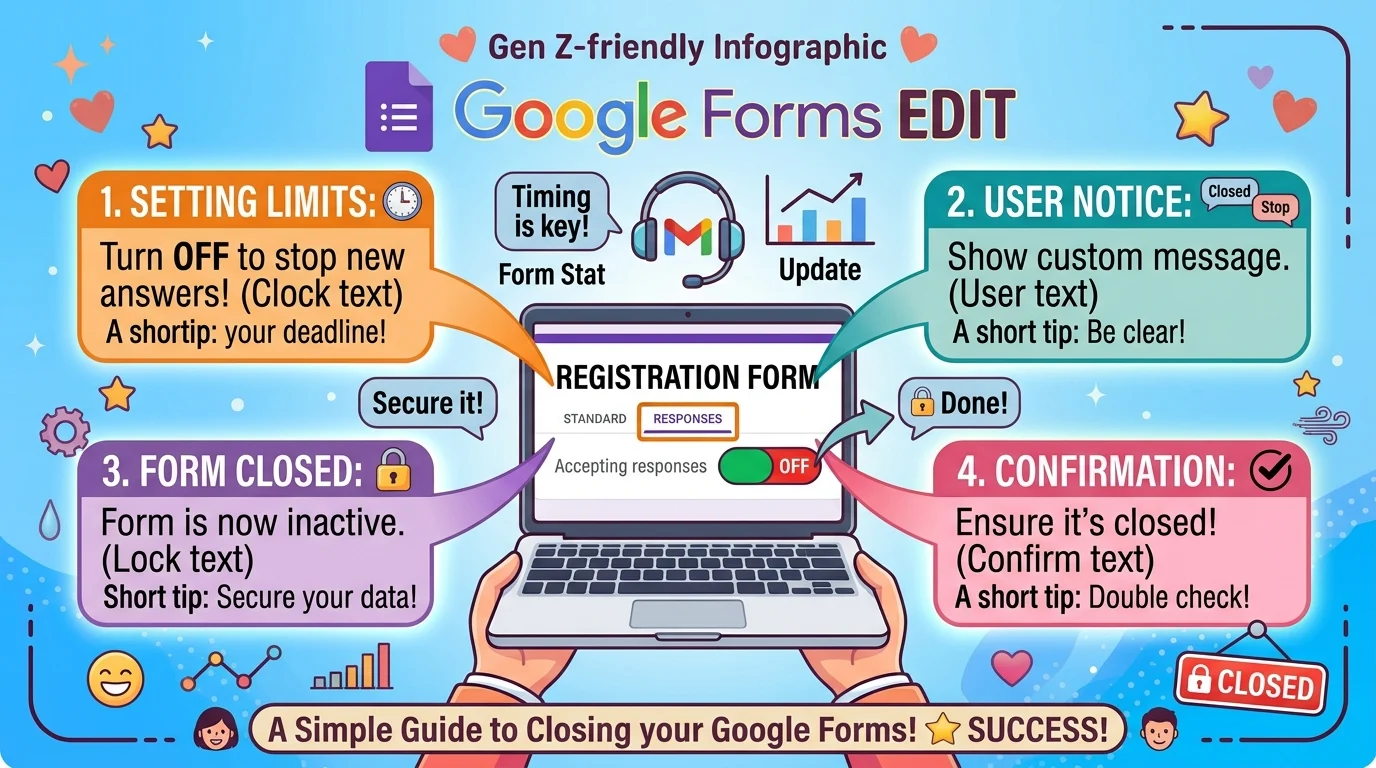
To close responses on Google Forms, open your form, go to the Responses tab, and toggle off “Accepting responses.” You can also set a response limit, close on a date, or use add-ons for advanced control.
Ever created a Google Form, sent it out, and then panicked because responses kept coming after you had enough? Maybe it is a survey, a quiz, or an event sign-up, and you need to hit pause without deleting your data. Learning how to close responses on Google Forms is one of those small skills that saves you a big headache.
The good news is that closing a form takes seconds once you know where to click. But there are smart ways to do it depending on your situation. You might want to stop responses immediately, keep a backup, or send a polite message to people who try to submit late. This guide gives you 150+ practical tips and steps, sorted by scenario and style, so you can close your form with confidence and zero drama.
Quick And Easy Responses
- Open the Responses tab and toggle off “Accepting responses.”
Example: Use this when you need to close a form right away.
Meaning: This is the fastest built-in method to stop new submissions. - Click the three dots menu and choose “Delete all responses” only if you are sure.
Example: Use this after you have exported your data.
Meaning: Removes collected data but does not close the form itself. - Go to Settings and turn off “Accepting responses” from the main form view.
Example: Use this when you are already editing the form.
Meaning: An alternative path to the same toggle. - Use the “Response limit” feature to cap submissions automatically.
Example: Use this for giveaways or limited spots.
Meaning: The form closes itself once the limit is reached. - Set a closing date and time in the Settings under “Response validation.”
Example: Use this for surveys with a deadline.
Meaning: Automatically stops responses at a specific moment. - Share a short link and then disable it from the same menu.
Example: Use this when you shared a shortened URL.
Meaning: Disabling the form link stops new entries. - Check the form preview to confirm the closure message appears.
Example: Use this after toggling off accepting responses.
Meaning: Ensures respondents see a clear end state. - Use the mobile Google Forms app to close responses on the go.
Example: Use this when you are away from your computer.
Meaning: The same toggle is available in the app. - Duplicate the form before closing if you might need it again.
Example: Use this for recurring surveys.
Meaning: Keeps a clean copy without old responses. - Turn off “Collect email addresses” before closing if you want privacy.
Example: Use this when you no longer need contact info.
Meaning: Adds an extra layer of data control. - Archive the form in Google Drive after closing.
Example: Use this to keep your Drive organized.
Meaning: Moves the form out of your active list. - Bookmark the responses spreadsheet before closing.
Example: Use this if you linked the form to Sheets.
Meaning: Keeps your data accessible after the form is closed.
For Beginners Responses
- Start by opening your form in Google Forms.
Example: Use this as the first step if you are new.
Meaning: Gets you to the right screen. - Look at the top menu and click the “Responses” tab.
Example: Use this to find the submission controls.
Meaning: This tab holds the main toggle. - Find the green toggle labeled “Accepting responses.”
Example: Use this to identify the on and off switch.
Meaning: Green means open, gray means closed. - Click the toggle once to turn it off.
Example: Use this when you are ready to stop responses.
Meaning: The form immediately stops accepting new entries. - A confirmation message will appear. Click “Close form” if asked.
Example: Use this if Google asks for confirmation.
Meaning: Confirms your action. - Test the form link in a new tab to see the closed message.
Example: Use this to verify the closure worked.
Meaning: Ensures respondents see the correct state. - Go back to the Responses tab to see your collected data.
Example: Use this after closing to review submissions.
Meaning: Your data remains safe and viewable. - Use the “Summary” view to see quick charts of responses.
Example: Use this for a fast overview.
Meaning: Helps you understand results without exporting. - Click the three dots next to “Accepting responses” for more options.
Example: Use this to find “Set response limit” or “Close on date.”
Meaning: Opens advanced closing settings. - Read the help text under each setting before changing it.
Example: Use this to avoid accidental closures.
Meaning: Prevents mistakes. - Save your changes by simply leaving the form. Google Forms autosaves.
Example: Use this if you are worried about losing work.
Meaning: No manual save needed. - Share the closed form link with a note that responses are now closed.
Example: Use this for transparency with your audience.
Meaning: Keeps people informed.
For Advanced Users Responses
- Use Google Apps Script to close a form automatically on a schedule.
Example: Use this for recurring weekly surveys.
Meaning: Automates the closing process. - Set a response limit based on a specific number of submissions.
Example: Use this for limited-capacity events.
Meaning: Closes the form exactly when you want. - Combine response limit with a custom closing message.
Example: Use this to tell latecomers why they cannot submit.
Meaning: Improves user experience. - Use a form add-on like Form Publisher to trigger closure after a condition.
Example: Use this for complex workflows.
Meaning: Adds logic-based closing. - Link the form to a Google Sheet and use a script to close when a cell value changes.
Example: Use this for data-driven closures.
Meaning: Gives you programmatic control. - Set up email notifications for new responses and close manually after the last one.
Example: Use this for small, high-value groups.
Meaning: Keeps you in the loop. - Use the “Response validation” settings to prevent submissions after a date.
Example: Use this for time-bound quizzes.
Meaning: Adds a date-based gate. - Embed the form on a website and remove the embed code to close it.
Example: Use this when the form is only on your site.
Meaning: Hides the form from visitors. - Create a duplicate form with no responses and close the original.
Example: Use this to keep a clean template.
Meaning: Preserves your setup for future use. - Use the “Pre-filled URL” feature and disable the original link.
Example: Use this for controlled distribution.
Meaning: Limits who can access the form. - Export responses to CSV before closing for a permanent backup.
Example: Use this for important data.
Meaning: Ensures you have a copy outside Google. - Document your closing steps in a shared team note.
Example: Use this for team projects.
Meaning: Helps others repeat the process.
When You Need To Stop Responses Immediately Responses
- Toggle off “Accepting responses” right now from the Responses tab.
Example: Use this when you spot spam or duplicate entries.
Meaning: Stops the flow instantly. - If you are on mobile, open the app and tap the same toggle.
Example: Use this when you are away from your desk.
Meaning: Closes the form from anywhere. - Delete the form link from all public places.
Example: Use this if the link was shared on social media.
Meaning: Reduces new clicks. - Send a quick email to your list saying responses are closed.
Example: Use this to prevent confusion.
Meaning: Manages expectations. - Use the “Response limit” set to the current number of responses.
Example: Use this as a backup if the toggle fails.
Meaning: Adds a second layer of closure. - Check the form’s “Settings” for any scheduled opening that might reopen it.
Example: Use this if the form reopens unexpectedly.
Meaning: Prevents accidental reopening. - If you use a third-party embed, disable it from that platform.
Example: Use this for forms embedded on other sites.
Meaning: Stops submissions from that source. - Turn off “Allow response editing” if respondents can change answers.
Example: Use this to lock in final data.
Meaning: Prevents post-closure edits. - Use a script to set the form to closed programmatically.
Example: Use this for urgent closures.
Meaning: Gives you a fast, code-based option. - Post a story or status update that responses are now closed.
Example: Use this for social media audiences.
Meaning: Communicates the change widely. - Reply to recent submitters with a thank you and a note that the form is closed.
Example: Use this for high-touch surveys.
Meaning: Shows care and closure. - Double-check the form preview one last time.
Example: Use this after any emergency closure.
Meaning: Confirms the form is truly closed.
When You Want To Keep Data Safe Responses
- Export responses to Google Sheets before closing.
Example: Use this for any important form.
Meaning: Creates a backup outside the form. - Download a CSV copy of all responses.
Example: Use this for offline storage.
Meaning: Ensures you have a portable file. - Make a copy of the form itself before closing.
Example: Use this to preserve the structure.
Meaning: Lets you reuse the form later. - Turn off “Collect email addresses” if you no longer need them.
Example: Use this for privacy compliance.
Meaning: Reduces stored personal data. - Delete sensitive responses only after exporting.
Example: Use this for confidential surveys.
Meaning: Cleans up while keeping a copy. - Use the “Individual” view to check for any missing data.
Example: Use this before closing.
Meaning: Ensures completeness. - Set the form to not accept responses and then archive it.
Example: Use this for long-term storage.
Meaning: Keeps your Drive tidy. - Share the exported sheet with only authorized people.
Example: Use this for team data.
Meaning: Maintains access control. - Use a password-protected folder for CSV files.
Example: Use this for extra security.
Meaning: Protects sensitive information. - Check the form’s “Responses” tab for any linked sheets.
Example: Use this to ensure the link is still active.
Meaning: Keeps your data pipeline clear. - Document the closing date and reason in a note.
Example: Use this for audits.
Meaning: Creates a record. - Review Google’s data retention policies if needed.
Example: Use this for compliance.
Meaning: Stays informed.
For Shared Forms Responses
- Coordinate with your team before closing a shared form.
Example: Use this when multiple people manage the form.
Meaning: Avoids cutting off needed responses. - Use the “Collaborate” feature to assign an owner for closing.
Example: Use this for clear responsibility.
Meaning: Prevents confusion. - Send a message in the shared chat that the form will close at a specific time.
Example: Use this for team awareness.
Meaning: Keeps everyone aligned. - Check if any team member has a pending export.
Example: Use this before toggling off.
Meaning: Prevents data loss. - Use version history to see who changed the form last.
Example: Use this if something goes wrong.
Meaning: Adds accountability. - Set a response limit that everyone agrees on.
Example: Use this for fair collection.
Meaning: Creates a shared rule. - Use a shared Google Sheet for responses so all can access after closure.
Example: Use this for team analysis.
Meaning: Keeps data visible to the group. - Assign one person to send the closure notification to respondents.
Example: Use this for clear communication.
Meaning: Avoids duplicate messages. - Document the closure in a shared project log.
Example: Use this for future reference.
Meaning: Builds a knowledge base. - Review the form’s permissions to ensure only authorized people can reopen it.
Example: Use this for security.
Meaning: Prevents accidental reopening. - Use the “Duplicate” feature to create a fresh copy for the next round.
Example: Use this for recurring team forms.
Meaning: Saves setup time. - Thank your team after closing.
Example: Use this for good morale.
Meaning: Builds positive collaboration.
For Quizzes And Tests Responses
- Turn off “Accepting responses” as soon as the test window ends.
Example: Use this for timed quizzes.
Meaning: Stops late submissions. - Set a response limit equal to the number of students or participants.
Example: Use this for a fixed group.
Meaning: Prevents extra entries. - Use the “Release grades” setting after closing.
Example: Use this to share results only after the window.
Meaning: Controls when participants see scores. - Check the “Individual” view for any partial submissions.
Example: Use this before closing to see who started but did not finish.
Meaning: Helps you decide on extensions. - Export quiz responses to Sheets for grading records.
Example: Use this after closing.
Meaning: Keeps a permanent gradebook. - Send a follow-up email with the correct answers after closing.
Example: Use this for learning purposes.
Meaning: Provides closure and education. - Disable “Allow response editing” before the quiz starts.
Example: Use this to prevent changes after submission.
Meaning: Ensures integrity. - Use a custom closing message that tells students when results will be shared.
Example: Use this for clear communication.
Meaning: Reduces follow-up questions. - Check the form’s “Settings” for any accidental reopening.
Example: Use this after closing.
Meaning: Prevents issues. - Archive the quiz form in a dedicated folder.
Example: Use this for organization.
Meaning: Keeps your Drive clean. - Share the closed status with co-teachers.
Example: Use this for team teaching.
Meaning: Keeps everyone informed. - Review the quiz analytics before closing if you need mid-course corrections.
Example: Use this for live quizzes.
Meaning: Allows real-time adjustments.
For Surveys And Feedback Responses
- Set a response limit based on your target sample size.
Example: Use this for research surveys.
Meaning: Stops collection at the right number. - Use the “Close on date” feature for a clear deadline.
Example: Use this for time-bound feedback.
Meaning: Automates the closure. - Turn off “Accepting responses” manually if you reach your goal early.
Example: Use this for flexible surveys.
Meaning: Gives you control. - Send a thank-you email to respondents after closing.
Example: Use this for good practice.
Meaning: Shows appreciation. - Export responses to Sheets for analysis before closing.
Example: Use this to avoid data loss.
Meaning: Creates a backup. - Use the “Summary” view to check for any anomalies before closing.
Example: Use this for quality control.
Meaning: Catches issues early. - Set a custom closing message that thanks participants.
Example: Use this for a polished experience.
Meaning: Leaves a positive impression. - Disable response editing before closing to lock in answers.
Example: Use this for final data.
Meaning: Prevents changes. - Share a summary of results with stakeholders after closing.
Example: Use this for transparency.
Meaning: Builds trust. - Archive the survey form and its responses in a labeled folder.
Example: Use this for organization.
Meaning: Easy retrieval later. - Check if the form is embedded anywhere and remove the embed.
Example: Use this for full closure.
Meaning: Stops all entry points. - Document the closing date and sample size for your records.
Example: Use this for research logs.
Meaning: Maintains accuracy.
For Event Registration Responses
- Set a response limit equal to your venue capacity.
Example: Use this for in-person events.
Meaning: Prevents overbooking. - Use the “Close on date” feature for RSVP deadlines.
Example: Use this for catering planning.
Meaning: Automates the cutoff. - Toggle off “Accepting responses” when capacity is reached.
Example: Use this for popular events.
Meaning: Stops new sign-ups instantly. - Send a confirmation email to all registrants after closing.
Example: Use this for clear communication.
Meaning: Reduces confusion. - Export the registration list to Sheets for check-in.
Example: Use this before the event.
Meaning: Creates a usable attendee list. - Use a custom closing message that says “Registration is full.”
Example: Use this for transparency.
Meaning: Manages expectations. - Check for duplicate registrations before closing.
Example: Use this for accurate counts.
Meaning: Cleans your data. - Turn off “Allow response editing” so attendees cannot change their details.
Example: Use this for final headcounts.
Meaning: Locks in the list. - Share the closed status on your event page or social media.
Example: Use this for public events.
Meaning: Prevents late requests. - Keep a waitlist form separate if needed.
Example: Use this for high-demand events.
Meaning: Captures interest without reopening. - Archive the registration form after the event.
Example: Use this for record-keeping.
Meaning: Keeps your Drive tidy. - Thank attendees in a follow-up email after the event.
Example: Use this for good relations.
Meaning: Builds community.
For Job Applications Responses
- Close the application form once the deadline passes.
Example: Use this for hiring timelines.
Meaning: Stops late applications. - Set a response limit if you only need a certain number of candidates.
Example: Use this for small hiring rounds.
Meaning: Caps the pool. - Toggle off “Accepting responses” manually when the role is filled.
Example: Use this for urgent hires.
Meaning: Stops new applications immediately. - Send an auto-reply email to applicants after closing.
Example: Use this for professional communication.
Meaning: Acknowledges their effort. - Export all applications to Sheets for review.
Example: Use this before closing.
Meaning: Creates a reviewable dataset. - Use a custom closing message that thanks applicants.
Example: Use this for a positive candidate experience.
Meaning: Leaves a good impression. - Disable response editing to prevent changes after submission.
Example: Use this for fair review.
Meaning: Locks in original answers. - Check for incomplete applications before closing.
Example: Use this to decide on extensions.
Meaning: Ensures you have complete data. - Archive the application form in a hiring folder.
Example: Use this for compliance.
Meaning: Keeps records organized. - Share the closure with the hiring team.
Example: Use this for alignment.
Meaning: Prevents confusion. - Remove the job posting link after closing.
Example: Use this to stop traffic.
Meaning: Reduces late clicks. - Document the number of applications received.
Example: Use this for hiring metrics.
Meaning: Tracks your process.
For Team Projects Responses
- Agree on a closing date with your team before sending the form.
Example: Use this for project surveys.
Meaning: Sets clear expectations. - Use the “Close on date” feature to automate the end.
Example: Use this for team feedback forms.
Meaning: Removes manual work. - Toggle off “Accepting responses” after the last team member submits.
Example: Use this for small teams.
Meaning: Gives you control. - Export responses to a shared Sheet for team access.
Example: Use this after closing.
Meaning: Keeps everyone informed. - Send a team message that the form is closed.
Example: Use this for transparency.
Meaning: Avoids duplicate submissions. - Check for any pending responses before closing.
Example: Use this for completeness.
Meaning: Ensures no one is left out. - Use a custom closing message that thanks the team.
Example: Use this for morale.
Meaning: Shows appreciation. - Disable response editing to lock in team input.
Example: Use this for final decisions.
Meaning: Prevents changes. - Archive the form in your project folder.
Example: Use this for future reference.
Meaning: Keeps things organized. - Share a summary of results with the team after closing.
Example: Use this for alignment.
Meaning: Builds trust. - Duplicate the form for the next project phase if needed.
Example: Use this for recurring feedback.
Meaning: Saves setup time. - Thank your team for participating.
Example: Use this for good teamwork.
Meaning: Builds positive culture.
For Personal Use Responses
- Close your form after you have enough responses for your personal project.
Example: Use this for hobby surveys.
Meaning: Stops unnecessary data collection. - Use the mobile app to toggle off responses from anywhere.
Example: Use this for convenience.
Meaning: Gives you flexibility. - Set a response limit if you only need a small sample.
Example: Use this for personal research.
Meaning: Caps the effort. - Export responses to Sheets for personal analysis.
Example: Use this before closing.
Meaning: Keeps your data safe. - Use a friendly closing message for friends and family.
Example: Use this for personal forms.
Meaning: Keeps the tone warm. - Check for any duplicate entries before closing.
Example: Use this for accuracy.
Meaning: Cleans your data. - Turn off “Collect email addresses” if you do not need them.
Example: Use this for privacy.
Meaning: Reduces stored info. - Archive the form in a personal folder.
Example: Use this for organization.
Meaning: Keeps your Drive tidy. - Share the closed status with anyone who might ask.
Example: Use this for clarity.
Meaning: Prevents confusion. - Duplicate the form for future personal projects.
Example: Use this for reuse.
Meaning: Saves time. - Thank anyone who participated.
Example: Use this for good manners.
Meaning: Shows appreciation. - Review your data one last time before closing.
Example: Use this for completeness.
Meaning: Ensures you have what you need.
For Education And Teachers Responses
- Close the form at the end of the class period or deadline.
Example: Use this for quizzes and exit tickets.
Meaning: Stops late submissions. - Set a response limit equal to the number of students.
Example: Use this for attendance forms.
Meaning: Prevents extra entries. - Use the “Release grades” feature after closing.
Example: Use this for assessments.
Meaning: Controls when students see results. - Export responses to Sheets for grading records.
Example: Use this after closing.
Meaning: Keeps a permanent record. - Send a follow-up email with correct answers after closing.
Example: Use this for learning.
Meaning: Provides closure. - Disable response editing before the form goes live.
Example: Use this for test integrity.
Meaning: Prevents changes. - Use a custom closing message that tells students when results will be shared.
Example: Use this for clear communication.
Meaning: Reduces questions. - Check for any accidental reopening in Settings.
Example: Use this after closing.
Meaning: Prevents issues. - Archive the form in a course folder.
Example: Use this for organization.
Meaning: Easy retrieval. - Share the closed status with co-teachers.
Example: Use this for team teaching.
Meaning: Keeps everyone aligned. - Review analytics before closing if you need mid-course corrections.
Example: Use this for live quizzes.
Meaning: Allows adjustments. - Thank students for participating.
Example: Use this for positive classroom culture.
Meaning: Builds rapport.
For Business And Clients Responses
- Set a clear closing date and communicate it upfront.
Example: Use this for client feedback forms.
Meaning: Sets expectations. - Use the “Close on date” feature to automate the deadline.
Example: Use this for professional surveys.
Meaning: Removes manual work. - Toggle off “Accepting responses” when you have enough data.
Example: Use this for agile feedback.
Meaning: Gives you control. - Send a thank-you email to clients after closing.
Example: Use this for good relations.
Meaning: Shows appreciation. - Export responses to Sheets for analysis.
Example: Use this before closing.
Meaning: Creates a backup. - Use a custom closing message that thanks clients for their time.
Example: Use this for a polished experience.
Meaning: Leaves a positive impression. - Disable response editing to lock in client input.
Example: Use this for final data.
Meaning: Prevents changes. - Check for any incomplete responses before closing.
Example: Use this for completeness.
Meaning: Ensures quality data. - Archive the form in a client folder.
Example: Use this for organization.
Meaning: Easy retrieval. - Share a summary of results with the client after closing.
Example: Use this for transparency.
Meaning: Builds trust. - Remove the form link from client-facing pages.
Example: Use this to stop traffic.
Meaning: Reduces late clicks. - Document the closing date and number of responses.
Example: Use this for reporting.
Meaning: Tracks metrics.
Funny And Creative Ways To Announce Closure Responses
- Post a meme that says “This form is closed. Go enjoy the real world.”
Example: Use this on social media after closing.
Meaning: Keeps the tone light and shareable. - Send an email with the subject line “The form has left the chat.”
Example: Use this for a friendly audience.
Meaning: Uses internet humor to announce closure. - Update your status to “Responses closed. My inbox is now a museum.”
Example: Use this for personal projects.
Meaning: Makes the closure memorable. - Use a GIF of a door closing in your follow-up message.
Example: Use this in a team chat.
Meaning: Adds visual humor. - Write “Form closed. Thanks for playing.” as your custom closing message.
Example: Use this for casual surveys.
Meaning: Keeps it playful. - Create a “Closed for business” graphic for your form page.
Example: Use this for event registrations.
Meaning: Adds personality. - Send a voice note saying “Responses are officially closed” if you are close with the group.
Example: Use this for friends or teammates.
Meaning: Personal and funny. - Use a countdown sticker on Instagram Stories to mark the closure.
Example: Use this for public forms.
Meaning: Builds anticipation and closure. - Post a “Thank you” reel with the form closed message.
Example: Use this for social media audiences.
Meaning: Engages your followers. - Reply to late submitters with “You just missed the boat, but thanks for swimming.”
Example: Use this for informal forms.
Meaning: Turns a rejection into a joke. - Add a small “Closed” badge to your website where the form was embedded.
Example: Use this for business sites.
Meaning: Communicates status visually. - Celebrate the closure with a team shout-out.
Example: Use this for team projects.
Meaning: Builds morale and marks the finish line.
FAQs
What does it mean to close responses on Google Forms?
It means you turn off the form so no one can submit new answers. Your existing responses stay safe and viewable.
Is closing responses the same as deleting the form?
No. Closing stops new submissions but keeps the form and its data. Deleting removes everything permanently.
Can I reopen responses after closing?
Yes. Just toggle “Accepting responses” back on. The form will start collecting again.
What happens to people who try to submit after I close the form?
They will see a message that the form is no longer accepting responses. You can customize this message in Settings.
Can I close responses on the Google Forms mobile app?
Yes. The same toggle is available in the app under the Responses tab.
Do I need to close responses manually every time?
No. You can set a response limit or a closing date so Google Forms closes automatically.
Will I lose my data if I close responses?
No. All submitted responses remain in the Responses tab and in any linked Google Sheet.
Can I close responses for only some people?
Not directly. Google Forms does not support per-person closing. You would need to use separate forms or a workaround with pre-filled URLs.
Conclusion
Closing responses on Google Forms is a simple skill that saves you time and keeps your data clean. Whether you are running a quiz, a survey, or an event sign-up, the right closing method depends on your situation. Use the toggle for speed, the response limit for control, and a custom message for a polished finish.
Try a few of these tips and see what fits your workflow. Share this guide with someone who manages forms, save it for your next project, and keep your inbox drama-free. You have got this. Now go close that form with confidence.
