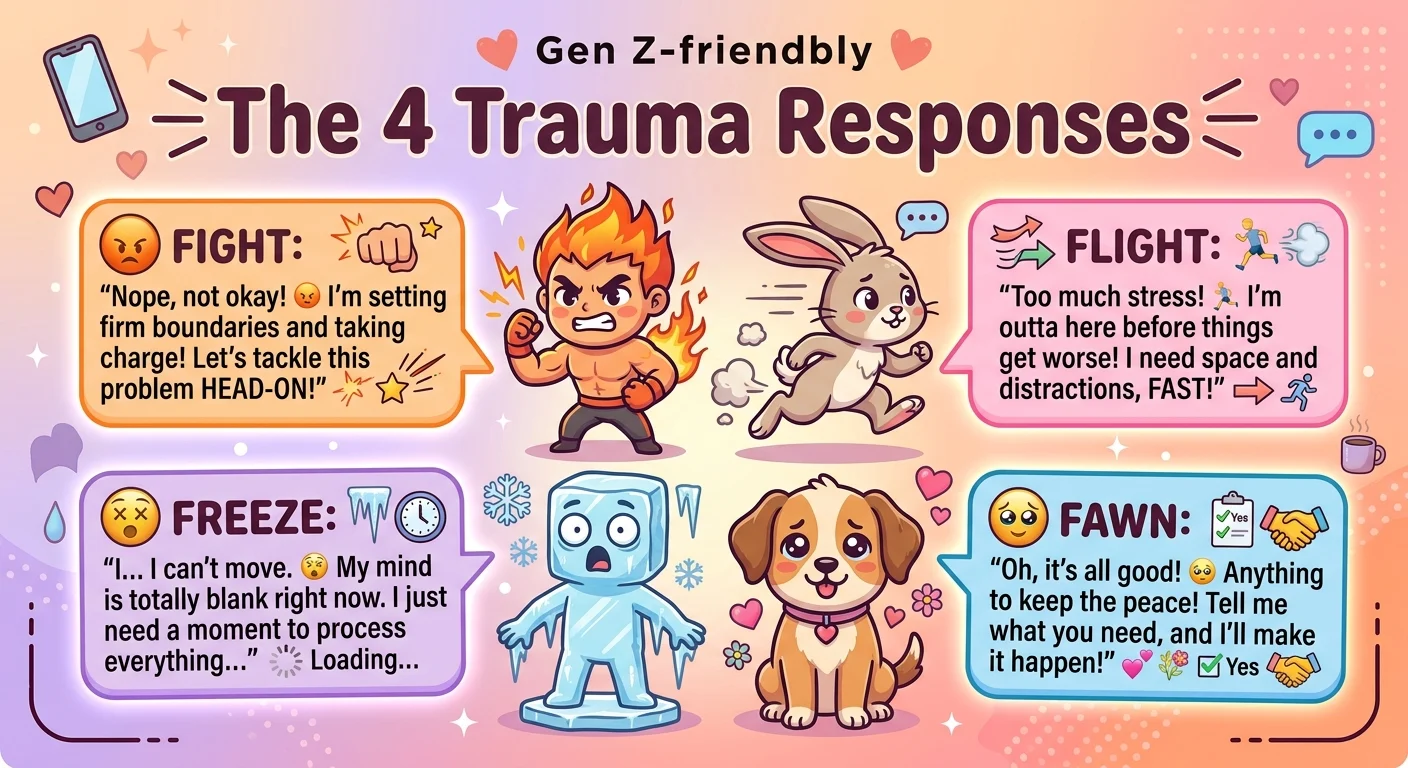
The 4 trauma responses are fight, flight, freeze, and fawn, and each one needs a different reply style. Try “I’m here,” “Take your time,” “You’re safe,” “No pressure,” or “I’ve got you” depending on what they’re showing.
Ever noticed how people react to stress in totally different ways? Some snap back, some disappear, some go silent, and some try way too hard to please. That’s the 4 trauma responses in action, and they show up everywhere from texts to DMs to awkward office chats.
Knowing how to reply when someone’s in fight, flight, freeze, or fawn mode can change the whole conversation. The right words keep things calm and show you actually get it. Whether you’re texting a friend, a crush, or a coworker, this guide has 150+ replies to match every mood and moment.
Funny Responses
- “So your brain chose violence today? Respect.”
- Example: Perfect for lightening the mood when a friend snaps over something small.
- Meaning: Acknowledges their fight response with playful honesty.
- “Flight mode activated? Same. Let’s run from our problems together.”
- Example: Use when someone avoids a topic and you want to keep it chill.
- Meaning: Makes avoidance feel shared and less lonely.
- “Freeze response? I thought you were just buffering.”
- Example: Drop this when someone goes quiet mid-conversation.
- Meaning: Adds humor to an awkward silence.
- “Fawning so hard you’re giving golden retriever energy.”
- Example: Use with a friend who people-pleases too much.
- Meaning: Calls out the pattern with affection.
- “Fight, flight, freeze, or fawn? I choose snacks.”
- Example: Perfect for breaking tension in a group chat.
- Meaning: Keeps things light and relatable.
- “Your trauma response has main character energy today.”
- Example: Say this when someone’s being extra dramatic about stress.
- Meaning: Adds fun to a heavy moment.
- “Brain said panic. I said pass the popcorn.”
- Example: Use when you’re watching someone spiral in real time.
- Meaning: Makes light of a tense situation.
- “So we’re doing the 4 trauma responses speedrun? Iconic.”
- Example: Perfect for when someone cycles through all four in one day.
- Meaning: Turns chaos into something shareable.
- “Fawn response? More like people-pleaser Olympics.”
- Example: Use when someone apologizes for existing.
- Meaning: Adds humor to self-awareness.
- “Freeze mode? You’re giving statue. Very artistic.”
- Example: Say this when someone clams up in a convo.
- Meaning: Makes silence feel less awkward.
- “Flight response but make it ‘I suddenly have plans’.”
- Example: Use when a friend dodges plans last minute.
- Meaning: Calls out avoidance with a wink.
- “Fight response? You’re not a warrior, you’re just hungry.”
- Example: Perfect for when someone snaps over nothing.
- Meaning: Reframes irritability with humor.
Flirty Responses
- “Fight response? I kinda like the fire.”
- Example: Use when someone gets feisty in a playful way.
- Meaning: Turns tension into chemistry.
- “You can run, but I’m still here.”
- Example: Say this when a crush goes distant after getting close.
- Meaning: Reassures them you’re not going anywhere.
- “Frozen? I’ll be your warmth. Just saying.”
- Example: Perfect for when someone shuts down emotionally.
- Meaning: Offers comfort with a flirty edge.
- “Fawning over me? I mean, I get it.”
- Example: Use when someone’s being overly nice to impress you.
- Meaning: Adds charm to their people-pleasing.
- “Fight, flight, freeze, fawn. I’d still choose you.”
- Example: Say this to someone who’s showing their messy side.
- Meaning: Reassures them with confidence and warmth.
- “Your brain’s in survival mode but you’re still cute.”
- Example: Perfect for lightening the mood with a compliment.
- Meaning: Adds sweetness to stress.
- “Flight response? Stay. I’m more fun than whatever you’re running from.”
- Example: Use when someone’s avoiding a deep chat.
- Meaning: Flirty invitation to open up.
- “Freeze response looks good on you.”
- Example: Say this when someone goes quiet on a date.
- Meaning: Turns awkward silence into charm.
- “Fawn response? You don’t have to impress me. You already did.”
- Example: Perfect for someone trying too hard.
- Meaning: Comforts with a flirty twist.
- “Fight mode? Okay, but can we argue somewhere cozier?”
- Example: Use when tension turns into banter.
- Meaning: Redirects conflict into chemistry.
- “You can freeze, flee, or fight. I’ll be right here.”
- Example: Say this to someone who’s hesitant about getting close.
- Meaning: Offers steady reassurance.
- “Fawn response? Cute. But I like the real you more.”
- Example: Perfect when someone’s being overly agreeable.
- Meaning: Encourages authenticity with charm.
Polite Responses
- “Take your time. I’m not going anywhere.”
- Example: Use when someone goes quiet during a tough chat.
- Meaning: Respectful reassurance.
- “I understand. No pressure at all.”
- Example: Say this when someone pulls away suddenly.
- Meaning: Keeps things calm and kind.
- “I’m here whenever you’re ready to talk.”
- Example: Perfect for someone in freeze mode.
- Meaning: Leaves the door open gently.
- “That makes sense. Thanks for explaining.”
- Example: Use when someone shares their reaction style.
- Meaning: Shows understanding without judgment.
- “I appreciate you being honest with me.”
- Example: Say this when someone admits they’re struggling.
- Meaning: Validates their vulnerability.
- “Please don’t feel bad. These things happen.”
- Example: Use when someone snaps and apologizes.
- Meaning: Removes shame from the moment.
- “I respect your space. Let me know when you’re ready.”
- Example: Perfect for a flight response.
- Meaning: Honors their need for distance.
- “I hear you. That sounds really hard.”
- Example: Say this when someone shares their stress.
- Meaning: Offers empathy with care.
- “Thank you for trusting me with that.”
- Example: Use when someone opens up about their patterns.
- Meaning: Acknowledges their courage.
- “I’m sorry you’re going through that. How can I help?”
- Example: Perfect for a fawn response from a friend.
- Meaning: Offers support respectfully.
- “No need to apologize. I get it.”
- Example: Say this when someone over-explains.
- Meaning: Keeps the vibe calm and kind.
- “I’m here if you need anything. No rush.”
- Example: Use when someone’s overwhelmed.
- Meaning: Gentle and supportive.
Professional Responses
- “I understand. Take the time you need.”
- Example: Perfect for a coworker who needs space.
- Meaning: Professional with compassion.
- “Thanks for letting me know. Let’s regroup when you’re ready.”
- Example: Use when someone pulls back at work.
- Meaning: Respectful and productive.
- “I appreciate your honesty. How can I support you?”
- Example: Say this to a colleague who shares they’re struggling.
- Meaning: Balances professionalism with care.
- “No problem at all. These things happen.”
- Example: Use when a teammate misses a deadline due to stress.
- Meaning: Removes pressure and keeps morale high.
- “Let’s find a solution that works for you.”
- Example: Perfect for a manager responding to an employee’s needs.
- Meaning: Shows flexibility and leadership.
- “Your wellbeing comes first. We can adjust.”
- Example: Say this when someone needs accommodations.
- Meaning: Prioritizes health over productivity.
- “Thanks for flagging this. I’ll follow up accordingly.”
- Example: Use in email replies about workload concerns.
- Meaning: Keeps things professional and proactive.
- “I’m glad you felt comfortable sharing that.”
- Example: Say this in a one-on-one meeting.
- Meaning: Builds trust in a professional relationship.
- “Let’s schedule a check-in when things settle.”
- Example: Use when someone needs space but you want to stay connected.
- Meaning: Maintains connection without pressure.
- “We value your contributions. Take care of yourself.”
- Example: Perfect for HR or leadership responses.
- Meaning: Reinforces support and appreciation.
- “That’s completely understandable. Let’s regroup later.”
- Example: Use in a team chat when someone needs a break.
- Meaning: Shows empathy and flexibility.
- “I’m here to help however I can.”
- Example: Say this to a colleague who’s overwhelmed.
- Meaning: Offers support in a professional tone.
Creative Responses
- “Fight response? Sounds like a remix of survival.”
- Example: Use when someone describes their reaction style.
- Meaning: Reframes struggle as something uniquely theirs.
- “Your brain’s just running an old software update.”
- Example: Perfect for explaining triggers in a tech-savvy way.
- Meaning: Makes the concept feel less scary.
- “You’re not broken. You’re just in survival mode.”
- Example: Say this when someone feels stuck.
- Meaning: Reframes pain as a temporary state.
- “Plot twist: the trauma response is the main character.”
- Example: Use when joking about how anxiety runs the show.
- Meaning: Adds humor to a heavy reality.
- “Your nervous system is just being dramatic. It’ll chill.”
- Example: Say this when someone’s on edge.
- Meaning: Lightens the moment while acknowledging the truth.
- “You’re a limited edition. Trauma responses included.”
- Example: Perfect for reminding someone they’re one of a kind.
- Meaning: Celebrates uniqueness even in struggle.
- “Anxiety called. It wants its spotlight back.”
- Example: Use when someone’s overthinking takes over.
- Meaning: Adds levity to overwhelming moments.
- “You’re not a mess. You’re a masterpiece in progress.”
- Example: Say this to someone who feels broken.
- Meaning: Reframes struggle as growth.
- “Your brain is just trying to protect you. Say thanks.”
- Example: Use when someone’s frustrated with their reactions.
- Meaning: Encourages self-compassion.
- “Trauma response? Sounds like a band name.”
- Example: Perfect for breaking tension with a laugh.
- Meaning: Turns heavy topics into something shared.
- “You’re not overreacting. You’re under-supported.”
- Example: Say this when someone feels dismissed.
- Meaning: Validates their feelings and points to the real issue.
- “Your survival skills are unmatched. Respect.”
- Example: Use when someone shares how they’ve coped.
- Meaning: Honors their strength with creativity.
Sarcastic Responses
- “Wow, who knew the 4 trauma responses could be so versatile?”
- Example: Use when someone lists all their coping mechanisms.
- Meaning: Adds dry humor to a real topic.
- “Oh great, another personality trait unlocked.”
- Example: Perfect for when you discover a new trigger.
- Meaning: Makes light of the chaos.
- “Sure, let’s blame the brain. Classic.”
- Example: Say this when someone jokes about their reactions.
- Meaning: Playfully deflects with sarcasm.
- “Love that for us. Anxiety and all.”
- Example: Use in a group chat full of overthinkers.
- Meaning: Creates solidarity through sarcasm.
- “Who needs therapy when you have group chats?”
- Example: Perfect when friends start diagnosing each other.
- Meaning: Jokes about coping while acknowledging the need for real support.
- “Trauma response? No, that’s just my brand.”
- Example: Use when owning your quirks with a smirk.
- Meaning: Claims your patterns with confidence.
- “Fight, flight, freeze, fawn. I choose all four.”
- Example: Say this when someone calls out your chaos.
- Meaning: Keeps the mood playful and self-aware.
- “At this point, my trauma response deserves a name and a backstory.”
- Example: Use when you’re overthinking your own reactions.
- Meaning: Adds humor to self-reflection.
- “Oh, we’re doing vulnerability today? Fun.”
- Example: Perfect for when a chat gets unexpectedly deep.
- Meaning: Covers discomfort with sarcasm.
- “My brain’s defense mechanism? Making everything a joke.”
- Example: Say this after laughing at the wrong time.
- Meaning: Owns your coping style with wit.
- “Trauma response speedrun? Not the flex I wanted.”
- Example: Use when things escalate fast.
- Meaning: Jokes about spiraling while acknowledging it.
- “Great, another thing to unpack in therapy.”
- Example: Perfect for when a new issue shows up.
- Meaning: Adds humor to the journey.
Cute Responses
- “You’re not too much. You’re just enough with extra sparkle.”
- Example: Say this to someone who worries about being clingy.
- Meaning: Reframes their worry with warmth.
- “I like you even when your brain’s being weird.”
- Example: Use when someone admits they’re anxious.
- Meaning: Reassures them they’re still loved.
- “Your trauma response is valid. And so are you.”
- Example: Perfect for a soft moment of support.
- Meaning: Combines reassurance with affection.
- “You’re my favorite person to overthink with.”
- Example: Say this to a partner who shares your anxiety.
- Meaning: Bonds over shared quirks.
- “You don’t have to be okay for me to care.”
- Example: Use when someone tries to hide their feelings.
- Meaning: Offers unconditional support.
- “I’m proud of you for surviving. And for being you.”
- Example: Say this to someone who’s been through it.
- Meaning: Celebrates resilience with warmth.
- “Your brain’s just being extra. I still like you.”
- Example: Perfect for lightening up a heavy moment.
- Meaning: Reassures without dismissing.
- “You’re safe with me. Anxiety and all.”
- Example: Use when someone needs reassurance.
- Meaning: Creates a space of trust.
- “I’m your safe place. No fighting or fleeing needed.”
- Example: Say this when someone’s in survival mode.
- Meaning: Comforts with care.
- “You’re doing better than you think. Promise.”
- Example: Perfect for moments of self-doubt.
- Meaning: Boosts confidence with kindness.
- “Your brain’s just being protective. I get it.”
- Example: Use when someone explains their triggers.
- Meaning: Validates their defenses with empathy.
- “I see you. All of you. And I’m staying.”
- Example: Say this to someone who fears abandonment.
- Meaning: Reassures them of your presence.
Dramatic Responses
- “So we’re just out here surviving and thriving? Okay.”
- Example: Use when acknowledging someone’s chaos.
- Meaning: Adds flair to their reality.
- “My trauma response should be in movies. It’s that dramatic.”
- Example: Say this when your reaction is over the top.
- Meaning: Owns it with theatrical confidence.
- “I’m not avoiding you. I’m just protecting my peace. Dramatically.”
- Example: Use when you need space but want to be extra.
- Meaning: Adds drama to your boundary.
- “The audacity of my own brain to betray me like this.”
- Example: Perfect for when anxiety hits out of nowhere.
- Meaning: Makes a big deal in a fun way.
- “This isn’t a trauma response. It’s a performance.”
- Example: Say this to own your flair for the dramatic.
- Meaning: Turns your reaction into art.
- “You think I’m joking? This is my origin story.”
- Example: Use when describing how your brain works.
- Meaning: Claims your chaos with confidence.
- “I’m not spiraling. I’m taking my thoughts on a tour.”
- Example: Perfect for when you’re overthinking loudly.
- Meaning: Makes anxiety sound exciting.
- “My survival mode? It’s cinematic.”
- Example: Say this when someone notices your intensity.
- Meaning: Celebrates your drama with pride.
- “Cue the dramatic music. We’re talking about feelings.”
- Example: Use when a conversation goes deep fast.
- Meaning: Adds flair to vulnerability.
- “This is my villain era. Except I’m the victim and the villain.”
- Example: Perfect for self-deprecating moments.
- Meaning: Makes fun of internal conflict.
- “I don’t have trauma. I have a spectacular backstory.”
- Example: Say this when telling your life story.
- Meaning: Reframes pain as narrative.
- “Anxiety? More like an Oscar-worthy performance.”
- Example: Use when you’re overthinking dramatically.
- Meaning: Turns stress into something showcase-worthy.
Chill and Casual Responses
- “Happens to the best of us.”
- Example: Use when someone admits they’re stressed.
- Meaning: Normalizes their reaction without fuss.
- “No worries. We’re good.”
- Example: Say this when someone cancels last minute.
- Meaning: Keeps the vibe light and easy.
- “Take your time. I’m not going anywhere.”
- Example: Perfect for when someone needs space.
- Meaning: Offers patience without pressure.
- “Totally get it. Do your thing.”
- Example: Use when someone says they’re overwhelmed.
- Meaning: Keeps things chill and supportive.
- “It’s all good. Life happens.”
- Example: Say this when someone apologizes for being distant.
- Meaning: Reassures them without making it weird.
- “We’re vibing. No stress.”
- Example: Use to set a relaxed tone.
- Meaning: Creates a low-pressure atmosphere.
- “I’m here when you’re ready. No rush.”
- Example: Perfect for a friend who’s been off the grid.
- Meaning: Keeps the door open casually.
- “That’s fair. I get it.”
- Example: Say this when someone explains their feelings.
- Meaning: Acknowledges without overcomplicating.
- “Totally normal. Don’t worry about it.”
- Example: Use when someone calls themselves out.
- Meaning: Removes shame in a laid-back way.
- “You’re good. Let’s just chill.”
- Example: Perfect for de-escalating tension.
- Meaning: Resets the vibe effortlessly.
- “That’s so relatable. Been there.”
- Example: Use when someone shares their experience.
- Meaning: Shows solidarity casually.
- “No big deal. We’ll figure it out.”
- Example: Say this when things go sideways.
- Meaning: Keeps energy calm and solution-focused.
Confident Responses
- “You’re not a burden. You’re human.”
- Example: Say this when someone apologizes for needing support.
- Meaning: Reframes their insecurity with certainty.
- “I know what I bring. You’re safe with me.”
- Example: Use when someone doubts your intentions.
- Meaning: Assures them with self-assurance.
- “Your trauma response doesn’t scare me. I’ve got this.”
- Example: Perfect when someone warns you about their patterns.
- Meaning: Shows strength without arrogance.
- “You’re allowed to be a work in progress. So am I.”
- Example: Say this when someone feels unworthy.
- Meaning: Normalizes growth with confidence.
- “I’m not here to fix you. I’m here to stay.”
- Example: Use when someone fears abandonment.
- Meaning: Offers loyalty without savior complex.
- “Your chaos doesn’t rattle me. I’ve got my own.”
- Example: Say this when someone opens up about their struggles.
- Meaning: Shows understanding with confidence.
- “I don’t run from the hard stuff. I lean in.”
- Example: Perfect for relationships built on trust.
- Meaning: Demonstrates emotional maturity.
- “You don’t have to be okay for me to want you.”
- Example: Use when someone shows their messy side.
- Meaning: Reassures with certainty.
- “I’m choosing you. Even on the hard days.”
- Example: Say this to someone who fears rejection.
- Meaning: Reinforces commitment with confidence.
- “Your tears don’t make you weak. They make you real.”
- Example: Perfect for moments of vulnerability.
- Meaning: Reframes emotion as strength.
- “You’re not falling apart. You’re just being honest.”
- Example: Use when someone feels like they’re breaking down.
- Meaning: Validates their experience with poise.
- “I’ve got the space. You bring the feelings.”
- Example: Say this to someone afraid to open up.
- Meaning: Creates safe space with confidence.
Emotional Responses
- “I hear you. Your feelings matter to me.”
- Example: Say this when someone shares their hurt.
- Meaning: Validates them with care.
- “That sounds really heavy. I’m here for you.”
- Example: Use when someone opens up about pain.
- Meaning: Offers support without pressure.
- “Thank you for trusting me with that.”
- Example: Perfect when someone shares something personal.
- Meaning: Honors their vulnerability.
- “You’re not alone in this. I promise.”
- Example: Say this to someone who feels isolated.
- Meaning: Reassures with presence.
- “I’m sorry you’re going through that. I care about you.”
- Example: Use when someone describes a struggle.
- Meaning: Offers compassion with honesty.
- “Take your time. Feelings don’t have a schedule.”
- Example: Perfect for someone processing something big.
- Meaning: Removes pressure with empathy.
- “Your pain is real. And so is my support.”
- Example: Say this when someone minimizes their hurt.
- Meaning: Affirms them with warmth.
- “I see how hard you’re trying. That counts.”
- Example: Use when someone feels like they’re failing.
- Meaning: Recognizes effort with sincerity.
- “You don’t have to go through this alone.”
- Example: Perfect for someone isolating themselves.
- Meaning: Offers connection with care.
- “It’s okay to not be okay. I’m not going anywhere.”
- Example: Say this during a tough conversation.
- Meaning: Provides steadiness in chaos.
- “I’m here. Whatever you need.”
- Example: Use when someone is struggling but won’t ask for help.
- Meaning: Makes support clear and simple.
- “Your feelings make sense. You make sense.”
- Example: Perfect for moments of doubt.
- Meaning: Affirms their reality with kindness.
Sweet Responses
- “You’re doing better than you think. I’m so proud of you.”
- Example: Say this when someone doubts their progress.
- Meaning: Boosts confidence with love.
- “I love that you trust me with this.”
- Example: Use when someone opens up about something personal.
- Meaning: Honors the moment with warmth.
- “Your brain’s just being protective. You’re safe.”
- Example: Perfect for moments of anxiety.
- Meaning: Reassures with tenderness.
- “You don’t have to apologize for being human.”
- Example: Say this when someone says sorry too often.
- Meaning: Removes shame with kindness.
- “I’m so glad you’re here. Exactly as you are.”
- Example: Use when someone feels like they don’t belong.
- Meaning: Affirms their worth.
- “I’ll always make space for you. No matter what.”
- Example: Perfect for someone who fears abandonment.
- Meaning: Shows unconditional care.
- “You make the world better just by being in it.”
- Example: Say this when someone feels invisible.
- Meaning: Offers love without condition.
- “I wish you could see yourself the way I do.”
- Example: Use during moments of self-doubt.
- Meaning: Offers a loving perspective.
- “Your heart is safe here. Always.”
- Example: Say this when someone’s been hurt before.
- Meaning: Creates a space of trust.
- “You’re not too much for me. Ever.”
- Example: Perfect for someone who feels overwhelming.
- Meaning: Reassures with softness.
- “I hope you know how much you matter.”
- Example: Use when someone needs a reminder.
- Meaning: Offers love with sincerity.
- “You deserve kindness. Especially from yourself.”
- Example: Say this when someone’s being hard on themselves.
- Meaning: Encourages self-love.
Clever Responses
- “Fight response? Or just another Tuesday?”
- Example: Use when someone’s chaos becomes routine.
- Meaning: Makes light of a tough reality.
- “Your brain’s just running an outdated script. Time to update.”
- Example: Perfect for explaining triggers with wit.
- Meaning: Reframes the pattern with humor.
- “Fight, flight, freeze, or fawn? I choose to overthink.”
- Example: Say this when your anxiety takes the wheel.
- Meaning: Adds cleverness to self-awareness.
- “You’re not broken. You’re just running an old version of yourself.”
- Example: Use when someone feels stuck.
- Meaning: Reframes struggle with intelligence.
- “Your nervous system’s just being extra dramatic. Classic.”
- Example: Perfect for lightening heavy moments.
- Meaning: Adds wit to emotional awareness.
- “That’s not a flaw. That’s a feature.”
- Example: Say this when someone points out their quirks.
- Meaning: Reframes imperfections as strengths.
- “You’re not too sensitive. You’re just well-tuned.”
- Example: Use when someone apologizes for being emotional.
- Meaning: Validates their sensitivity with smarts.
- “Your trauma response is like a boomerang. It always comes back.”
- Example: Say this when the same patterns repeat.
- Meaning: Names the cycle with cleverness.
- “Anxiety’s just your brain being overprotective. Cute, right?”
- Example: Perfect for a lighthearted take.
- Meaning: Adds charm to a tough topic.
- “You’re not overthinking. You’re just thinking with extra layers.”
- Example: Use when someone gets stuck in their head.
- Meaning: Reframes overthinking with wit.
- “Your brain’s just being extra. Tell it to chill.”
- Example: Say this when anxiety spikes.
- Meaning: Offers a clever way to cope.
- “You’re not a mess. You’re a puzzle worth solving.”
- Example: Use when someone feels complicated.
- Meaning: Adds charm to self-compassion.
Brutal (Honest) Responses
- “That’s a trauma response. Let’s talk about it.”
- Example: Use when you want to call out someone’s coping pattern directly.
- Meaning: Confronts the issue with care but no sugarcoating.
- “You’re not fine. And that’s okay.”
- Example: Say this when someone keeps insisting they’re okay.
- Meaning: Gently challenges denial and invites honesty.
- “I see what you’re doing. You can stop now.”
- Example: Perfect for catching someone mid-deflection.
- Meaning: Signals awareness without being mean.
- “Pushing me away won’t make you feel safer.”
- Example: Use when someone isolates after conflict.
- Meaning: Names the pattern while showing you care.
- “You don’t have to perform being okay with me.”
- Example: Say this to a friend who masks their feelings.
- Meaning: Offers permission to be real.
- “Silence is your shield. I get it. But I’m still here.”
- Example: Use when someone goes quiet after a tough talk.
- Meaning: Acknowledges their defense while staying present.
- “That joke was your panic button.”
- Example: Call out a friend who deflects with humor.
- Meaning: Gently exposes the real emotion underneath.
- “You’re allowed to feel this. Stop apologizing.”
- Example: Perfect when someone keeps saying sorry for being upset.
- Meaning: Validates emotion without judgment.
- “I know you’re trying to protect yourself. But I’m not the threat.”
- Example: Use when someone projects past pain onto you.
- Meaning: Reassures while setting an honest boundary.
- “Avoidance is your comfort zone. I see it.”
- Example: Say this when someone keeps dodging important topics.
- Meaning: Names the behavior with compassion.
- “You can’t outrun your feelings. Trust me.”
- Example: Use when someone stays busy to avoid processing.
- Meaning: Shares hard truth from a caring place.
- “That wall you built? I’m not climbing it. I’m waiting here.”
- Example: Say this to someone who isolates during stress.
- Meaning: Shows patience while respecting their boundaries.
FAQs
What are the 4 trauma responses?
They are fight, flight, freeze, and fawn. Each one is how your brain reacts to overwhelming stress or perceived danger.
How do I know which trauma response someone is showing?
Watch their behavior. Fight looks like aggression, flight is avoidance, freeze is going silent, and fawn is people-pleasing. Context helps too.
Can I use these replies at work?
Yes, the professional section is perfect for coworkers and bosses. Keep it respectful and supportive, and you’re good.
What if I don’t actually mean the supportive thing I’m saying?
You can keep it simple with “I hear you” or “That sounds tough.” You don’t have to fix everything, just show you care.
Is humor okay when talking about trauma responses?
Yes, when used appropriately. Humor can ease tension and build connection. Just make sure it doesn’t feel dismissive. Match the mood and stay kind.
Conclusion
Understanding the 4 trauma responses changes how you show up in conversations. Whether someone’s fighting, fleeing, freezing, or fawning, the right reply can make them feel seen and supported. Now you’ve got 150+ options to pick from, so there’s always something that fits the moment.Try mixing up your replies depending on the vibe.
Use up and down arrow keys to resize the meta box pane.
Move upMove downShow or hide panel
Optimize your content for discovery or get new content suggestions.Get content suggestions
Focus keyphrase
Focus keyphrase
Use the main word or phrase you want your content found for across search, AI, and beyond. Learn more about best practices for keyphrases.(Opens in a new browser tab)
Discover related keyphrases(Opens in a new browser tab)
Search appearance
Determine how your post should look in the search results.Google preview
MobileGoogle preview: Switch to desktop preview. Currently showing mobile preview.
Desktop
Url preview:
sayitwise.com
SEO title preview:
244 + How the 4 Trauma Responses Affect Daily Life In 2026
Meta description preview:
Oct 22, 2026 - Please provide a meta description by editing the snippet below. If you don’t, Google will try to find a relevant part of your post to show in the search results.
SEO titleInsert variableGenerate SEO title
Title
Slug
Meta descriptionInsert variableGenerate meta description
SEO analysisGood4 trauma responses
Add related keyphrasePremiumTrack SEO performance
Content blocksNew
Internal linking suggestionsPremium
Cornerstone content
Advanced
Insights
Move upMove downShow or hide panel
Move upMove downShow or hide panel
| Disable the automatic insertion of the table of contents. | |
| Header Label | Eg: Contents, Table of Contents, Page Contents |
| Position | Select Position Before first heading (default) After first heading After first paragraph After paragraph number After Image number Top Bottom Choose where where you want to display the table of contents. |
| Word Count Limit | Minimum word count to display TOC. Set to 0 for unlimited words (default). |
| Appearance: | NOTE:Using the appearance options below will override the global Appearance settings. |
| Device Target | Select Mobile Desktop |
| Alignment | None (Default) Left Right Center |
| Advanced: | NOTE:Using the advanced options below will override the global advanced settings. |
| Headings: | Heading 1 (h1) Heading 2 (h2) Heading 3 (h3) Heading 4 (h4) Heading 5 (h5) Heading 6 (h6) Select the heading to consider when generating the table of contents. Deselecting a heading will exclude it. |
| Initial View | Initially hide the table of contents. |
| Hide Counter | Do not show counters for the table of contents. |
| Alternate Headings | Specify alternate table of contents header string. Add the header to be replaced and the alternate header on a single line separated with a pipe <code>|</code>. Put each additional original and alternate header on its own line. |
Examples:Level [1.1]|Alternate TOC Header Replaces Level [1.1] in the table of contents with Alternate TOC Header.Note:This is case sensitive. | |
| Exclude Headings | Specify headings to be excluded from appearing in the table of contents. Separate multiple headings with a pipe <code>|</code>. Use an asterisk <code>*</code> as a wildcard to match other text. |
Examples:Fruit*Ignore headings starting with “Fruit”.*Fruit Diet*Ignore headings with “Fruit Diet” somewhere in the heading.Apple Tree|Oranges|Yellow BananasIgnore headings that are exactly “Apple Tree”, “Oranges” or “Yellow Bananas”.Note: This is not case sensitive. |
PostBlock
244 + How the 4 Trauma Responses Affect Daily Life In 2026
 ReplaceRemoveAdd an excerpt…
4,134 words, 22 minutes read time.
Last edited 4 minutes ago.
StatusDraft
PublishImmediately
Slug4 trauma responses
Authorhafiztanzeel1112@gmail.com
DiscussionOpen
FormatStandardMove to trash
Active Elements
Yoast SEO
SEO analysis: Good
Readability analysis: Good
Inclusive language: Good
Categories
ResponsesAdd Category
Tags
Move upMove downShow or hide panel
Post without related posts
Move upMove downShow or hide panelSidebar Layout Default Right Sidebar Left Sidebar No Sidebars Both Sidebars Both Sidebars on Left Both Sidebars on Right Footer Widgets Default 0 Widgets 1 Widgets 2 Widgets 3 Widgets 4 Widgets 5 Widgets Content Container
Choose your content container type. Default Full Width Contained Disable Elements Content Title
Move upMove downShow or hide panelDisable CacheDisable Image LazyloadDisable VPIViewport ImagesViewport Images – Mobile
Learn MoreOpen publish panel
A funny line can break the ice, while a sweet response can offer comfort. The more you practice, the more natural it becomes. Save this list for the moments you’re stuck and need a little inspo.Share it with a friend who always overthinks their texts, or keep it for yourself as a go-to cheat sheet. You’ve got this, and your conversations are about to get a whole lot smoother!
