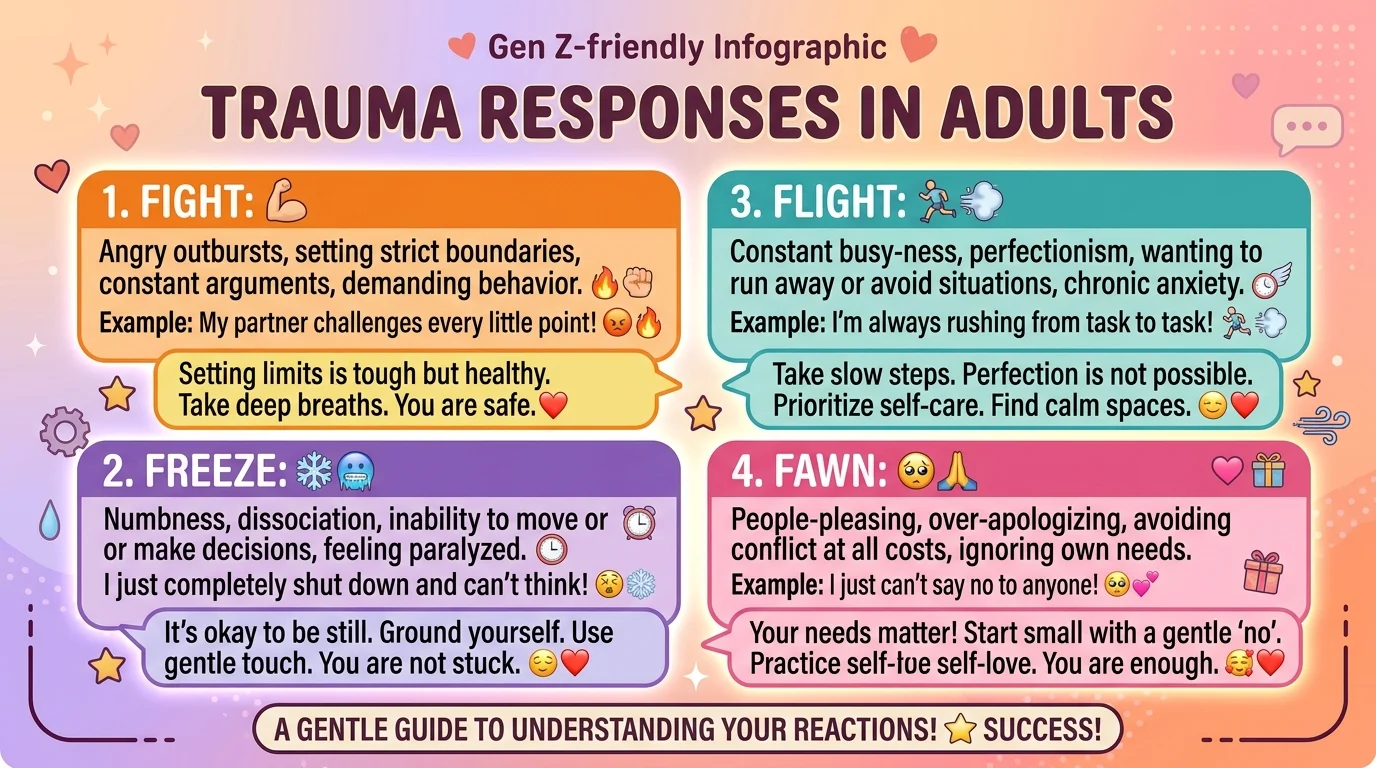
Trauma responses in adults are automatic survival reactions, most often described as fight, flight, freeze, and fawn. Helpful responses include: “I am safe right now,” “You do not have to explain,” “Let us slow this down,” “What do you need from me,” and “This reaction makes sense.”
You meant to send a simple text, but your hands went cold, your chest tightened, and suddenly you were apologizing for something that was not your fault. That is what trauma responses in adults often feel like from the inside. Not dramatic movie moments, just quiet automatic reactions that show up in DMs, meetings, family dinners, and relationships long after the original event is over.
These responses are survival adaptations, not character flaws, and they are far more common than most people admit. Understanding them changes how you talk to yourself and how you support someone else. This guide breaks down the main patterns, the everyday signs, and 180+ supportive phrases you can actually use, sorted by situation, so the next hard moment feels a little less lonely and a lot more manageable.
What Trauma Responses in Adults Actually Are
- They are automatic, not chosen.
Example: When you snap at a partner over a small comment and feel confused afterward.
Meaning: It helps you separate a survival reaction from a deliberate choice. - They usually come from the nervous system, not the personality.
Example: When someone calm in every other area of life panics in one specific situation.
Meaning: It reframes the reaction as protection rather than a flaw. - Fight looks like anger, control, or confrontation.
Example: When a mild criticism triggers an outsized defensive response.
Meaning: It names the pattern so it becomes easier to notice. - Flight looks like leaving, overworking, or staying busy.
Example: When a hard conversation sends you straight into tasks.
Meaning: It explains avoidance as a form of self protection. - Freeze looks like going blank, numb, or unable to decide.
Example: When you cannot speak during conflict even though you have plenty to say.
Meaning: It reassures people that shutdown is a valid stress response. - Fawn looks like over apologizing, pleasing, and self blame.
Example: When you take responsibility for someone else’s bad mood.
Meaning: It names the pattern that often hides behind being “easy going.” - Most people show a mix, not just one type.
Example: When you freeze in conflict but fawn afterward to smooth things over.
Meaning: It removes pressure to fit into a single label. - Triggers can be small and seemingly random.
Example: When a certain tone of voice ruins an otherwise fine day.
Meaning: It explains why reactions can feel disproportionate. - Responses can show up years after the event.
Example: When a new relationship surfaces old fears.
Meaning: It normalizes delayed reactions and reduces shame. - They often intensify under stress or poor sleep.
Example: When a busy month makes old patterns louder.
Meaning: It connects capacity to basic needs. - Awareness is the first real step.
Example: When naming the pattern helps you pause before reacting.
Meaning: It shows that insight alone can create breathing room. - Professional support helps, and asking for it is normal.
Example: When patterns keep interfering with work or relationships.
Meaning: It encourages reaching out without framing it as a crisis.
Fight Responses in Adults
- “I need a minute before I answer that.”
Example: When a comment lands wrong and you feel the heat rising.
Meaning: It buys time so anger does not speak for you. - “That came out sharper than I meant it to.”
Example: When you catch yourself snapping at someone safe.
Meaning: It repairs quickly without spiraling into shame. - “I am not angry at you. I am activated right now.”
Example: When your partner did nothing wrong but your body reacted.
Meaning: It separates the person from the response. - “I am going to step outside for five minutes.”
Example: When you feel the urge to argue until you win.
Meaning: It gives the nervous system space to settle. - “Can we come back to this when I am calmer?”
Example: When a conversation is escalating fast.
Meaning: It protects the relationship instead of the point. - “I notice I am defending myself before anyone attacked.”
Example: When you hear criticism that was not actually there.
Meaning: It names the pattern out loud and reduces its grip. - “I need to feel heard before I can problem solve.”
Example: When you are too activated to think logically.
Meaning: It communicates a real need instead of lashing out. - “I am going to breathe before I respond.”
Example: When a message triggers an instant reply urge.
Meaning: It puts a pause between trigger and text. - “I am not in danger, even if it feels that way.”
Example: When your body reacts to a normal disagreement.
Meaning: It grounds you in present reality. - “I want to fix this, not win this.”
Example: When an argument starts pulling you into combat mode.
Meaning: It reorients the conversation toward repair. - “I am sorry. That was my nervous system, not my opinion of you.”
Example: When you overreact to someone you trust.
Meaning: It offers a clear, non defensive apology. - “I am going to move my body and come back.”
Example: When anger needs a physical outlet.
Meaning: It channels activation in a safer direction.
Flight Responses in Adults
- “I am avoiding this because it feels big, not because I do not care.”
Example: When you keep postponing an important conversation.
Meaning: It names avoidance honestly instead of hiding it. - “I need a short break, and I will come back.”
Example: When you feel the urge to leave mid discussion.
Meaning: It sets a return expectation so it does not read as abandonment. - “I am staying busy so I do not have to feel this.”
Example: When you throw yourself into work after a hard day.
Meaning: It brings awareness to coping through distraction. - “I am going to sit with this for ten minutes before I reply.”
Example: When a message makes you want to disappear.
Meaning: It replaces fleeing with a small, contained pause. - “I keep overbooking myself and I think it is related.”
Example: When your calendar is full and your feelings are not.
Meaning: It connects busyness to emotional avoidance. - “I want to be here for this, even though it is uncomfortable.”
Example: When you are tempted to cancel on someone who matters.
Meaning: It reinforces a chosen value over an automatic impulse. - “I am not running from you. I am regulating.”
Example: When you need space but worry it will be misread.
Meaning: It clarifies the difference between distance and rejection. - “Can we do this in a smaller chunk?”
Example: When a task or conversation feels overwhelming.
Meaning: It reduces the urge to escape by lowering the load. - “I notice I am making excuses to leave.”
Example: When you catch yourself inventing reasons to go.
Meaning: It adds honesty to a pattern that usually stays hidden. - “I am going to stay for five more minutes and check in with myself.”
Example: When you want to practice tolerating discomfort.
Meaning: It builds tolerance in small, manageable steps. - “I need a plan before I can feel calm about this.”
Example: When uncertainty triggers the urge to avoid.
Meaning: It turns escape energy into preparation. - “I came back, and I am proud of that.”
Example: When you return after a pause you needed.
Meaning: It reinforces the new behavior you want to repeat.
Freeze Responses in Adults
- “I am still here. I just need a moment to find words.”
Example: When you go quiet during a tense conversation.
Meaning: It reassures others that silence is not withdrawal. - “My mind went blank and that is okay.”
Example: When someone asks a question and you cannot answer.
Meaning: It removes shame from a common stress response. - “Can you ask me again in a minute?”
Example: When processing takes longer than the moment allows.
Meaning: It buys space without disappearing. - “I am listening. I am just not ready to respond.”
Example: When a heavy conversation needs a slower pace.
Meaning: It keeps the connection open during shutdown. - “I need to write this down instead of saying it.”
Example: When speaking feels impossible but typing works.
Meaning: It offers an alternative route to communication. - “I am noticing that I have gone numb.”
Example: When you feel detached from a situation that should sting.
Meaning: It names the freeze honestly and reduces isolation. - “I do not need to decide right now.”
Example: When pressure to choose makes you shut down further.
Meaning: It removes urgency and restores a sense of control. - “I am safe. I can feel my feet on the floor.”
Example: When you need something concrete to return to.
Meaning: It uses a physical anchor to come back to the present. - “Please do not take my silence as disagreement.”
Example: When you worry someone will misread your stillness.
Meaning: It prevents unnecessary conflict from a shutdown. - “I am going to move slowly and that is fine.”
Example: When you need to rebuild momentum after freezing.
Meaning: It replaces self criticism with patience. - “I can answer in a text if that is easier.”
Example: When a phone call feels impossible.
Meaning: It finds a workable way to communicate. - “I came back into the conversation. That counts.”
Example: When you reengage after a shutdown.
Meaning: It reinforces progress instead of perfection.
Fawn Responses in Adults
- “I am sorry, and I have not actually done anything wrong.”
Example: When you apologize automatically in a neutral situation.
Meaning: It interrupts the reflex and adds accuracy. - “I need a second before I agree to something.”
Example: When you feel the urge to say yes immediately.
Meaning: It creates space between impulse and commitment. - “I am allowed to have a different opinion here.”
Example: When you soften your view to keep the peace.
Meaning: It reaffirms your right to hold your own perspective. - “That is not mine to fix.”
Example: When you take on someone else’s emotions out of habit.
Meaning: It sets a gentle but firm internal boundary. - “I want to help, and I need to check my capacity first.”
Example: When a request comes in and you usually just say yes.
Meaning: It balances kindness with self respect. - “I am not responsible for how they reacted.”
Example: When you replay a conversation looking for your fault.
Meaning: It separates your behavior from someone else’s response. - “I can disagree without losing the relationship.”
Example: When conflict feels dangerous even when it is not.
Meaning: It reframes disagreement as safe. - “I am going to say no and sit with the discomfort.”
Example: When declining feels physically uncomfortable.
Meaning: It builds tolerance for healthy boundaries. - “I notice I am shrinking to make someone comfortable.”
Example: When you catch yourself minimizing your needs.
Meaning: It brings awareness to a pattern that usually runs quietly. - “My needs matter in this conversation too.”
Example: When you have been accommodating all day.
Meaning: It restores balance without confrontation. - “I do not need to earn my place here.”
Example: When you feel you must be useful to be loved.
Meaning: It challenges a deeply held belief gently. - “I can be kind and still be honest.”
Example: When you worry that honesty will hurt someone.
Meaning: It removes the false choice between warmth and truth.
Common Triggers and Early Warning Signs
- “My chest is tight, which tells me I am activated.”
Example: When a routine message causes physical tension.
Meaning: It uses body cues as an early warning system. - “I am reading this as rejection and I should check that.”
Example: When a short reply feels like withdrawal from someone.
Meaning: It tests an assumption before reacting to it. - “I am scanning the room more than usual.”
Example: When hypervigilance shows up in a safe space.
Meaning: It names a subtle but common trauma response sign. - “I feel numb and that is information, not a problem.”
Example: When you shut down after a small conflict.
Meaning: It reframes numbness as a signal rather than a failure. - “Loud voices are a known trigger for me.”
Example: When a crowded restaurant makes you tense.
Meaning: It helps you plan ahead instead of being caught off guard. - “I am feeling small and I know why.”
Example: When a certain tone brings back an old dynamic.
Meaning: It connects the present reaction to the past pattern. - “I need to leave early tonight and that is a boundary, not a rejection.”
Example: When a social event exceeds your capacity.
Meaning: It communicates limits before they become a crisis. - “I am irritable today and it usually means I am overwhelmed.”
Example: When small things set you off for no obvious reason.
Meaning: It links irritability to underlying stress. - “I am apologizing a lot today.”
Example: When you notice the reflex showing up repeatedly.
Meaning: It turns self awareness into a gentle reset. - “I have not eaten or slept well, so my reactions are louder.”
Example: When your capacity is low and everything feels sharper.
Meaning: It treats basic needs as part of regulation. - “I am going to check in with myself before I reply to this.”
Example: When a message triggers an instant stress response.
Meaning: It builds a habit of pausing before reacting. - “This feeling is familiar and I have survived it before.”
Example: When an old pattern resurfaces unexpectedly.
Meaning: It reminds you of your own resilience.
Calm and Grounding Phrases to Say to Yourself
- “I am safe right now in this moment.”
Example: When your body reacts as if danger is present.
Meaning: It anchors you to present reality. - “This is a reaction, not a prediction.”
Example: When your mind jumps to worst case scenarios.
Meaning: It separates a nervous system response from an actual outcome. - “I do not have to solve everything today.”
Example: When the pressure to fix it all becomes overwhelming.
Meaning: It lowers the load to something manageable. - “I can feel my feet on the ground.”
Example: When you need a physical anchor during a spiral.
Meaning: It uses sensation to bring you back. - “I can name five things I can see.”
Example: When your mind is racing and you need a reset.
Meaning: It uses the senses to interrupt escalation. - “I am allowed to take up space.”
Example: When you feel the urge to shrink.
Meaning: It counters the instinct to disappear. - “My reaction makes sense given what I have been through.”
Example: When you feel embarrassed about a strong response.
Meaning: It replaces shame with self compassion. - “I can be scared and still take the next small step.”
Example: When fear is present but action is needed.
Meaning: It allows both feelings and progress. - “I do not need to explain myself perfectly.”
Example: When you are afraid of being misunderstood.
Meaning: It removes pressure to justify every feeling. - “I am allowed to pause.”
Example: When the moment feels too fast.
Meaning: It gives you permission to slow down. - “I have gotten through harder days than this.”
Example: When today feels unusually heavy.
Meaning: It draws on evidence of your own resilience. - “I am doing the best I can with what I have right now.”
Example: When you feel like you are falling short.
Meaning: It replaces self criticism with realistic kindness.
Supportive Things to Say to a Partner
- “I am here. You do not have to explain right now.”
Example: When your partner goes quiet after something triggering.
Meaning: It offers presence without pressure. - “That reaction makes sense to me.”
Example: When they feel embarrassed about a strong response.
Meaning: It validates them instead of analyzing them. - “What do you need from me in this moment?”
Example: When you are unsure whether to comfort or give space.
Meaning: It gives them control over their own support. - “I am not going anywhere.”
Example: When they test whether you will leave.
Meaning: It offers reassurance without overpromising perfection. - “Take your time. I am not in a rush.”
Example: When they need longer to process.
Meaning: It removes the pressure of the clock. - “You are not too much for me.”
Example: When they apologize for having needs.
Meaning: It directly challenges a common fear. - “I can handle this conversation.”
Example: When they worry their emotions will overwhelm you.
Meaning: It signals steadiness and capacity. - “Let us slow this down together.”
Example: When a discussion is escalating quickly.
Meaning: It brings both of you back to a calmer pace. - “I noticed your energy shifted. Do you want to talk or take a break?”
Example: When you spot a trigger before it becomes a fight.
Meaning: It offers choice instead of assumption. - “That is not your fault.”
Example: When they blame themselves for a reaction.
Meaning: It interrupts the self blame loop early. - “I love you on the hard days too.”
Example: When they feel unlovable during a difficult moment.
Meaning: It reinforces unconditional care. - “We can work on this over time, not all at once.”
Example: When progress feels slow.
Meaning: It removes the pressure for instant healing.
Supportive Things to Say to a Friend or Family Member
- “I am glad you told me.”
Example: When they finally open up about a hard pattern.
Meaning: It rewards honesty instead of making it feel risky. - “You do not owe me the full story.”
Example: When they share only part of what happened.
Meaning: It respects their pace and privacy. - “Do you want advice or do you want company?”
Example: When you are unsure how to respond to a heavy message.
Meaning: It helps you support them the way they need. - “I believe you.”
Example: When they worry you will doubt their experience.
Meaning: It offers validation that many people rarely receive. - “That sounds exhausting.”
Example: When they describe living with a constant reaction.
Meaning: It names the effort without minimizing it. - “You are not broken.”
Example: When they describe themselves as damaged.
Meaning: It challenges a common and painful belief. - “I do not think less of you for this.”
Example: When they seem embarrassed after opening up.
Meaning: It removes the fear of judgment. - “What would feel supportive right now?”
Example: When you want to help but do not want to guess wrong.
Meaning: It puts them in charge of what happens next. - “I am not going to push you to talk.”
Example: When they seem overwhelmed by the conversation.
Meaning: It removes pressure and keeps the door open. - “You can text me later if talking is too much.”
Example: When a call or in person chat feels like a lot.
Meaning: It offers an easier way to stay connected. - “I am learning, so tell me if I get this wrong.”
Example: When you want to support them without overstepping.
Meaning: It shows humility and openness. - “You are not a burden.”
Example: When they apologize for needing support.
Meaning: It counters a very common fear directly.
Professional and Workplace Responses
- “I need a moment to gather my thoughts before I respond.”
Example: When a meeting comment catches you off guard.
Meaning: It buys time without revealing more than you want to share. - “Can we move this discussion to a quieter space?”
Example: When a loud or public setting makes it harder to think.
Meaning: It reduces triggers while staying professional. - “I would prefer to follow up in writing.”
Example: When speaking feels too difficult in the moment.
Meaning: It gives you a communication method that works. - “I need clarity on priorities before I commit.”
Example: When pressure triggers a fawn response and instant yes.
Meaning: It replaces automatic agreement with thoughtfulness. - “I am going to take my break now and return to this after.”
Example: When capacity is low and reactions are louder.
Meaning: It protects your ability to work well. - “That feedback landed harder than intended. Let me process it.”
Example: When criticism triggers an outsized emotional response.
Meaning: It communicates honestly without overexplaining. - “I am stepping away from this thread for now.”
Example: When a tense email chain is escalating.
Meaning: It removes you from an activated exchange. - “Could we keep this conversation solution focused?”
Example: When a discussion is drifting into blame.
Meaning: It redirects the conversation toward something useful. - “I would rather not discuss this in a group setting.”
Example: When a topic feels too personal for an open room.
Meaning: It sets a boundary while staying professional. - “I need a written summary of expectations.”
Example: When ambiguity increases anxiety.
Meaning: It reduces uncertainty and gives you something concrete. - “I am not available for this after hours.”
Example: When work messages intrude on rest.
Meaning: It protects recovery time that regulation depends on. - “I want to do this well, so let me take the time I need.”
Example: When rushing increases errors and stress.
Meaning: It frames a boundary as a quality commitment.
Gentle Boundary Setting Responses
- “I am not able to take this on right now.”
Example: When a request comes in and your capacity is full.
Meaning: It declines clearly without over explaining. - “I can help with this part, but not that part.”
Example: When someone asks for more than you can offer.
Meaning: It offers a partial yes instead of a resentful full one. - “I need to think about it before I answer.”
Example: When you feel pressure to agree immediately.
Meaning: It interrupts the automatic yes reflex. - “That tone does not work for me, and I still want to help.”
Example: When someone speaks to you sharply.
Meaning: It sets a limit while keeping the relationship open. - “I am not going to discuss this today.”
Example: When a topic is too activating in the moment.
Meaning: It protects your capacity with a clear limit. - “I need this to be a two way conversation.”
Example: When the other person is venting without listening.
Meaning: It asks for mutuality instead of absorbing everything. - “I care about you and I also need rest.”
Example: When someone leans on you heavily.
Meaning: It shows both can be true at once. - “I am going to end this conversation for now.”
Example: When a discussion is going in circles and escalating.
Meaning: It takes control of the exit calmly. - “I can listen, but I cannot be your only support.”
Example: When someone depends on you for everything.
Meaning: It sets a sustainable boundary with kindness. - “I am not comfortable sharing that.”
Example: When a question feels too personal.
Meaning: It answers without needing to justify. - “I need some time before we talk about this again.”
Example: When you are still activated from a previous conversation.
Meaning: It buys space without closing the door. - “I am allowed to change my mind.”
Example: When you agreed too fast and now feel resentful.
Meaning: It gives you permission to adjust a decision.
De-Escalation and Conflict Responses
- “I want to understand what you are saying. Can you say it again slower?”
Example: When a conversation has become heated.
Meaning: It slows the pace and signals genuine interest. - “I think we are both activated right now.”
Example: When an argument is escalating on both sides.
Meaning: It names the dynamic rather than blaming one person. - “Let us take ten minutes and come back to this.”
Example: When emotions are too high to think clearly.
Meaning: It creates a pause with a clear return point. - “I hear that you are upset. I am not ignoring that.”
Example: When someone feels dismissed mid argument.
Meaning: It validates emotion before moving to solutions. - “Can we agree on what we are actually trying to solve?”
Example: When an argument has drifted off topic.
Meaning: It refocuses the conversation on the real issue. - “I am not going to raise my voice, even if you do.”
Example: When someone escalates the volume.
Meaning: It sets a standard without matching their energy. - “I need to stop this conversation before I say something I regret.”
Example: When you feel anger building.
Meaning: It protects the relationship from damage. - “I can see this matters a lot to you.”
Example: When someone is emotional and needs to feel seen.
Meaning: It lowers defensiveness by acknowledging importance. - “Let us each say one thing we need right now.”
Example: When both people feel unheard.
Meaning: It brings structure to a chaotic moment. - “I am not going to continue while we are both this upset.”
Example: When the conversation is going nowhere productive.
Meaning: It draws a calm, clear line. - “I am sorry this turned into a fight.”
Example: When a small disagreement escalated quickly.
Meaning: It offers repair without assigning blame. - “We can come back to this when we are both calmer.”
Example: When a discussion needs to be paused.
Meaning: It commits to revisiting instead of avoiding.
Therapeutic and Clinical Language
- “That sounds like a fight response showing up.”
Example: When someone describes sudden anger in a safe situation.
Meaning: It offers a shared, non judgmental frame. - “Freeze is protective, not lazy.”
Example: When a client criticizes themselves for shutting down.
Meaning: It reframes the response with compassion. - “Fawning often starts as a way to stay safe.”
Example: When someone recognizes chronic people pleasing.
Meaning: It connects the pattern to its original purpose. - “Hypervigilance is your system trying to keep you safe.”
Example: When someone describes constant scanning and alertness.
Meaning: It explains the mechanism without pathologizing it. - “Avoidance makes sense as a coping strategy.”
Example: When a client keeps postponing difficult tasks.
Meaning: It validates the behavior before exploring alternatives. - “Trauma responses are adaptations, not symptoms of weakness.”
Example: When someone feels ashamed of their reactions.
Meaning: It reframes the entire conversation around strength. - “Window of tolerance is a useful way to think about this.”
Example: When someone wants a framework for their reactions.
Meaning: It offers a concept that makes the experience understandable. - “Grounding is a skill you can build over time.”
Example: When a client feels hopeless about managing reactions.
Meaning: It emphasizes practice rather than instant change. - “Somatic work can help the body catch up with the mind.”
Example: When insight alone has not changed the pattern.
Meaning: It points to approaches that include the body. - “Triggers often point to unfinished protection, not weakness.”
Example: When someone is frustrated by an old reaction.
Meaning: It reframes triggers as meaningful information. - “Relapse into old patterns is part of the process.”
Example: When a client feels they have undone their progress.
Meaning: It normalizes setbacks and reduces shame. - “What would safety look like in this moment?”
Example: When a session turns toward practical next steps.
Meaning: It turns abstract discussion into something actionable.
Everyday Coping and Reset Responses
- “I am going to drink some water and breathe.”
Example: When you feel activated and need something simple.
Meaning: It uses basic physical care to settle the nervous system. - “I am going for a short walk.”
Example: When your body needs movement to discharge stress.
Meaning: It turns restless energy into regulation. - “I am turning my phone off for twenty minutes.”
Example: When messages are making everything worse.
Meaning: It creates a temporary protective boundary. - “I am going to write this down instead of spiraling.”
Example: When thoughts are looping and need somewhere to go.
Meaning: It gives the mind a container for the noise. - “I am going to eat something before I decide anything.”
Example: When low energy is amplifying every reaction.
Meaning: It treats basic needs as part of emotional care. - “I need silence, not a solution.”
Example: When people offering advice feels overwhelming.
Meaning: It communicates what actually helps right now. - “I am going to do one small thing and then reassess.”
Example: When tasks feel impossible and you are frozen.
Meaning: It lowers the barrier to momentum. - “I am going to put my feet on the floor and count to ten.”
Example: When you need something quick and physical.
Meaning: It uses a simple ritual to return to the present. - “I am going to text someone safe.”
Example: When you feel alone in a hard moment.
Meaning: It uses connection as a regulation tool. - “I am going to let this be unfinished today.”
Example: When perfectionism is adding pressure.
Meaning: It gives permission to stop. - “I am going to move slower on purpose.”
Example: When everything feels rushed and loud.
Meaning: It deliberately lowers the pace to reduce activation. - “I am going to be kind to myself about this.”
Example: When self criticism is making things worse.
Meaning: It chooses compassion as an active practice.
Long Term Healing and Professional Support
- “I am going to talk to a professional about this pattern.”
Example: When the same reaction keeps disrupting relationships.
Meaning: It treats support as a practical next step. - “I am looking for someone who understands trauma specifically.”
Example: When general advice has not been enough.
Meaning: It helps you find the right kind of support. - “I am allowed to try more than one approach.”
Example: When the first method does not fit.
Meaning: It removes pressure to get it right immediately. - “I am working on tolerance, not perfection.”
Example: When progress feels inconsistent.
Meaning: It frames healing as a skill built over time. - “I am learning my triggers so I can plan ahead.”
Example: When certain situations keep catching you off guard.
Meaning: It turns self knowledge into practical preparation. - “I am building a support network on purpose.”
Example: When you realize you have been isolating.
Meaning: It treats connection as part of recovery. - “I am going to be honest with my doctor about this.”
Example: When physical symptoms accompany stress.
Meaning: It brings the whole picture into the conversation. - “I am allowed to set boundaries while I heal.”
Example: When people expect you to bounce back quickly.
Meaning: It protects the process from outside pressure. - “Progress includes the days I just get through.”
Example: When a hard week feels like failure.
Meaning: It reframes survival as part of the work. - “I am not the same person I was, and that is okay.”
Example: When you notice changes in how you connect.
Meaning: It accepts change without labeling it as loss. - “I am going to keep showing up for myself.”
Example: When motivation is low but the work continues.
Meaning: It reinforces consistency over intensity. - “Asking for help is a skill, not a weakness.”
Example: When reaching out still feels uncomfortable.
Meaning: It reframes support seeking as strength.
FAQs
What are trauma responses in adults?
They are automatic reactions the nervous system uses to protect you, commonly described as fight, flight, freeze, and fawn. They can show up long after the original event.
Are trauma responses the same as being dramatic?
No. They are physiological survival reactions, not a performance. The intensity can feel out of proportion to the moment, and that is part of how they work.
Can someone have more than one type?
Yes, most people show a mix depending on the situation. Freeze in conflict and fawn afterward is a very common combination.
Is it okay to talk about this at work?
Share only what you are comfortable with. You can set practical boundaries like requesting written instructions or a quieter space without disclosing personal history.
What if I said something I did not mean during a reaction?
Repair quickly. A short, honest apology that names the reaction and clarifies your intent goes a long way.
Is humor appropriate when discussing trauma responses?
Gentle humor can help people feel less alone, but timing matters. Read the room and avoid joking about someone else’s experience.
When should someone seek professional help?
When reactions interfere with work, relationships, sleep, or daily life, or when someone feels stuck despite coping efforts.
Conclusion
Trauma responses in adults are not personal failures. They are old protection systems doing their job long after the danger has passed. Naming them gently, learning your triggers, and choosing responses that fit the moment can make a real difference over time. A pause before you reply is often more powerful than the perfect thing to say.
Save this list, share it with someone who is hard on themselves about their reactions, and revisit it on the days that feel heavier than usual. You do not need to get this perfect, and you do not have to do it alone.
