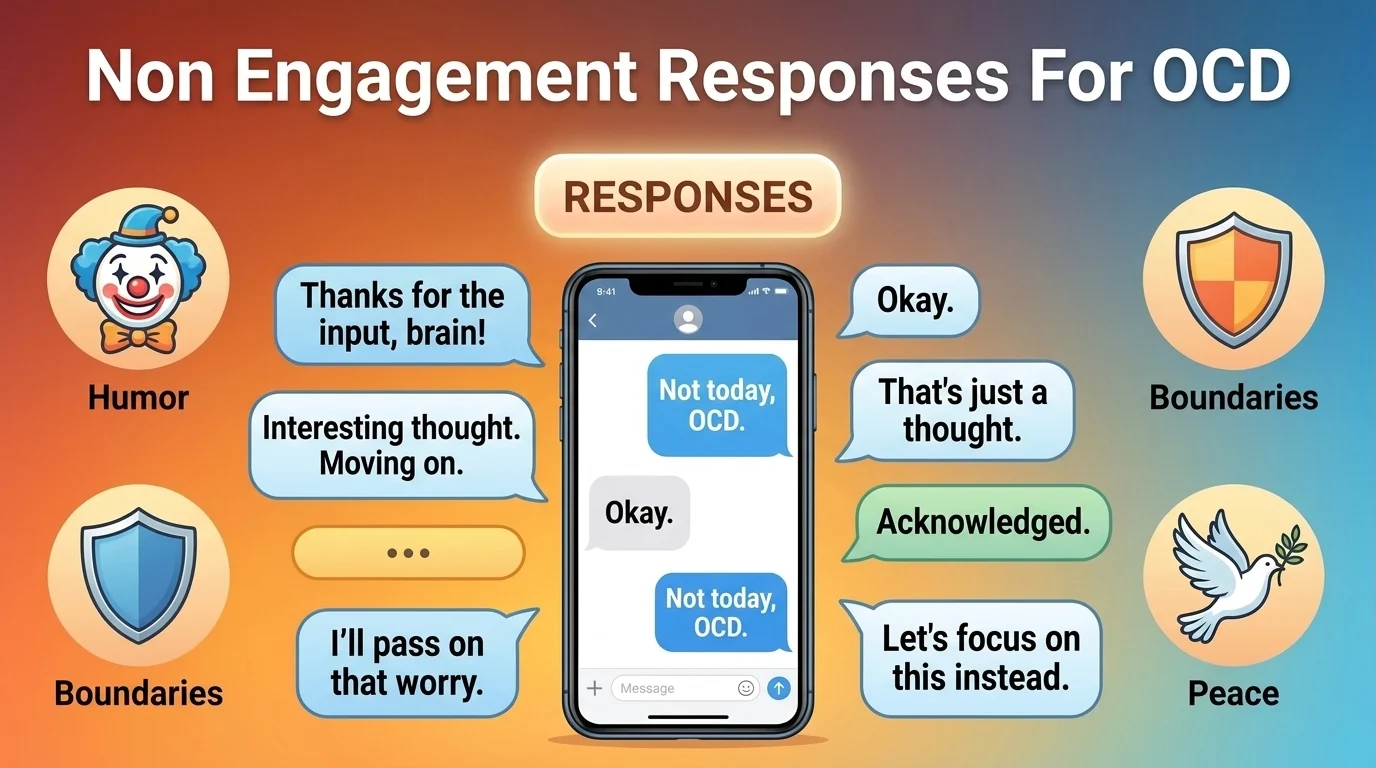
Handling OCD non engagement responses means staying calm, keeping it brief, and not feeding into the loop. Top alternatives: “Thanks for letting me know,” “I hear you,” “Got it,” “Noted,” “I’m here if you need me.”
Ever been stuck in a conversation where someone’s OCD is making simple replies feel like a mental maze? Whether it’s a friend seeking reassurance, a coworker over-explaining, or a crush who keeps double-texting for validation, knowing how to respond without feeding the cycle is a real skill. Social media and DMs make this even trickier because tone gets lost in text.
Mastering non engagement responses for OCD isn’t about being cold. It’s about being smart, kind, and boundary-aware. The right reply can calm a situation, protect your energy, and keep relationships intact. The wrong one? Well, let’s just say you’ll be stuck in reply loops forever.
This guide gives you 150+ ready-to-use responses broken down by mood and situation. Whether you’re going for funny, polite, firm, or sweet, we’ve got you covered. Save this list, screenshot it, send it to a friend. Your future self will thank you.
1. Funny Responses
- “My brain just buffered for a sec, what were we saying?”
Example: Use when someone repeats the same question and you need to lighten the mood without snapping.
Meaning: Deflects tension with humor and gives everyone a chance to reset. - “Plot twist: we’re both overthinking this right now.”
Example: Perfect for when a friend is spiraling and you want to break the cycle with a laugh.
Meaning: Acknowledges the shared awkwardness while keeping things light. - “If I had a nickel for every time we circled back, I’d be rich.”
Example: Use with close friends who are stuck on the same topic and need a gentle nudge.
Meaning: Points out the repetition in a playful way that doesn’t feel critical. - “I’m gonna file this under ‘things we’ve already solved.'”
Example: Great for coworkers who keep re-asking the same thing in meetings.
Meaning: Signals that the topic is closed without being harsh. - “My anxiety said hi but I told it you’re busy.”
Example: Use when someone asks if you’re mad and you want to reassure them playfully.
Meaning: Disarms the worry with self-deprecating humor. - “Hold on, let me check my non engagement handbook.”
Example: Ideal when someone keeps pushing for a reaction you don’t want to give.
Meaning: Turns the situation into a joke while subtly setting a boundary. - “We’re giving main character energy to a side quest right now.”
Example: Use when a conversation derails into unnecessary detail and you want to pull it back.
Meaning: Playfully reminds everyone to focus on what actually matters. - “I love you but my thumbs are tired.”
Example: Perfect for a friend who sends 47 texts in a row about the same worry.
Meaning: Affectionate way to say you need a breather. - “This conversation has more reruns than my comfort show.”
Example: Use when the same topic keeps coming back and you need to break the loop.
Meaning: Calls out the repetition with a pop culture twist. - “Are we rehearsing or living? Asking for a friend.”
Example: Great for when someone keeps scripting scenarios that haven’t even happened.
Meaning: Gently points out that over-planning isn’t helping anyone. - “My brain has left the chat.”
Example: Use when you’re done with the back-and-forth and want to exit gracefully.
Meaning: Signals mental exhaustion in a way that’s funny, not rude. - “Plot twist: we survive this too.”
Example: Perfect for dramatic friends who need a reminder that things work out.
Meaning: Offers reassurance with a playful edge.
2. Polite Responses
- “Thanks for sharing that with me.”
Example: Use when someone over-explains their OCD thoughts and you want to acknowledge them without engaging deeply.
Meaning: Shows respect without inviting more detail. - “I appreciate you keeping me in the loop.”
Example: Great for coworkers who update you on every tiny detail of their process.
Meaning: Validates their effort while gently closing the conversation. - “Got it, thanks for the clarity.”
Example: Use when someone repeats themselves and you want to confirm you understood.
Meaning: Ends the loop with a simple acknowledgment. - “I hear you, and I’m glad you told me.”
Example: Perfect for friends seeking reassurance about a shared plan.
Meaning: Offers emotional validation without encouraging more discussion. - “That makes sense, thanks for explaining.”
Example: Use when a coworker over-clarifies something you already understood.
Meaning: Respectfully signals that the explanation is complete. - “Noted, I’ll keep that in mind.”
Example: Ideal for when someone gives you unsolicited advice about their OCD triggers.
Meaning: Acknowledges their input without committing to action. - “I’m here if you need to talk more.”
Example: Use when you want to be supportive but don’t have bandwidth for a long chat.
Meaning: Leaves the door open without actively engaging now. - “Thanks for checking in.”
Example: Perfect for when someone keeps asking if you’re okay after a minor thing.
Meaning: Reassures them briefly and closes the loop. - “I understand where you’re coming from.”
Example: Use when someone explains their OCD reasoning and you want to be kind without debating.
Meaning: Shows empathy without agreeing or disagreeing. - “I’ll let you know if anything changes.”
Example: Great for situations where someone keeps asking for updates you don’t have.
Meaning: Sets a clear boundary without being dismissive. - “Thanks for being so thorough.”
Example: Use with a colleague who over-documents everything and needs validation.
Meaning: Praises their effort while signaling you’re up to speed. - “No worries at all, we’re good.”
Example: Perfect for when someone apologizes repeatedly for an OCD moment.
Meaning: Quickly reassures them so they can stop spiraling.
3. Work-Safe Responses
- “I’ve reviewed everything and we’re on track.”
Example: Use with a manager who keeps checking if you understood a task.
Meaning: Confirms completion and reduces the need for follow-ups. - “Let’s park this for now and revisit if needed.”
Example: Great in meetings when a colleague keeps circling back to a settled point.
Meaning: Professionally closes the loop and sets a time to revisit. - “I’ll follow up if anything needs your input.”
Example: Use when a coworker keeps asking if you need help with a simple task.
Meaning: Politely takes ownership and limits unnecessary check-ins. - “Thanks for flagging that, I’ll take it from here.”
Example: Perfect when someone over-explains a process you already know.
Meaning: Acknowledges their concern while taking control. - “That’s helpful context, appreciate it.”
Example: Use in a team chat when someone shares more detail than needed.
Meaning: Validates their contribution without extending the conversation. - “I’ve noted your points and will incorporate them.”
Example: Great for when a colleague repeats feedback you’ve already addressed.
Meaning: Signals that the feedback is received and no further discussion is needed. - “Let’s keep this moving for now.”
Example: Use when a meeting is stuck on a minor detail.
Meaning: Professionally redirects focus to keep things productive. - “I’ll loop you in when there’s an update.”
Example: Perfect for when someone keeps asking for status reports.
Meaning: Sets expectations and reduces repeated inquiries. - “Confirmed on my end, thanks.”
Example: Use when someone double-checks that you received their message.
Meaning: Ends the back-and-forth with a clear confirmation. - “Good question, I’ll look into it and get back to you.”
Example: Great for when someone asks something you’ve already answered.
Meaning: Buys time and closes the loop without repeating yourself. - “Appreciate the attention to detail.”
Example: Use with a coworker who over-checks everything and needs positive reinforcement.
Meaning: Praises their thoroughness while signaling you’re satisfied. - “We’re aligned, let’s move forward.”
Example: Perfect for wrapping up a conversation that’s gone in circles.
Meaning: Confirms agreement and ends the discussion.
4. Firm Responses
- “We’ve covered this, so I’m going to leave it there.”
Example: Use when someone keeps re-asking the same question despite your answers.
Meaning: Clearly states the topic is closed. - “I’ve said what I can say on this.”
Example: Great for when a friend keeps pushing for reassurance you can’t give.
Meaning: Sets a firm boundary without being unkind. - “I’m not going to keep discussing this.”
Example: Perfect for when a conversation about OCD rituals becomes exhausting.
Meaning: Directly ends the loop. - “This isn’t up for debate anymore.”
Example: Use when someone keeps trying to renegotiate a decision you’ve made.
Meaning: Confirms finality. - “I need you to respect my answer.”
Example: Great for when someone dismisses your response and keeps asking.
Meaning: Requests respect for your boundary. - “I’ve given you my answer.”
Example: Use when someone keeps asking the same thing in different ways.
Meaning: Confirms you’ve already responded and won’t repeat. - “I’m not available for this conversation right now.”
Example: Perfect when you need to step away from a repetitive discussion.
Meaning: Sets a time and space boundary. - “Let’s agree to disagree.”
Example: Use when a debate about OCD behaviors is going nowhere.
Meaning: Ends the conflict without further engagement. - “I’m going to stop here.”
Example: Great for when a conversation is draining and unproductive.
Meaning: Clearly ends the exchange. - “I won’t be re-explaining that.”
Example: Use when someone claims they didn’t understand your previous answer.
Meaning: Reinforces that your answer stands. - “I need you to take my word on this.”
Example: Perfect for when someone keeps seeking reassurance about your intentions.
Meaning: Requests trust without more back-and-forth. - “This conversation isn’t helping either of us.”
Example: Use when a loop is exhausting and you need to call it out.
Meaning: Acknowledges the cycle and ends it.
5. Sarcastic Responses
- “Oh good, I was worried we’d run out of things to overthink.”
Example: Use with close friends who keep spiraling on the same topic.
Meaning: Playfully points out the repetition. - “Wow, what a plot twist. Never saw that coming.”
Example: Perfect for when someone brings up the same worry for the fifth time.
Meaning: Gently mocks the loop without being mean. - “Let me clear my schedule for this rerun.”
Example: Great for when a friend keeps re-opening the same conversation.
Meaning: Signals the repetition with dry humor. - “Groundbreaking. Truly.”
Example: Use when someone shares a thought you’ve already heard ten times.
Meaning: Lightly teases the lack of new information. - “I see the WiFi is working and so is the loop.”
Example: Perfect for group chats where someone keeps circling back.
Meaning: Calls out the cycle with a tech twist. - “Someone call the record label, we’ve got a hit.”
Example: Use when a topic keeps replaying like a song.
Meaning: Points out repetition in a funny way. - “I’d say we’ve cracked the code, but we haven’t.”
Example: Great for when someone keeps analyzing the same situation.
Meaning: Mocks the over-analysis without being harsh. - “We’re really maximizing our screen time here.”
Example: Use when a texting loop drags on.
Meaning: Playfully notes the unnecessary length of the conversation. - “I’m adding this to my list of things we’ve definitely solved.”
Example: Perfect for when someone keeps re-raising a resolved issue.
Meaning: Sarcastically confirms closure. - “Your dedication to the loop is inspiring.”
Example: Use with a friend who keeps bringing up the same worry.
Meaning: Gently teases the repetition. - “If overthinking burned calories, we’d be unstoppable.”
Example: Great for self-deprecating humor when you’re both stuck.
Meaning: Lightens the mood while acknowledging the pattern. - “Is this a conversation or a subscription service?”
Example: Use when someone keeps coming back with the same topic.
Meaning: Jokes about the recurring nature of the chat.
6. Chill Responses
- “All good on my end.”
Example: Use when someone checks if you’re upset for the third time.
Meaning: Simple reassurance without extra detail. - “We’re fine, no stress.”
Example: Perfect for when a friend worries about a minor misunderstanding.
Meaning: Calmly closes the loop. - “I’m not worried, so you don’t have to be.”
Example: Great for when someone seeks reassurance about your feelings.
Meaning: Reassures them by modeling calm. - “Take your time, no rush.”
Example: Use when someone over-apologizes for delayed replies.
Meaning: Removes pressure and closes the anxiety loop. - “It’s not a big deal, honestly.”
Example: Perfect for when someone keeps apologizing for a small mistake.
Meaning: Downplays the issue to stop the spiral. - “We can figure it out later if needed.”
Example: Use when someone keeps planning for unlikely scenarios.
Meaning: Delays unnecessary problem-solving. - “I’m easy, whatever works.”
Example: Great for when someone keeps asking for your preference repeatedly.
Meaning: Signals flexibility and ends the questioning. - “No need to over-explain, I get it.”
Example: Use when a coworker is giving you unnecessary context.
Meaning: Politely cuts the explanation short. - “All sorted, no worries.”
Example: Perfect for closing a concern quickly.
Meaning: Confirms resolution without discussion. - “Let’s just go with the flow.”
Example: Use when someone is over-planning and you want to simplify.
Meaning: Encourages a relaxed approach. - “I’m good if you’re good.”
Example: Great for mutual reassurance without long conversation.
Meaning: Closes the loop with mutual agreement. - “Nothing to fix here.”
Example: Use when someone thinks there’s a problem that doesn’t exist.
Meaning: Clearly states there’s no issue.
7. Confident Responses
- “I trust my answer, and you can too.”
Example: Use when someone keeps doubting your response.
Meaning: Projects certainty to end the loop. - “I’ve made my decision, and it’s solid.”
Example: Perfect for when someone keeps re-asking about a choice you made.
Meaning: Confirms finality with confidence. - “You don’t need to worry about that.”
Example: Great for when someone seeks reassurance about your intentions.
Meaning: Calmly takes control of the narrative. - “I know what I’m doing here.”
Example: Use when a coworker keeps checking in on a task you’ve got handled.
Meaning: Asserts competence without arrogance. - “We’re on the right track.”
Example: Perfect for when someone needs confirmation that things are okay.
Meaning: Confirms direction and closes the loop. - “I’m confident in this, so let’s move on.”
Example: Use when a discussion keeps circling and you’re ready to proceed.
Meaning: Signals readiness to progress. - “This is handled.”
Example: Great for quickly ending questions about a task.
Meaning: Short, firm, and clear. - “I’ve got this covered.”
Example: Use when someone keeps offering unnecessary help.
Meaning: Confirms ownership and competence. - “I’m sure about this one.”
Example: Perfect for when someone doubts your answer repeatedly.
Meaning: Reinforces certainty without extra words. - “Let’s trust the process.”
Example: Use when someone is anxious about an outcome you can’t control.
Meaning: Encourages faith in the plan. - “I stand by what I said.”
Example: Great for when someone tries to re-open a settled debate.
Meaning: Confirms your position is final. - “We’re good here, no doubts.”
Example: Use when someone keeps asking if you’re okay with a decision.
Meaning: Closes the loop with confidence.
8. Creative Responses
- “If this conversation were a movie, we’d be in the sequel nobody asked for.”
Example: Use when a friend keeps re-opening the same topic.
Meaning: Playfully calls out the repetition. - “My brain just sent a ‘low battery’ notification.”
Example: Great for when you need to exit a draining loop.
Meaning: Signals mental fatigue in a creative way. - “I’m putting this conversation in airplane mode.”
Example: Use when you’re ready to disengage from repetitive back-and-forth.
Meaning: Playfully announces a break. - “This loop called, it wants its plot back.”
Example: Perfect for when a topic keeps circling.
Meaning: Uses humor to highlight the repetition. - “Let’s hit pause and save the rest for the director’s cut.”
Example: Use when you need to exit a long conversation gracefully.
Meaning: Creates a fun way to end the chat. - “My energy bar is at 10 percent, so I’m logging off this topic.”
Example: Great for group chats where the conversation is draining.
Meaning: Sets a limit with a gaming reference. - “We’ve reached the credits on this one.”
Example: Use when a conversation has run its course.
Meaning: Signals the end in a cinematic way. - “I’m gonna bookmark this for later and probably never return.”
Example: Perfect for when someone keeps promising to revisit a topic.
Meaning: Politely deflects without commitment. - “Let’s put this in the drafts folder.”
Example: Use when a discussion isn’t productive and you want to table it.
Meaning: Defers without engaging further. - “My phone needs a break from this plotline.”
Example: Great for when you’re texting in circles.
Meaning: Humorously signals disengagement. - “I’m sending this conversation to voicemail.”
Example: Use when you need to step back from a loop.
Meaning: Playfully exits the exchange. - “We’ve got enough content for a trilogy, let’s wrap it up.”
Example: Perfect for when a topic has been discussed to death.
Meaning: Creatively calls for closure.
9. Direct Responses
- “I’ve already answered that.”
Example: Use when someone keeps asking the same question.
Meaning: Clearly points out the repetition. - “That’s been settled.”
Example: Great for shutting down reopened debates.
Meaning: Confirms finality. - “I’m not discussing this further.”
Example: Perfect when a conversation is draining.
Meaning: Sets a hard boundary. - “We’re done with this topic.”
Example: Use when you need to move on.
Meaning: Ends the discussion clearly. - “I’ve given you everything I’m going to say.”
Example: Great for when someone keeps pushing for more.
Meaning: Confirms the conversation is complete. - “This is not up for negotiation.”
Example: Perfect for firm boundaries on decisions.
Meaning: Ends the back-and-forth. - “Please stop asking.”
Example: Use when someone won’t let a topic go.
Meaning: Directly addresses the behavior. - “I need you to move on from this.”
Example: Great for friends stuck in a loop.
Meaning: Requests a topic change. - “That’s final.”
Example: Use for clear closure.
Meaning: Confirms no further discussion. - “I’m not repeating myself.”
Example: Perfect for when someone keeps asking for clarification.
Meaning: Reinforces that your answer stands. - “We’ve closed this chapter.”
Example: Use when a topic is officially done.
Meaning: Signals finality with a touch of drama. - “Let it go, it’s not needed.”
Example: Great for lightheartedly ending over-analysis.
Meaning: Politely but firmly moves things along.
10. Dramatic Responses
- “I cannot do this loop one more time, I’m exhausted.”
Example: Use with close friends who know your dramatic streak.
Meaning: Over-the-top way to say you’re done. - “The drama is done, the curtain is closed.”
Example: Perfect for ending an intense conversation.
Meaning: Announces finality with flair. - “This conversation has officially outworn its welcome.”
Example: Use when a topic keeps dragging.
Meaning: Theatrical way to end the loop. - “I am officially exiting the arena.”
Example: Great for gracefully bowing out of repetitive chats.
Meaning: Signals departure with style. - “If I hear this one more time, I’m writing a memoir.”
Example: Use when a topic is repeated endlessly.
Meaning: Humorously highlights exhaustion. - “I need a dramatic pause and then a permanent exit.”
Example: Perfect for when you’re done with the loop.
Meaning: Adds theater to your boundary. - “The credits are rolling, my friend.”
Example: Use when a conversation has clearly ended.
Meaning: Closes the scene. - “I’m done, no encore.”
Example: Great for short, firm exits.
Meaning: Confirms no further engagement. - “Take me off the loop’s mailing list.”
Example: Use humorously when someone keeps re-raising a point.
Meaning: Asks to be excluded from the cycle. - “My exit music is playing.”
Example: Perfect for leaving a repetitive chat.
Meaning: Signals departure creatively. - “We’ve hit the final act, let’s wrap.”
Example: Use when a topic has run its course.
Meaning: Announces closure with drama. - “I’m out, and I’m taking the spotlight with me.”
Example: Great for dramatic exits from endless discussions.
Meaning: Exits with confidence.
11. Strategic Responses
- “Let’s focus on what’s actionable right now.”
Example: Use in meetings when someone keeps spiraling on hypotheticals.
Meaning: Redirects to practical steps. - “I’ll update you when there’s something new.”
Example: Great for when someone keeps asking for status updates.
Meaning: Sets expectations and reduces check-ins. - “We can revisit this if things change.”
Example: Use when someone keeps worrying about future scenarios.
Meaning: Defers unnecessary discussion. - “Let’s table this for now.”
Example: Perfect for ending a loop in a professional setting.
Meaning: Defers without dismissing. - “What’s the next step here?”
Example: Use when a conversation is stuck in analysis.
Meaning: Moves things forward. - “I think we’ve covered what we need to.”
Example: Great for wrapping up a repetitive discussion.
Meaning: Signals completeness. - “Let’s prioritize the most important point.”
Example: Use in meetings when a topic gets over-complicated.
Meaning: Refocuses attention. - “I’ll handle this and keep you posted.”
Example: Perfect for ending repeated questions about your task.
Meaning: Takes control and closes the loop. - “We’ve got what we need, let’s move.”
Example: Use when discussion is done.
Meaning: Pushes forward efficiently. - “Let’s circle back only if necessary.”
Example: Great for setting boundaries around follow-ups.
Meaning: Minimizes future loops. - “I’ll document this so we don’t have to rehash it.”
Example: Use in work settings to end repeated clarifications.
Meaning: Creates a record to reduce questions. - “Let’s align on the next action.”
Example: Perfect for ending circular conversations in teams.
Meaning: Moves toward action.
12. Self-Protective Responses
- “I need to step away from this for a bit.”
Example: Use when a conversation is affecting your energy.
Meaning: Sets a boundary for your well-being. - “I’m not in a place to discuss this right now.”
Example: Great for when you’re overwhelmed.
Meaning: Honestly communicates your limits. - “I’m taking some space.”
Example: Use when you need to pause the conversation.
Meaning: Clearly states your need for distance. - “I have to prioritize my own peace today.”
Example: Perfect for when a friend keeps draining you.
Meaning: Puts your mental health first. - “I can’t keep engaging with this.”
Example: Use when a loop is affecting your mood.
Meaning: Ends the cycle for self-protection. - “I’m going to say no to this conversation.”
Example: Great for firm boundaries.
Meaning: Directly declines further discussion. - “I need to recharge, let’s talk later.”
Example: Perfect for exiting a draining chat.
Meaning: Sets a clear pause. - “My bandwidth is low right now.”
Example: Use when you don’t have energy for the loop.
Meaning: Signals capacity limits. - “I’m learning to protect my space.”
Example: Great for friends who understand your journey.
Meaning: Frames the boundary as growth. - “I can’t pour from an empty cup.”
Example: Perfect for when you’ve been over-giving.
Meaning: Reminds them you need to care for yourself too. - “This isn’t good for my mental health.”
Example: Use when the conversation is genuinely harmful.
Meaning: Honest and clear. - “I’m choosing peace today.”
Example: Great for closing loops with self-love.
Meaning: Puts your well-being first.
13. Playful Responses
- “You’re really trying to break my record for patience, huh?”
Example: Use with close friends who know you’re joking.
Meaning: Teases gently while hinting at the repetition. - “If this conversation had a step counter, we’d hit 10,000.”
Example: Perfect for long back-and-forths.
Meaning: Notes the looping with a laugh. - “I’m gonna start charging for reruns.”
Example: Use when someone keeps replaying the same topic.
Meaning: Playfully sets a limit. - “Your persistence is truly something to study.”
Example: Great for when someone won’t drop a topic.
Meaning: Compliments and teases at the same time. - “Are we auditioning for a soap opera?”
Example: Use when a conversation gets too dramatic.
Meaning: Lightens the mood with humor. - “This loop could win a marathon.”
Example: Perfect for endless conversations.
Meaning: Points out repetition playfully. - “I think we’ve set a world record.”
Example: Use when the same point is raised repeatedly.
Meaning: Notes the repetition with a wink. - “If this were a game, we’d be stuck on level one.”
Example: Great for when no progress is made.
Meaning: Uses gaming slang to highlight the loop. - “You’re testing my main character patience.”
Example: Use with friends who get your humor.
Meaning: Adds personality while setting a boundary. - “I’m running out of responses, and I’m a walking response list.”
Example: Perfect for when you’ve answered multiple times.
Meaning: Self-aware humor about the loop. - “This is a long movie, can we get to the credits?”
Example: Use when you’re ready to end the chat.
Meaning: Playfully signals closure. - “I’m starting a support group for people stuck in this loop.”
Example: Great for lightheartedly addressing repetition.
Meaning: Adds comedy while highlighting the issue.
14. Clever Responses
- “The plot thickens, but so does my patience.”
Example: Use when a conversation keeps evolving unnecessarily.
Meaning: Witty way to comment on the loop. - “I’m responding, just not engaging.”
Example: Perfect for when someone wants a reaction.
Meaning: Sets a clear boundary with wordplay. - “I’ve archived this in the ‘already discussed’ folder.”
Example: Use when someone brings up a settled topic.
Meaning: Smart way to signal closure. - “My reply is on airplane mode.”
Example: Great for when you need a break from texting.
Meaning: Clever way to say you’re not available. - “This conversation is going in the recycle bin.”
Example: Use when a topic needs to be dropped.
Meaning: Playfully signals you’re done. - “I’m out of spoons for this topic.”
Example: Perfect for when you’re low on energy.
Meaning: Uses spoon theory to communicate limits. - “I’m putting this loop on mute.”
Example: Great for ending repetitive conversations.
Meaning: Signals disengagement clearly. - “That thought is in my drafts.”
Example: Use when you don’t want to engage but want to be polite.
Meaning: Deflects without lying. - “I’m exiting the roundabout.”
Example: Perfect for circular conversations.
Meaning: Cleverly signals movement away from the loop. - “Consider this my auto-reply.”
Example: Use when you’re done engaging but still being friendly.
Meaning: Sets a boundary with a modern twist. - “My mind is taking a rain check.”
Example: Great for when you need to step back.
Meaning: Signals departure gracefully. - “I’ve closed the tab on this one.”
Example: Use when a conversation needs a final click.
Meaning: Confirms closure with tech slang.
15. Empowering Responses
- “I’m choosing not to engage, and that’s okay.”
Example: Use when you need to protect your peace.
Meaning: Validates your own boundaries. - “My energy is my priority today.”
Example: Great for friends who respect your limits.
Meaning: Puts self-care first. - “I’m allowed to say no to this.”
Example: Perfect for when you’re learning to set boundaries.
Meaning: Affirms your right to decline. - “I don’t have to explain myself twice.”
Example: Use when someone keeps questioning your answer.
Meaning: Reinforces your position. - “I trust myself on this one.”
Example: Great for when someone doubts your decisions.
Meaning: Confirms self-assurance. - “I’m taking back my time.”
Example: Perfect for leaving a draining conversation.
Meaning: Signals ownership of your energy. - “I’m enough, and so is my answer.”
Example: Use when you’re done defending yourself.
Meaning: Ends the loop with self-love. - “I’m allowed to walk away from this.”
Example: Great for when you need to disengage fully.
Meaning: Affirms your right to protect yourself. - “I’ll honor my needs first.”
Example: Perfect for when you’re tempted to over-engage.
Meaning: Puts your well-being front and center. - “I’m steady, and I’m done.”
Example: Use when you’re confident in your answer.
Meaning: A calm close to the conversation. - “I’m setting this down and moving on.”
Example: Great for putting an end to loops.
Meaning: Confirms closure with intention. - “My peace is non-negotiable.”
Example: Perfect for firm boundaries with love.
Meaning: Empowers you to step away.
FAQs
What does non engagement responses for OCD mean?
It means replying without feeding into the cycle. You acknowledge the person but don’t over-engage or provide excessive reassurance.
Can these responses come across as flirty?
Some can! Light, playful replies like “I’m always here for you, just not this loop” can feel warm and charming.
Can I use these in professional settings?
Absolutely. Stick to Work-Safe or Strategic responses for a polished, boundary-setting tone.
What if I don’t actually mean the response?
Keep it kind but vague. “Thanks for sharing” works when you want to be polite without committing.
Is humor appropriate?
Yes, with people who get your vibe. Funny responses can defuse tension without being dismissive.
Conclusion
You’ve now got 150+ non engagement responses for OCD, ready to text, DM, or say out loud. These replies help you stay kind, protect your energy, and keep conversations from spiraling. Remember, your words shape the vibe, and having options gives you confidence. Try a few, mix them up, and find what fits your style.
Save this list, share it with a friend, or screenshot your favorites. You’ve got this, and you’ve got plenty of ways to say things without getting stuck in the loop. Go forth and reply with confidence.
